Lung cancer, like all cancers, could be a scary topic for many. Although lung cancer isn’t the only type that can spread, it is one of the biggest cancers when it comes to spreading. In the UK, between 2017-2019, almost half of all cancer deaths were from lung, bowel, breast, or prostate cancer,1 with lung cancer being the most common cause of cancer death in the UK (2017-2019). With lung cancer being so dangerous, and more than 43,000 people being diagnosed with it every year in the UK,2 it’s important to understand it the best we can, whether it’s for you or someone you know, understanding just a little can go a long way. It can also provide a baseline of understanding to help you ask the best questions to learn more.
As cancer is always named after where it started, it is important to keep this in mind when thinking about how lung cancer spreads. For example, if lung cancer spreads to the bones, it is still referred to as lung cancer, as that’s the primary cancer.
So, what exactly is it? Lung cancer specifically starts in the windpipe (trachea), the main airway (bronchus) or lung tissue. Beginning in the lung, this is called primary lung cancer; if it spreads elsewhere, it’s then referred to as a secondary lung cancer.
There are two main types of lung cancer.2 The first is non-small-cell lung cancer. This is the most common form, accounting for around 80-85 out of 100 cases. It can therefore be one of three types: squamous cell carcinoma, adenocarcinoma or large-cell carcinoma. The other type is small-cell lung cancer. This is a less common form that usually spreads faster than non-small-cell lung cancer.
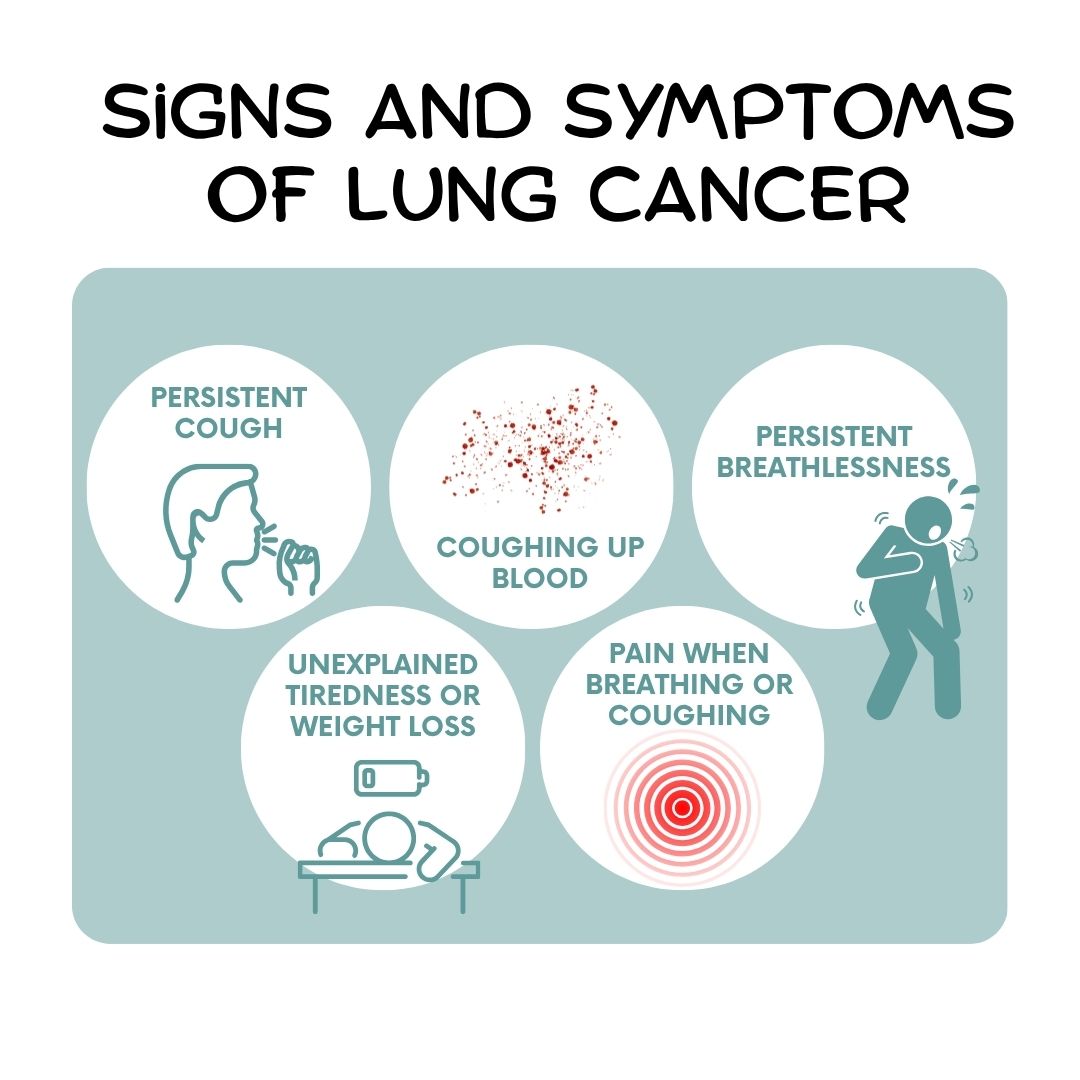
Typically, it’s not the easiest to catch early, as it is often asymptomatic until the cancer has already spread to other parts of the body. So, it is important to consider the following symptom clues:
In simple terms, metastasis is where cancer spreads from the place where it first formed to another part of the body. This process means that cancer cells break away from the original (primary) tumour and travel through the blood or lymph system, forming new tumours elsewhere, becoming ‘advanced lung cancer’. The fundamental job of the lungs is to deliver oxygen to the body’s cells. The cancer then hitches a ride on these cells, travelling around the body. So when we consider metastatic lung cancer, we can see why it is one of the most dangerous, as it spreads quickly, while symptoms may still be absent. Considering this, it’s quite common for lung cancer to metastasise, with 57% of patients with lung cancer diagnosed when the cancer has already metastasised.4 Although size doesn’t matter, large tumours are more likely to find their way somewhere else.
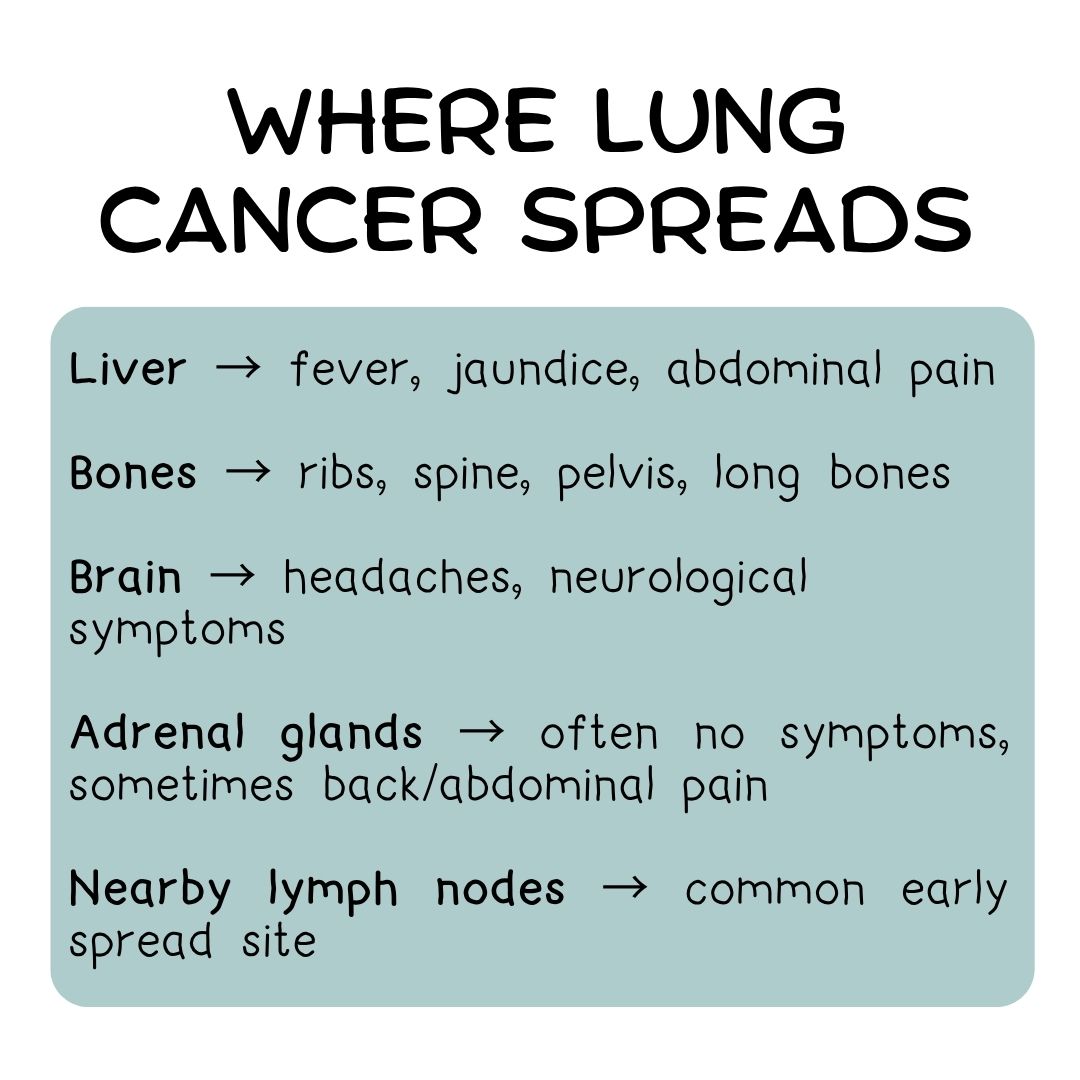
As we know, cancer knows no bounds when it comes to aggression. So, when we look at the spread of one of the most dangerous cancers, we have to be aware of its capabilities when it comes to spreading. Metastatic lung cancer can spread mostly anywhere, but there are places that it's most likely to go to, which we can see below.
Once cancer has spread to the liver, unfortunately, there's a slim chance of curing it, as it would be beyond stage 1 at this point. And cancer in the liver is much harder to remove at the later stages. Symptoms are uncommon, but you may experience a fever, jaundice (yellowing of the skin or whites of the eyes), loss of appetite, nausea, abdominal pain (upper right side), sweats and weight loss.
The bone-lung cancer typically spreads to consist of the ribs, pelvis, spine, and long bones in the body. Again, this is a difficult one to treat as it is a secondary cancer, in a new environment, where it can grow and spread. It can, however, be controlled with treatment.
Along with other cancers, like melanoma and breast cancer, lung cancer can spread to the brain. Again, at the moment, there is no definite cure for this, but treatment can be used to try and control it, and/or prevent problems from developing. Treatments include steroids, radiotherapy, hormone treatment, targeted cancer drugs and, in some cases, surgery.
This is a common place for lung cancer to spread. This secondary cancer, again, is unlikely to show symptoms, but it can rarely cause back and/or abdominal pain.
Doctors don’t typically count it as metastatic unless it’s spread to further parts of the body; however, the lymph nodes are known to be a place where the cancer clings to quickly.5
Different types of lung cancers seem to have different preferred sites of metastasis, such as liver metastasis in small-cell lung carcinoma (SCLC) and brain metastasis in SCLC and adenocarcinoma.6
Small cell lung cancer usually grows and spreads faster than non-small cell lung cancer. Around 70% of small-cell lung cancers have already spread at the time of diagnosis. Some forms of non-small cell lung cancer are also fast-growing, such as large-cell undifferentiated carcinoma and large-cell neuroendocrine carcinoma.7
Non-small cell lung cancer, however, may spread at different rates. A tumour could double in size in around 7 months. The spread is measured using a system called staging. This system allows healthcare professionals to understand the severity of the cancer and to start developing a treatment plan.
A 2019 study found that the median doubling time of NSCLC was 230 days. Some tumours studied doubled in size in as few as 19 days, while others never grew that much.8 In contrast, a 2020 research review suggests the doubling time for small cell lung cancer (SCLC) as 86 days.9
Lung cancer more commonly affects older people. It is rarer in people younger than 40. More than 4 out of 10 people diagnosed with lung cancer in the UK are aged 75 and older.2 This is understandable considering that over time, the accumulation of cell damage and increased exposure to risk factors like smoking occur.
Smoking is also one of the most commonly known factors when it comes to developing lung cancer. However, this doesn’t mean that smokers are going to develop lung cancer, or that non-smokers can’t develop lung cancer.
In addition, black men are about 15% more likely to develop lung cancer than white men. The rate of lung cancer in Black women is about 14% lower than in white women.
On top of this, the likelihood of lung cancer spreading can differ depending on racial and ethnic variations. A study done in 2016 found that non-small cell lung cancer progresses more quickly in white Americans than African or Asian Americans, which is consistent with earlier research done in Europe, Africa and Asia.10 As a result, it’s important to consider how often a patient with lung cancer should be screened.
Treatments for lung cancer vary as it’s so quick to spread and hard to detect until later stages, considering the right type of treatment is a tricky choice.
Surgery is not usually the first port of call for this type of cancer, as it spreads so quickly, cutting just one tumour out would not rid the body of any traces of cancer that have spread elsewhere.
If surgery is an option, thoracotomy, an open chest surgery from either the midline or the side of the body, might be considered. Incisions may involve multiple muscles and a rib cage retractor, which would be inserted to access the lungs. This surgery is typically more suitable for tumours of more than 8 cm in size, where the entire lobe needs to be removed, or for patients who require complicated surgery to connect the vasculature.
Another surgery option would be assisted thoracoscopic surgery (VATS), which is more suitable for patients with smaller tumours that do not crowd any nearby organs, aka Stage 1 or 2. This method involves a tiny camera and surgical tools to create small cuts in the chest wall and use the camera to investigate the lungs.
Although in other cases, chemotherapy is what the majority of patients have, not all patients respond and have underlying genetic faults driving their cancer. To work around this, there’s a new approach in treatments designed to target a protein called EGFR that plays a crucial role in cell growth. For example, erlotinib,11 gefitinib,12 and cetuximab13 have revolutionised lung cancer therapy this way.
For patients who do respond to chemotherapy, however, it's typically used to stop cancer cells from dividing, aiming to decrease the mass and stop it from spreading. Typically, appropriate for patients with Stage 3 or 4 cancer that has spread to nearby organs.
Another option is radiation therapy. This is where high-energy beams are used to kill cancer cells. Used for small and non-small cell lung cancer, it can be used as pain relief and to shrink tumours in palliative care.
Immunotherapy is less well-known than radiation or chemotherapy. It uses medication that will trigger the body’s immune response to get rid of cancer cells. Suitable for patients with Stage 3 or 4 cancer, it can also be administered concurrently with chemotherapy, radiation therapy, or surgery as recommended by the oncologist.
Some other options to consider are:
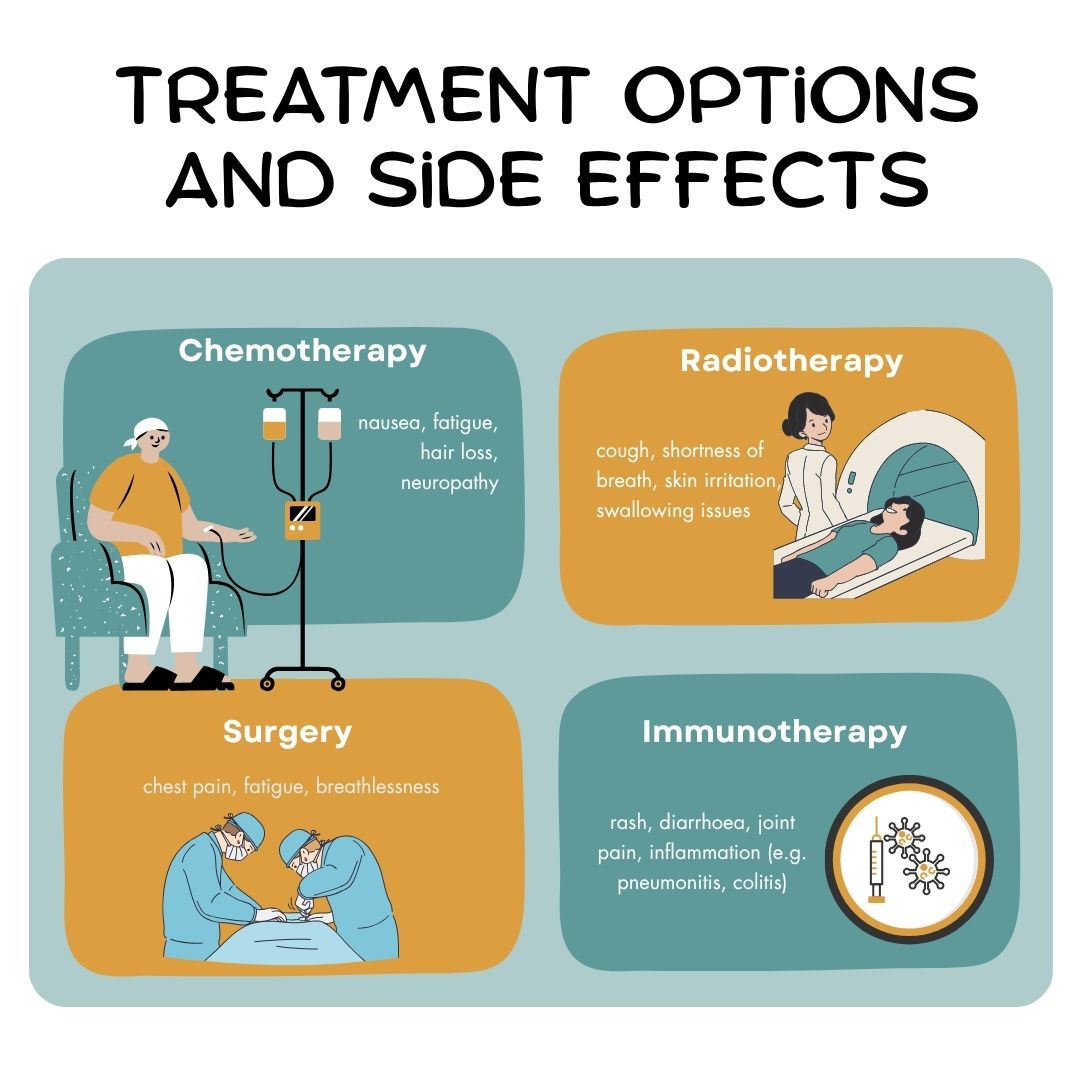
The main treatments are chemotherapy, immunotherapy, radiation therapy, and surgery. Below are some of the symptoms to expect if you choose to receive any of these treatments:
The most important part of cancer care is choosing what is best for you. The spread of cancer is not something we have control over, but we can choose the treatments provided to suit preferences and different stages of cancer. Different bodies react to different treatments, and the symptoms can differ too. Moving forward, consider the effects of each treatment, and choose what is right for you, or to help someone you know.
Edited by: Katheeja Imani
We strongly advise you to talk with a health care professional about specific medical conditions and treatments.
The information on our site is meant to be helpful and educational but is not a substitute for medical advice.
Now As I Was Ready For Healing And Looking Forward To Gradually Bringing Myself To The Land Of Work Again...To Enjoy Being Out And About Again.
Discover Dr. Judith Murray’s Insights On The Many Faces Of Loss Following A Cancer Diagnosis. Learn To Cope With Clarity And Resilience As She Redefines Loss In Cancer Care
This powerful on-demand session: Radiation & Resilience: Protecting Your Body During & After Treatment is delivered by one of the world’s foremost authorities in cancer rehabilitation.