Lung cancer is not just a diagnosis; it is an unexpected interruption and, for many, a completely different pace of life. Whether you have recently been diagnosed or are further along the path of treatment, the truth is that this journey is rarely linear, and that’s okay! You are allowed to have questions, fears, good days, and deeply exhausting ones.
There is no one-size-fits-all guide to this experience, but there are things that can help you feel more informed and less alone along the way. In this article, I would like to walk you through what treatment typically involves today, the most recent updates in lung cancer research, and some practical, lived tips that can make a difference when you are in the thick of it.
First Things First: Understanding the Treatment Landscape
The type of lung cancer, non-small cell (NSCLC) or small cell (SCLC), plays a major role in determining the treatment approach. Your care team will also consider the stage of cancer, overall health, and any specific genetic mutations that might open the door to targeted therapies. 1
Treatment might include:
- Surgery: Often used when the cancer is found early. Recovery can take weeks, and pain management is essential. Don’t hesitate to speak openly with your medical team.
- Chemotherapy and Radiotherapy: Common for both types of lung cancer (NSCLC and SCLC). These treatments can be physically and emotionally taxing. Side effects vary depending on the treatment and the individual body's reaction; therefore, getting prepared well in advance and having a plan for managing them is highly recommended.2
- Immunotherapy: This treatment helps the immune system recognise and respond to cancer cells. Immunotherapy is commonly used for advanced NSCLC, and in some cases, it has been shown to prolong life when other treatments are no longer effective.3
- Targeted Therapy: If the tumour has specific mutations such as EGFR, ALK, or ROS1, certain medications can be used to prevent cancer growth more directly.4
Many people go through a combination of these treatments depending on different factors. It can feel overwhelming and exhausting, but it is absolutely fine to ask for explanations again and again at any stage of your treatment, as you have every right and deserve to understand what is happening to your body.
What’s New in Lung Cancer Research?
The good news is that researchers are constantly pushing forward. Here are a few highlights from recent studies that are offering new possibilities:
- KRAS G12C Inhibitors: Drugs like adagrasib and sotorasib are now options for NSCLC with KRAS G12C mutations, a mutation that used to have very limited treatment choices. A phase 2 trial showed a 43% overall response rate to adagrasib, with a manageable safety profile.5
- Neoadjuvant Immunotherapy: New trials suggest giving immunotherapy before surgery can shrink tumours more effectively and reduce recurrence risk. For example, the CheckMate 816 trial found that adding nivolumab to chemotherapy before surgery significantly increased the pathologic complete response rate.6
- Liquid Biopsies: These are blood tests that detect tumour DNA and may eventually help monitor disease progression or recurrence earlier than imaging alone. Although not yet a routine standard everywhere, they are being increasingly studied and used in certain contexts.7
- AI in Diagnostics: Artificial intelligence is now being used to enhance early detection of lung cancer via CT scans, especially in high-risk populations. While this approach is still under evaluation, these tools may improve diagnostic accuracy, help detect the malignancies that were missed by the naked eye, reduce human errors, and speed up the process.8
While none of these represent a definite universal solution, it still shows that the researchers are working on improving the drugs and treatments, as well as progressing to find approaches that are more tailored, more effective, and less invasive.
Navigating the Emotional Side of Treatment
Lung cancer doesn’t just affect the body; it shifts your whole reality. The grief, uncertainty, anger, and all other emotions you might experience during this difficult time are all valid. And sometimes, it is not even the big stuff that hits hardest; it is the small changes, like needing to rest halfway up the stairs or missing a family dinner because of the side effects.
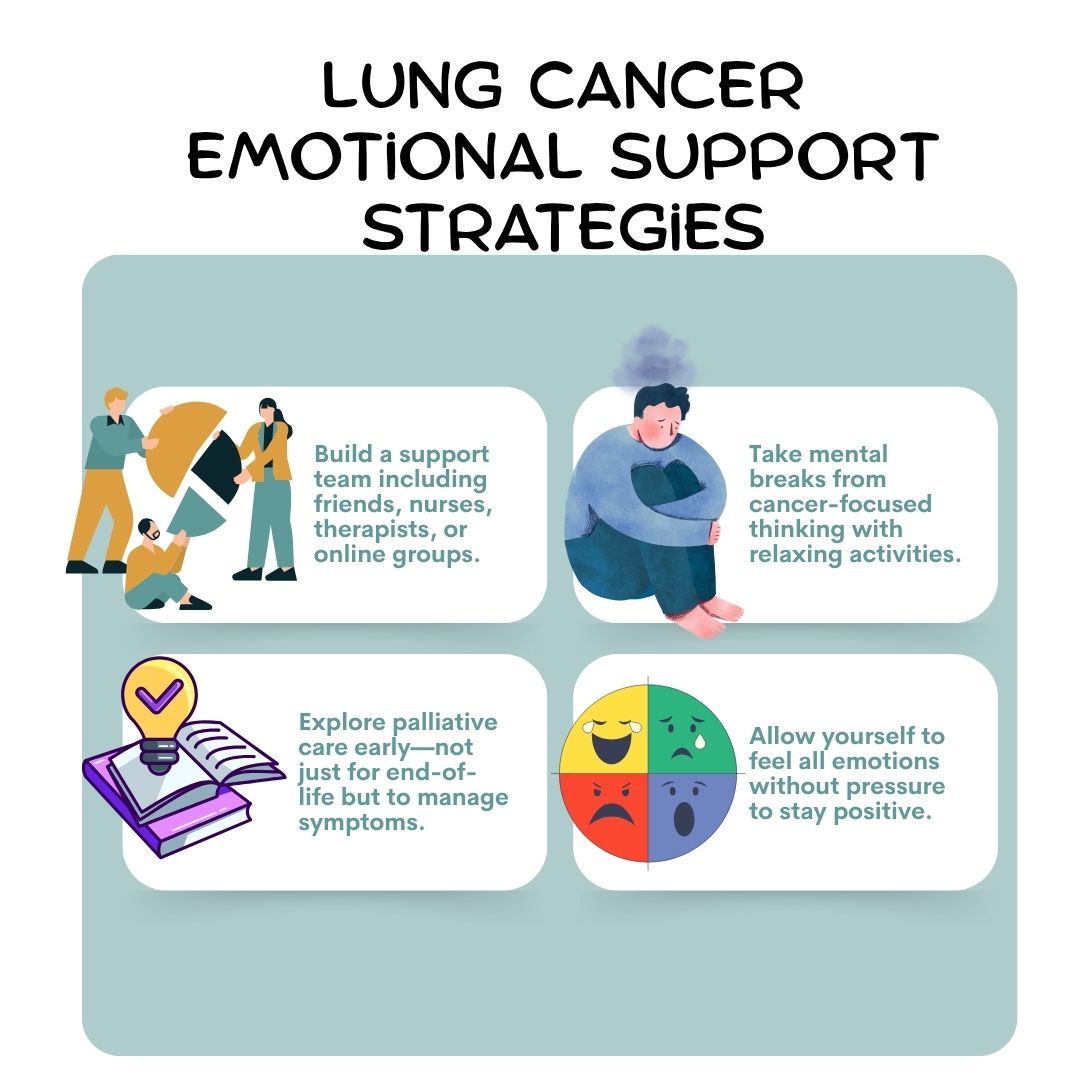
As a normal human being, you are not required to be positive all the time. That pressure of acting like an emotionless, positive robot can be extremely draining. What matters more is having support that acknowledges your feelings and understands how hard this really is.
Here are a few things others have found genuinely helpful:
- Build a support team: This can include a trusted friend, a specialist nurse, a psychotherapist, or an online support group. You are not a burden for asking; people often want to help and don’t know how unless you tell them.
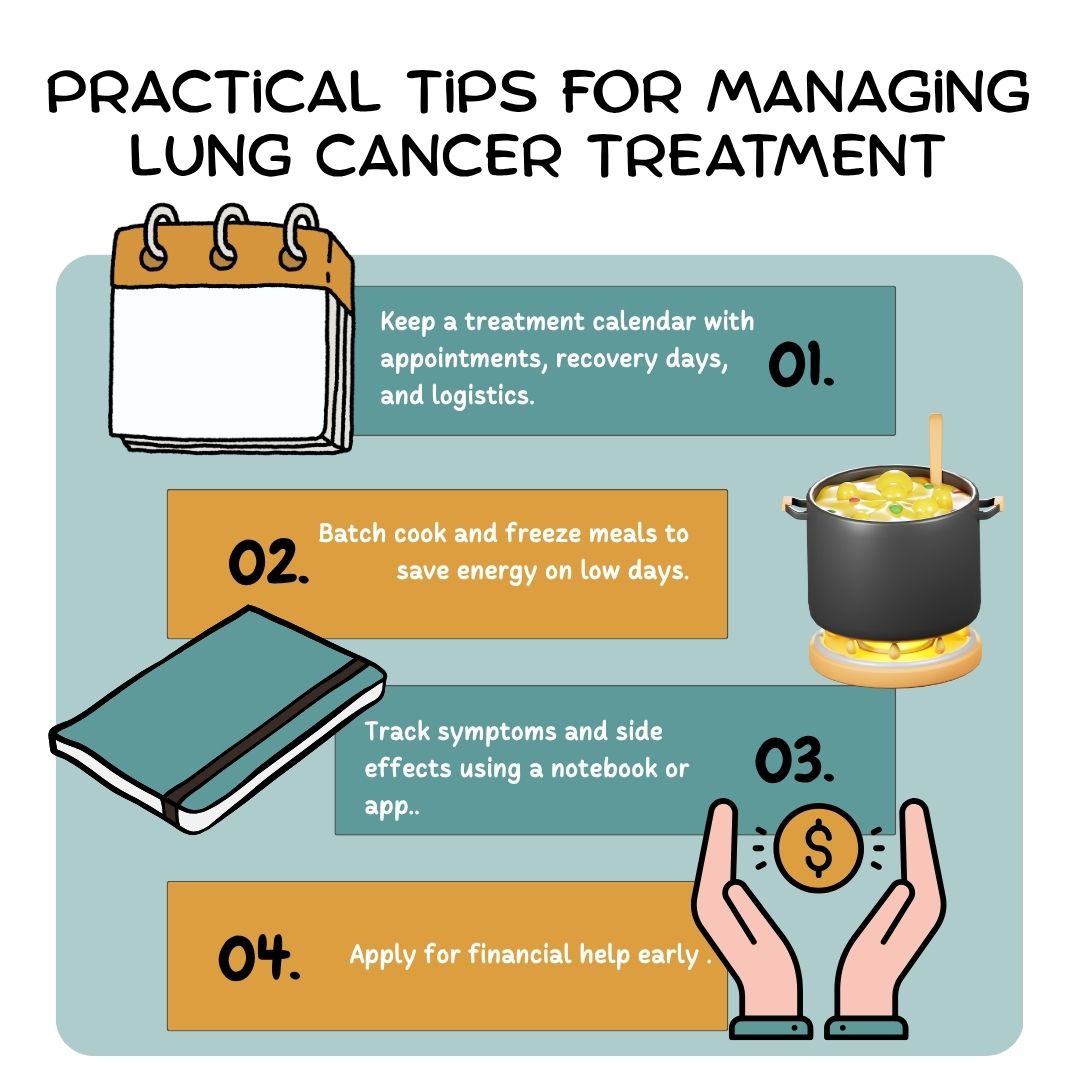
- Track symptoms and side effects: Writing things down in a notebook or app can help you notice patterns and communicate more clearly with your doctors. You can also use this notebook to write your concerns and questions at any time and discuss them with your healthcare professionals during your appointments.
- Take breaks from cancer: It is okay to rest from the constant mental focus on the illness. Watch a show, take a walk, or do something familiar that gives you a break. Having cancer does not mean that you are forced to pause all aspects of your life and focus only on the disease. While it may be beneficial to learn more about your condition and research the treatments, side effects, and other relevant information, it can also be very devastating to use all your energy 24/7, digging into the internet to gain more and more information. Give your brain a break and try finding a new habit or start redoing things that used to make you feel better in general before getting diagnosed (of course, ensure that you are physically capable of doing certain physical activities).
- Explore palliative care early: Despite the misconceptions, palliative care is not just for the end of life. It is a layer of support for managing symptoms, stress, and pain at any stage of illness.9
The Practical Bits That No One Tells You
Sometimes it is not the treatment itself that causes the most stress; it is everything around it. Logistics, admin, fatigue, household tasks, must-do daily routine, etc.
Here are some practical strategies that people have found helpful:
- Keep a treatment calendar: Include not just appointments but also recovery days, travel time, and even food delivery schedules. Share it with someone close if that feels helpful.
- Batch cook and freeze meals: If you have energy one day, use it to prep meals. On bad days, even something simple is fine. Don’t pressure yourself to cook routinely and perfectly. As long as you focus on having a healthy diet and avoid processed foods as much as you can, it is absolutely fine not to cook freshly made food every day.
- Apply for financial help early: In the UK, Macmillan offers grants and benefits advice, and you may be eligible for travel assistance or energy cost help.
- Delegate when possible: If someone offers to help, be specific; ask them to walk the dog, do a food shop, or pick up medication. Most people are relieved to have something concrete to do. Sometimes, people avoid offering help without being asked for it, as they think you might get offended. Therefore, ask for help whenever you need it, even if it is from a neighbour or a delivery driver. Most of the time, you can make someone's day by asking for help that they can offer you, as people generally feel amazing if they can improve others' lives with the slightest thing.
Recovery, Adaptation, and Life After Treatment
For some, treatment ends, and recovery begins. For others, ongoing management becomes part of their daily life. In either case, recovery does not always mean going back to how things used to be; it means adapting to how things are now.
You might grieve the energy you used to have or find yourself anxious about the cancer returning. That is completely valid and normal. Healing is not just physical; it is also emotional and mental. A good therapist can be a great help at this stage.
Let your recovery be slow if it needs to be. Listen to your body. Ask questions. And don’t feel guilty for needing help, time, or rest. You are not falling behind; you are just doing what needs to be done to get through.
Final Thoughts
Same as any other cancer, there is no right way to go through lung cancer. It is a tough road, often unclear, non-linear, and sometimes overwhelming. But it is not one you have to walk alone. With new research slowly improving outcomes and support systems evolving, there is space, however small, for hope, clarity, progression, and comfort.
You do not have to be inspirational. You do not have to be a superhero. You just have to be a human with all its imperfections and specific characteristics as an individual and live your life to the fullest while you can, and that is more than enough!
References
- Cancer Research UK, 2024. Lung cancer treatment. [online] Available at: https://www.cancerresearchuk.org/about-cancer/lung-cancer/treatment
- Jänne, P.A., Riely, G.J., Gadgeel, S.M., Heist, R.S., Ou, S.H.I., Pacheco, J.M., Sabari, J.K., Kim, E.S., Lazzari, C., Bazhenova, L.A. and Song, Y., 2022. Adagrasib in non–small-cell lung cancer harboring a KRASG12C mutation. New England Journal of Medicine, 387(2), pp.120–131.
- Forde, P.M., Spicer, J., Lu, S., Provencio, M., Mitsudomi, T., Awad, M.M., Felip, E., Broderick, S.R., Brahmer, J.R., Swanson, S.J. and Hoang, C.D., 2022. Neoadjuvant Nivolumab plus Chemotherapy in Resectable Lung Cancer. New England Journal of Medicine, 386(21), pp.1973–1985.
- Wan, J.C.M., Massie, C., Garcia-Corbacho, J., Mouliere, F., Brenton, J.D., Caldas, C., Pacey, S., Baird, R. and Rosenfeld, N., 2017. Liquid biopsies come of age: towards implementation of circulating tumour DNA. Nature Reviews Cancer, 17(4), pp.223–238.
- Ardila, D., Kiraly, A. P., Bharadwaj, S., Choi, B., Reicher, J. J., Peng, L., Tse, D., Etemadi, M. and Ye, W., 2019. End-to-end lung cancer screening with three-dimensional deep learning on low-dose chest computed tomography. Nature Medicine, 25(6), pp.954–961.
Senior Editor: Katheeja Imani