Living with cancer can feel like carrying an invisible weight, one that doesn’t just sit in the body but presses on the heart, mind, and spirit. It’s a weight made of questions, fears, memories, and moments that don’t always make sense. And while the world often rushes to offer solutions, sometimes, what’s needed most is permission:
Permission to pause. To feel. To not be okay.
This article doesn’t promise answers or quick fixes. Instead, it offers gentle ways to cope, to feel seen, and to find moments of ease. You deserve that space, especially when life feels heavy.
Some days, the emotions rise like a tide. Other days, they barely whisper. And both are okay.
Martha, a 47-year-old living with breast cancer, once shared how guilty she felt for feeling numb. “Everyone kept saying I was strong,” she said, “but I couldn’t feel anything at all—not fear, not sadness, just…nothing. I thought something was wrong with me.”
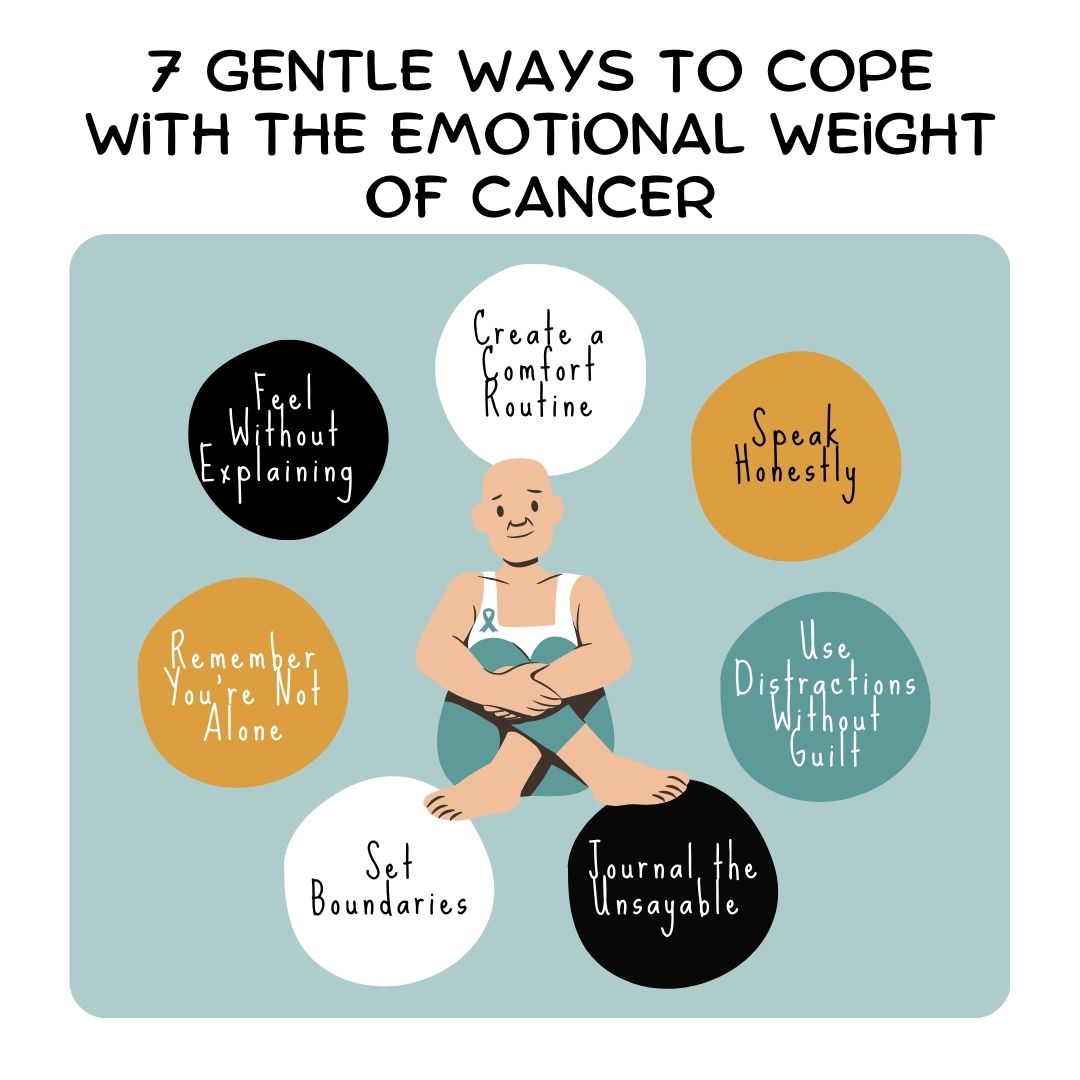
But emotional numbness is, in itself, a response. Sometimes our minds protect us by muting everything. Letting yourself feel—whatever that feeling is—without needing to explain or justify it, is part of emotional care. You’re not doing it wrong. You’re just doing the best you can in a complicated reality.
There’s something powerful in creating small rituals of comfort, especially when much of life feels unpredictable.
David, a cancer patient in his early 30s, started lighting the same candle every evening and playing soft piano music as the sun went down. “It wasn’t magical,” he said, “but it helped mark the end of each day. Like I’d survived another one. That mattered.”
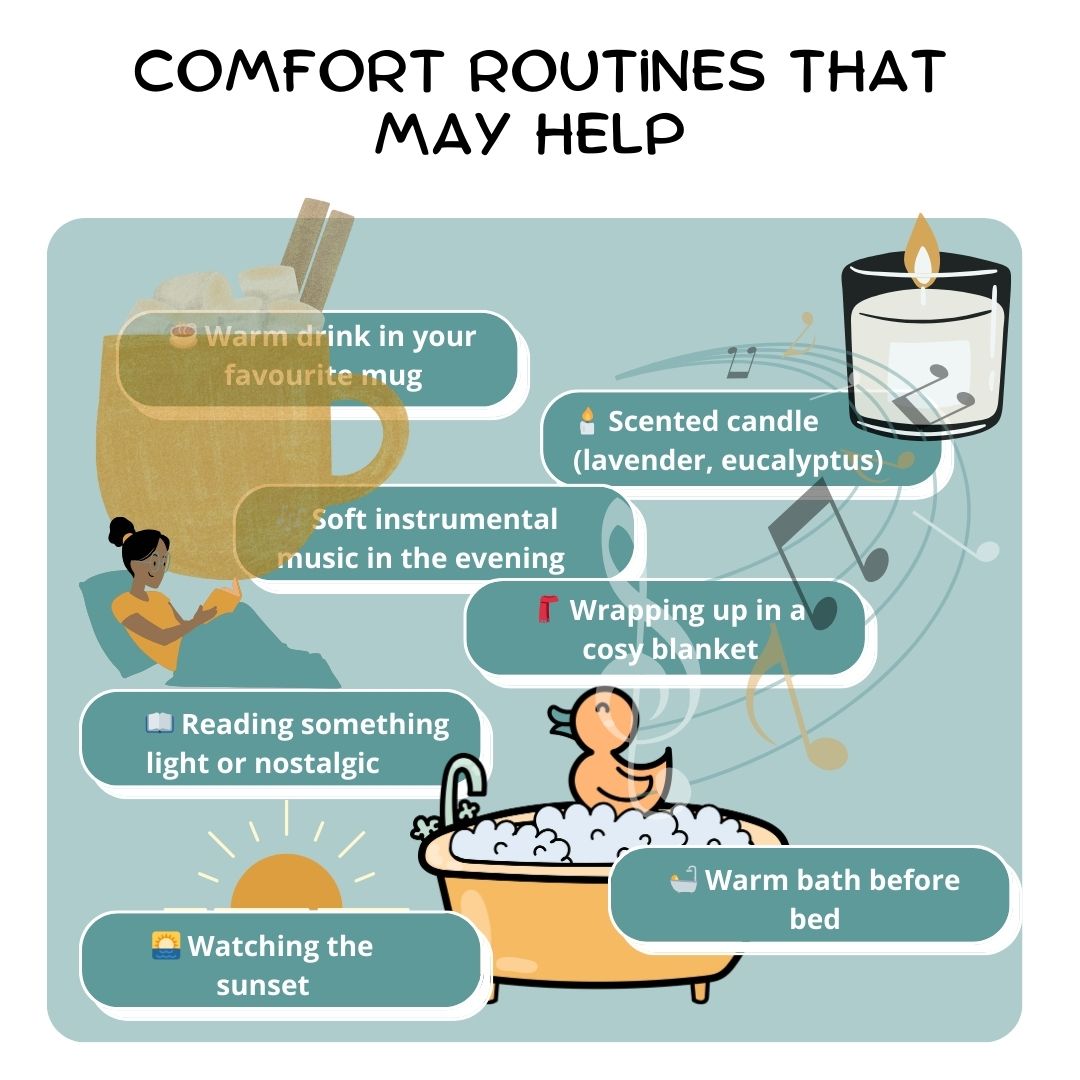
Comfort routines might include a warm drink, a familiar blanket, music, or quiet reading. They don’t have to be elaborate. Just yours. A thread of stability when everything else feels like it’s unravelling.
It can be exhausting pretending you’re fine when you’re not. And you don’t have to.
Asha, newly diagnosed with leukaemia, found it hard to talk to her family without editing herself. “They were so scared; they needed me to be okay,” she shared. Eventually, she texted a close friend:
“I don’t want to talk. I just need someone to know that today is heavy.”
Speaking honestly doesn’t mean oversharing or explaining everything. Sometimes, it’s a simple text or sentence. A small truth that says: “This is my reality right now.”
You deserve people who can hold that truth without rushing to fix it.
When emotions are intense, sometimes the kindest thing you can do is step away from them, for a little while.
Elijah found comfort in watching documentaries about space. “It took me out of my body,” he said. “Out of the hospital. Into stars and galaxies. I needed that.”
Distractions aren’t about avoiding your feelings—they’re about giving yourself a break from carrying them all the time. Art, television, puzzles, podcasts, or cooking can offer emotional breathers.
Let joy exist. Let peace exist. Let boredom exist. You don’t need permission to take up space that feels good.
Some thoughts don’t feel ready for other people. That’s where journaling can help.
Priya began writing letters to her future self after her third chemotherapy round. She wrote about her fears, her wins, her anger, and the silence. “I didn’t show them to anyone,” she said. “But it helped me remember who I was beyond the hospital bed.”
Journaling doesn’t need rules. You can write a single sentence. Or make a list. Or just scribble. Try prompts like:
You don’t need to make sense. You just need space.
You don’t owe everyone access to your energy or your updates.
Nate, who had been open about his cancer diagnosis online, found himself overwhelmed by constant messages. “I love that people care,” he said, “but I needed to not talk about it every day.”
It’s okay to step back. To not answer. To say, “I can’t hold this conversation right now.” Boundaries aren’t rejection; they’re self-protection. You also get to set boundaries with yourself. To stop reading heavy articles at night. To avoid certain topics. To say no when your body says no.
One evening, I got a call I’ll never forget. It was from a close friend of mine, diagnosed with stomach cancer. He was at stage two, and I could hear in his voice that something was wrong.
That night, he told me he didn’t want to live anymore. The weight was unbearable. He had been drinking and taking pills and was spiralling. On top of dealing with treatment, he felt betrayed by his partner, unheard by his family, and completely alone in Nakuru.
I was in Nairobi, and I had no one to call who could reach him fast. But I stayed on that call. I talked to his partner. I reminded him that he mattered, even in that pain.
Today, he’s still here. And he’s doing better.
This isn’t a story about fixing someone. It’s a reminder that being present, listening, and staying connected can change a life.
If you’re feeling isolated, know this: you are not alone. There are support groups, online spaces, and people, even strangers, who care.
Your emotions are real. Your story matters. And there is space for you here.
You don’t have to carry it all alone. Living with cancer means carrying so much that others don’t always see. And while you may feel pressure to stay positive, this article is here to tell you: you don’t have to be anything other than yourself.
Take things moment by moment. Be gentle with your mind, your body, and your spirit.
And if today all you can do is read this article and take one deep breath, that’s more than enough.
Edited by: Katheeja Imani
We strongly advise you to talk with a health care professional about specific medical conditions and treatments.
The information on our site is meant to be helpful and educational but is not a substitute for medical advice.
The Popular Lifestyle Parenting Online Magazine Stressy Mummy Has Featured Our The Little Monkey Mighty Big Hamper Suitable For All Children With Cancer.
A cancer diagnosis doesn’t just impact the body—it reshapes relationships, silences voices, and tests our ability to connect. Conversations that once felt easy can suddenly feel fraught with emotion, fear, or even avoidance. How do you express what you need without overwhelming others? How do you listen without assuming or shutting down? These are the […]
In This Article, We Focus On The Guidelines And The Type Of Exercise That You Can Do After Mastectomy Or Breast Reconstruction And Other Breast Surgeries.