It has been ten years, almost eleven. I’m 21 now.
This month I will finish my third year of University. You told me to become a solicitor (sorry, that didn’t happen), how could I after observing the work of the amazing people that looked after you during your illness? Especially the team at the Donegal Hospice, they truly are angels!
As I got older, I became more aware of just how brave you were. My mind was filled with questions and I battled with the injustice of this terrible disease and how it had affected our family. I felt an overwhelming determination to make you proud, even if it is in a way that I don’t think you would have ever expected. I am the first person in the family to go to University and hopefully in a few years, the first doctor.
I didn’t get into medicine first time around and that was a great thing for me. I wasn’t ready. Instead, I sceptically accepted an offer for the only other course I had applied for, Stratified Medicine. It turned out to be the best thing I ever did!
And that’s fair. This course didn’t exist when you were alive. It was established in 2014 and is the only of its kind in the UK, operating between the Ulster University Magee campus and C-TRIC, Altnagelvin Hospital. Stratified Medicine addresses the fact that a ‘One-size fits all’ approach to healthcare will never be enough, instead putting emphasis on: “The right treatment, for the right person, at the right time” It works on the basis of dividing people into subgroups based on what drug or treatment is most likely to work best for them. Often, we hope to achieve this by examining genetic factors.
We know that being overweight and having an unhealthy diet puts us at risk for heart disease, but what about individuals that don’t fit into this general risk profile? One culprit is genetics.
Each one of us has our own unique genetic code, which could be described as the language of our DNA. In this language we have four letters that string together to form the code words to write our DNA. They are; A (adenine), C (cytosine), G (guanine) and T (thymine).
An alteration in the code words of a gene is called a mutation. Mutations occur frequently in the body as the cells divide. Usually, these mistakes are irrelevant but if by chance they affect the wrong gene, disease can occur. Lifestyle and environmental factors can also influence mutations for example smoking, bad eating habits, lack of exercise, radiation from UV light and exposure to dangerous chemicals but sometimes mutations occur without any known external cause.
Researchers began to look at what exactly our genetic code should look like and also how it changes or mutates when a condition or disease is present. Some mutations in the genetic code are as a result of an insertion (Huntington’s Disease), deletion (Cystic Fibrosis) or substitution (Sickle Cell Anaemia) of DNA base letters.
Which makes us think: Can we play around with our genetic code like someone spell-checking a word document? Taking the misspelled words and correcting them, changing the grammar so everything reads more smoothly? One day, I hope it will be that simple, but until then we have a lot of research and trials to complete.
Researchers discovered that Huntington’s Disease is caused by a mutation in a protein that was named Huntingtin protein. This mutation results in over 40 repeats of CAG where an unaffected person would have only between 10 and 35 for this specific gene. Initial thoughts were to remove the ‘mistake’ to make the disease go away. However, it was realised that this protein is also required for survival. Showing that the complex interactions that happen inside our body and within our genetic code can prove difficult to alter without disturbing another essential function.
Dad, your cancer which was Ocular Melanoma is still considered a rare form of eye cancer. The methods used to assess prognosis in Ocular Melanoma have evolved from indicators such as tumour size, location and cell morphology to methods including the counting of chromosomal gains and losses and also gene expression profiling.
In Stratified Medicine, the first step of understanding any disease is to narrow down the possible genes that are implicated in its cause. I have recently been involved in a study called Stratification in Alzheimer’s Disease. In this study we recruited people all over Northern Ireland with Alzheimer’s, Dementia and Mild Cognitive Impairment but also people without these conditions, known as controls. Controls are an important part of the analysis in this study as we look for possible genetic causes for why some people go on to develop these conditions, and others don’t. Promising mutations for the prediction of Ocular Melanoma are in the GNAQ and GNA11 genes.
In June 2020 my placement year officially ended at Northern Ireland Clinical Research Services (NICRS) but I am delighted to continue working for Dr Geraldine Horigan. Over the last ten months, Geraldine has been an amazing teacher not just in the services that her company offers such as participant recruitment, phlebotomy and health checks but also in the charming way in which she interacts with everyone she meets.
This year, despite the Coronavirus pandemic, Geraldine has successfully opened her first clinic in Derry, Melrose Clinic. I have watched her adapt her business, putting a lot of her new anticipated services on hold to help the research community in Northern Ireland continue with new and existing studies, including Ulster University COVID-19 studies.
Writing ethics applications, recruiting participants onto research studies and taking blood samples, right through to processing those samples in the lab and working with the data that they produce.
When I started university, the first exam question stuck with me: “What is the difference between Stratified Medicine and Personalised Medicine?” I realised that my course was the first step of many in utilising the potential of our genetics in disease management. Just as Stratified Medicine looks at what treatments will work for groups of people with common characteristics, Personalised Medicine delves deeper looking at the patient as an individual. This year my course was renamed Personalised Medicine, an exciting step forward.
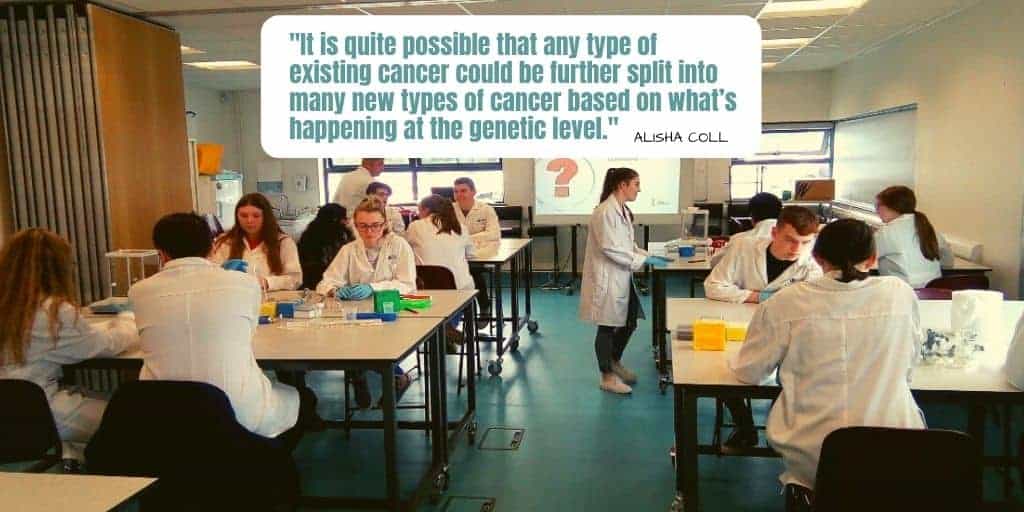
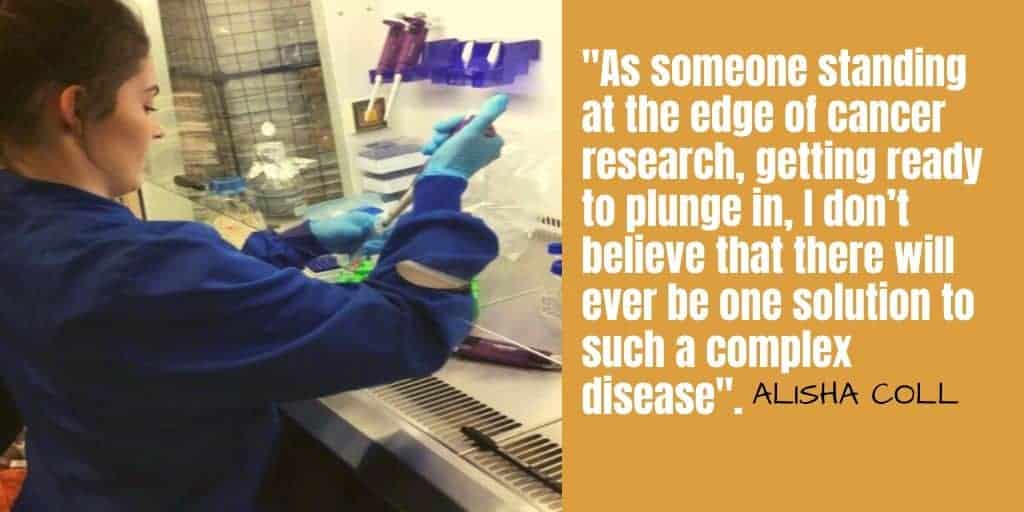
As someone standing at the edge of cancer research, getting ready to plunge in, I don’t believe that there will ever be one solution to such a complex disease. It is quite possible that any type of existing cancer could be further split into many new types of cancer based on what’s happening at the genetic level. Considering how different each one of us is, from the lifestyle choices we make, the environments we occupy, the genes we inherit and the events we experience, a single solution will never work for everyone.
I hope that Stratified Medicine and eventually Personalised Medicine becomes the revolution in healthcare that we so desperately need, not just in terms of cancer, but in the screening, prevention and treatment of all diseases and disorders. Your cancer story didn’t have a happy ending, but I am determined to work to improve outcomes for other families in my future career.
We strongly advise you to talk with a health care professional about specific medical conditions and treatments.
The information on our site is meant to be helpful and educational but is not a substitute for medical advice.
As a married mum of 2 young girls, it’s sad to say that we have nursed two of our parents through cancer.
A Cancer Diagnosis Show Us Petty Things Don’t Matter. Patience And Persistence Is Where You Stand Up And Make That Unwelcome Journey YOUR Welcome Journey.
Learn About The Healing Path To Reclaiming Sexuality And Intimacy Needs During All Types Of Cancer And Illness