One of the most important things to understand about PSA is that levels naturally change with age. What's considered a typical level for a man in his 40s is quite different from what we'd expect to see in a man in his 70s. For instance, a common guideline suggests a PSA below 2.5 ng/ml for a 45-year-old, but a level under 6.5 ng/ml might be perfectly fine for a 75-year-old.
These age-specific ranges are a crucial tool for doctors to decide if a result warrants a closer look.
When we talk about prostate health, there’s no magic "normal" PSA number that fits all men. Instead, we use age-adjusted reference ranges. It's best to think of these not as rigid cut-off points, but as helpful signposts that give context to your individual result. Your PSA level is just one piece of a much larger health puzzle.
This approach is rooted in simple biology. As a man gets older, his prostate gland tends to grow. This common, non-cancerous enlargement is called benign prostatic hyperplasia (BPH), and it can cause PSA levels to creep up over the years. This means a PSA reading that might raise a red flag for a younger man could be completely unremarkable for someone older.
To help interpret these results, clinicians often refer to guidelines that set out the typical upper limits for different age groups. Remember, crossing these thresholds isn't a diagnosis, it's a trigger for a conversation with your doctor about what to do next. The whole point is to find a balance between catching potential problems early and avoiding unnecessary tests and procedures.
Here's a table that breaks down the reference ranges commonly used in clinical practice. These are the levels that might prompt a doctor to suggest a referral to a specialist for further assessment.
| Age Group | Upper PSA Level Guideline (ng/ml) |
|---|---|
| 40-49 years | 2.5 |
| 50-59 years | 3.5 |
| 60-69 years | 4.5 |
| 70+ years | 6.5 |
Again, these are just guidelines. Your doctor will interpret your result based on your personal health history, risk factors, and any changes in your PSA level over time, a concept known as PSA velocity.
Before we can get into what normal PSA levels by age look like, it’s worth understanding what the test is actually checking for.
Think of the prostate gland as a tiny factory that produces a protein called Prostate-Specific Antigen (PSA). Its main role is to help liquefy semen, which is important for fertility. A tiny amount of this protein naturally seeps out of the prostate and into the bloodstream. A PSA test is simply a blood test that measures how much of this protein is circulating in your system, reported in nanograms per millilitre (ng/mL).
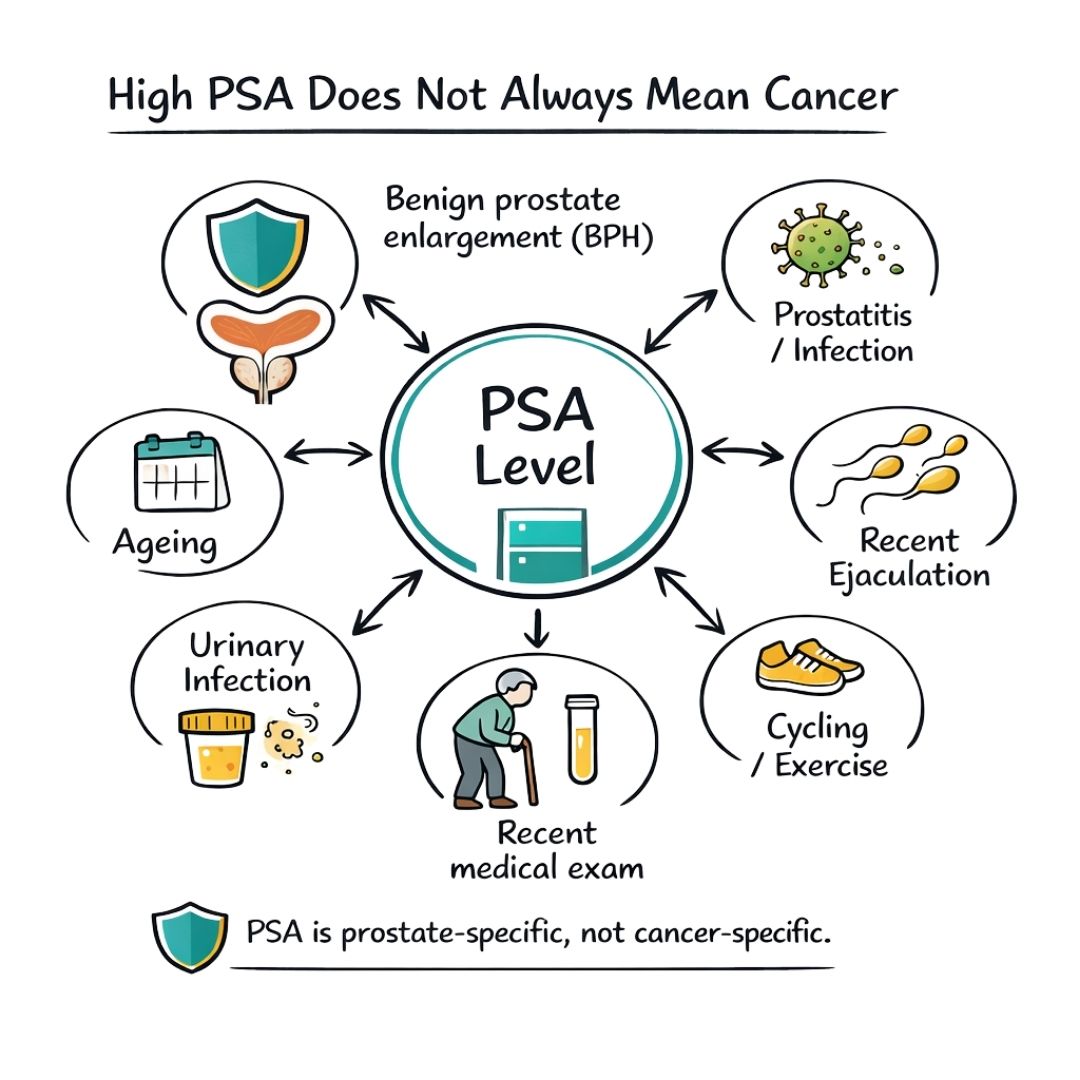
Here’s the single most important takeaway: PSA is prostate-specific, not cancer-specific. It’s a subtle but crucial difference. A high reading tells us something is going on with the prostate gland, but it doesn't automatically mean cancer is the cause.
Imagine the prostate factory suddenly ramps up production. This could certainly be due to something serious like cancer, but often it’s triggered by something much more common and harmless. A simple infection or a bit of inflammation, for example, can make the factory work overtime and release more PSA.
Likewise, as men get older, the prostate naturally gets bigger, a condition known as benign prostatic hyperplasia (BPH). A bigger factory will naturally produce more of its product, leading to higher PSA levels in the blood.
A higher PSA level is a signal flare. It alerts your doctor that your prostate might be more active than usual, warranting a closer look. It is not, on its own, a diagnosis.
Grasping this concept is the first step to understanding your prostate health without getting bogged down by worry. If you want to get into the nitty-gritty, you can read more about the prostate-specific antigen and what it does.
Several completely benign things can cause a temporary spike in your PSA levels. These include:
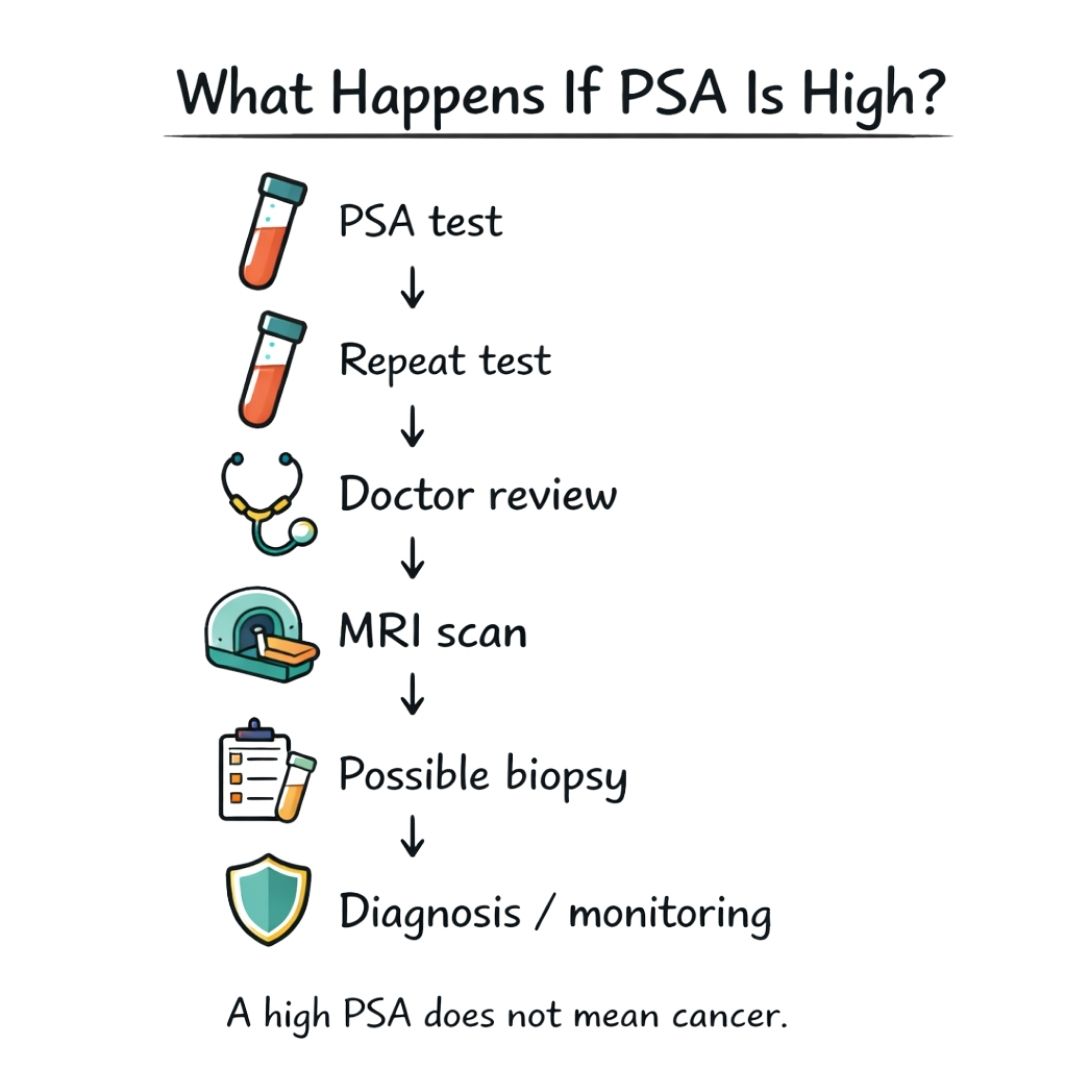
This is precisely why if one test comes back high, your doctor will likely suggest waiting a few weeks and repeating it. This simple step helps rule out any of these temporary factors and gives a much clearer picture of your true baseline PSA level.
As men age, it’s completely normal for the prostate gland to grow. This is just a fact of life, but it’s a crucial one because it directly affects what we consider a ‘normal’ PSA level. In short, age is the single most important piece of context for understanding your test result.
Think of your prostate as a small factory. When you’re in your 20s or 30s, it’s a compact and highly efficient little operation. But as the years go by and you head into your 50s, 60s, and beyond, that factory naturally starts to expand. This common, non-cancerous growth is known as benign prostatic hyperplasia (BPH). A bigger prostate factory simply produces more PSA, so it’s expected to see higher levels in your bloodstream over time.
This is exactly why a PSA reading of 4.0 ng/ml might signal the need for a closer look in a 55-year-old, yet be considered perfectly normal for a man of 75. Without the context of age, the number itself is almost meaningless.
Using age-specific PSA thresholds is just a more sensible way for doctors to make good clinical decisions. It helps in two key ways:
It's a tailored approach that acknowledges that a man's prostate health isn't static—it changes throughout his life.
The core idea behind age-adjusted PSA levels is simple: "normal" is a moving target. What is typical for one decade is not the same for the next, and medical guidelines are designed to reflect this natural progression.
This is why your doctor won't just glance at the number; they will always interpret it through the lens of your age.
Globally, age is widely recognised as the strongest predictor for both rising PSA levels and the likelihood of a man having a test. Data from a large UK Biobank study showed that men aged 65–70 were nearly 19 times more likely to have had a PSA test than those in their early 40s. This isn't surprising, as it mirrors the sharp increase in prostate cancer risk after the age of 50.
Because PSA naturally drifts upwards with age due to BPH, many health systems use higher thresholds for older men to avoid over-investigation. For instance, a PSA of 4.2 ng/ml might trigger a referral for a 55-year-old, but it could be considered fine for a 72-year-old. You can explore more about these trends in this detailed study on PSA testing variations.
While age is a key piece of the puzzle for what’s considered a normal PSA level, it’s certainly not the whole picture. Think of your PSA reading as a sensitive indicator, not a static number. It can move up and down for a variety of reasons that have nothing to do with cancer, and knowing what these are is crucial for making sense of your results without jumping to conclusions.
A single high reading is rarely a reason to panic. In fact, research suggests that for a significant majority of men—up to 75%—an elevated PSA level isn't caused by prostate cancer at all. So, what else is going on? A whole host of benign conditions and even daily activities can cause a temporary spike.
The prostate is a sensitive gland, and when it gets irritated or physically stimulated, it can leak more PSA into your bloodstream. This can temporarily push your reading into a higher range, so being aware of the common triggers helps you and your doctor get a much more accurate baseline.
Here are a few of the most common non-cancerous culprits:
A PSA test is just a snapshot in time. If a result comes back higher than expected, your doctor will almost always suggest waiting a few weeks and re-testing to see if the level settles back down.
It's not just infections or exercise that can skew the numbers. Even some routine medical checks can have an impact. A digital rectal exam (DRE), where a doctor physically feels the prostate, can cause a release of PSA into the blood. This is precisely why the blood for a PSA test should always be drawn before a DRE is performed, never after.
Other procedures like having a urinary catheter fitted or a bladder examination (cystoscopy) can also irritate the prostate. If you've had any recent medical interventions, it’s absolutely vital to let your doctor know. This context is essential for them to correctly interpret your results.
By simply being aware of these factors and preparing properly for your test, you give yourself and your doctor the best chance of getting reliable information. A little bit of knowledge here goes a long way in proactively managing your prostate health.
Getting a PSA result that’s higher than expected for your age can naturally cause some concern. But it’s crucial to know that this number is just a starting point for a conversation with your doctor, not a final diagnosis. Think of it as one piece of a much larger health puzzle.
A single raised PSA test on its own rarely leads to a firm conclusion. Instead, your doctor will view it as a prompt to look a little deeper, rather than an immediate red flag for cancer. This careful, holistic approach ensures that any next steps are based on a complete picture of your health.
To really understand what's going on, your doctor will dig into the details. They'll consider your personal and family medical history, your ethnic background, and what they find during a physical examination. They might also look at more advanced PSA metrics to add colour to the result.
Two key concepts help build this clearer picture:
Your PSA result is never read in isolation. It’s always interpreted in the context of your age, family history, and how the numbers are trending over time. This multi-faceted approach helps avoid unnecessary worry and invasive tests.
Globally, there isn't a single, rigid definition of a "normal" PSA level. Instead, GPs and specialists use age-specific guidelines to decide who needs a referral. As Cancer Research UK points out, while most men have a PSA below 3 ng/ml, a referral for more tests is usually triggered if the level is above the specific threshold for your age group.
These thresholds are a core part of health guidelines to help clinicians decide who needs to see a urology specialist. Understanding that early detection is key to prostate cancer survival really helps to put this careful process into perspective. For a deeper dive, you can find excellent details from Cancer Research UK about the PSA test.
Ultimately, your doctor pieces all this information together to create your personal risk profile. For example, a slightly raised PSA in a man with no other risk factors might just lead to a repeat test in a few months. However, that very same number in someone with a strong family history of the disease could rightly prompt a referral for further investigation, like an MRI scan.
When we talk about normal PSA levels by age, the conversation takes a different turn for men in their 80s. At this stage of life, the approach often moves away from routine, aggressive screening and towards a more personal plan that puts overall health and quality of life first.
You won't find a hard-and-fast PSA number that’s considered 'normal' for men over 80. There's a very practical reason for this: many prostate cancers discovered at this age are so slow-growing they're unlikely to cause any problems in a man's lifetime. The potential downsides of follow-up tests and treatments—like the stress of a diagnosis, the discomfort of a biopsy, or treatment side effects—can easily outweigh the benefits.
So, instead of fixating on a specific number, the focus shifts to a more balanced, individualised assessment. It becomes less about hunting down every possible cancer and more about managing symptoms and preserving wellbeing.
For a man in his 80s, any discussion about PSA testing should be a partnership with his doctor. The central question becomes: will investigating a raised PSA actually improve this person's health or extend their life? This is especially important if other health conditions are already part of the picture.
Many guidelines deliberately avoid setting a rigid PSA cut-off for men aged 80 and over, as the most significant benefits of screening and treatment are seen in men aged 50–70. Studies show that a small percentage of men diagnosed in their 80s go on to have radical treatments like radiotherapy, often because they have other health issues or a naturally shorter life expectancy. Because of this, the priority shifts from chasing a 'normal' PSA level to weighing the burden of testing against any realistic benefit. You can find out more about how UK guidelines approach PSA testing in older men.
For this age group, clinical care often moves from trying to cure the cancer to managing it. The goal is to control urinary symptoms or relieve pain, not necessarily to treat a slow-growing tumour that may never become a threat.
Ultimately, if a man is otherwise fit and healthy with a good life expectancy, his doctor might still keep an eye on his PSA. But for many, the conversation will centre on 'watchful waiting' and symptom management, making sure comfort is the main goal. Treatments like hormone therapy for prostate cancer might be used to ease symptoms, rather than as an attempt to cure the disease.
Getting your head around PSA testing can leave you with plenty of questions. Even when you know the typical PSA ranges for your age, it's natural to have a few things you're still not sure about. Let's walk through some of the most common queries with clear, straightforward answers.
It's a really important question, and the answer is yes, you can. While it’s not the most common scenario, a small number of men with prostate cancer will have a PSA level that looks perfectly normal for their age. This is one of the key limitations of relying on the PSA test alone.
This is exactly why your doctor looks at the bigger picture, not just a single number on a lab report. They'll consider other crucial pieces of the puzzle, like your family history, ethnic background, and what they find during a physical prostate exam. If you have any symptoms that are worrying you, it's absolutely vital to talk to your GP, regardless of what your PSA result says.
At the moment, many countries, including the UK, do not have a routine national screening programme for prostate cancer. This isn't a decision taken lightly; it’s based on careful consideration of the evidence. Experts have found that while screening does save lives, it can also lead to the over-diagnosis of harmless, slow-growing cancers that might never have caused any problems.
The focus is often on 'informed choice.' This means that men, especially those over 50, are encouraged to have a chat with their doctor. Together, you can weigh up the personal pros and cons of a PSA test to decide if it's the right move for you.
First off, don't panic. A high PSA result doesn’t automatically mean you have cancer. It's simply a trigger for a more detailed look. Your doctor will almost certainly refer you to a urologist—a specialist in this area—to investigate further.
Here’s what you can generally expect from the specialist:
This state-of-the-art scan is a game-changer. It gives the urology team a highly detailed picture of your prostate, helping them spot any suspicious areas that might need a biopsy. A biopsy, where a small tissue sample is taken, is the only way to get a definitive cancer diagnosis.
To understand more about what might prompt these discussions, take a look at our guide on the early signs of prostate cancer what to look for.
We strongly advise you to talk with a health care professional about specific medical conditions and treatments.
The information on our site is meant to be helpful and educational but is not a substitute for medical advice.
"Since My Diagnosis I Have Had Many Conversations With Men About Their Risk, The Need To Be Screened And Prostate Cancer Survival".
Discover the advanced signs of prostate cancer. Learn key symptoms, risk factors, and when to seek help for early detection and better outcomes.
Support lymphatic health during cancer recovery. Learn practical tips and expert advice from Kirsty Wales, the Award-Winning Lymphatic Drainage Therapist