A pink ribbon can be easy to dismiss as branding. The outcomes behind it are not.
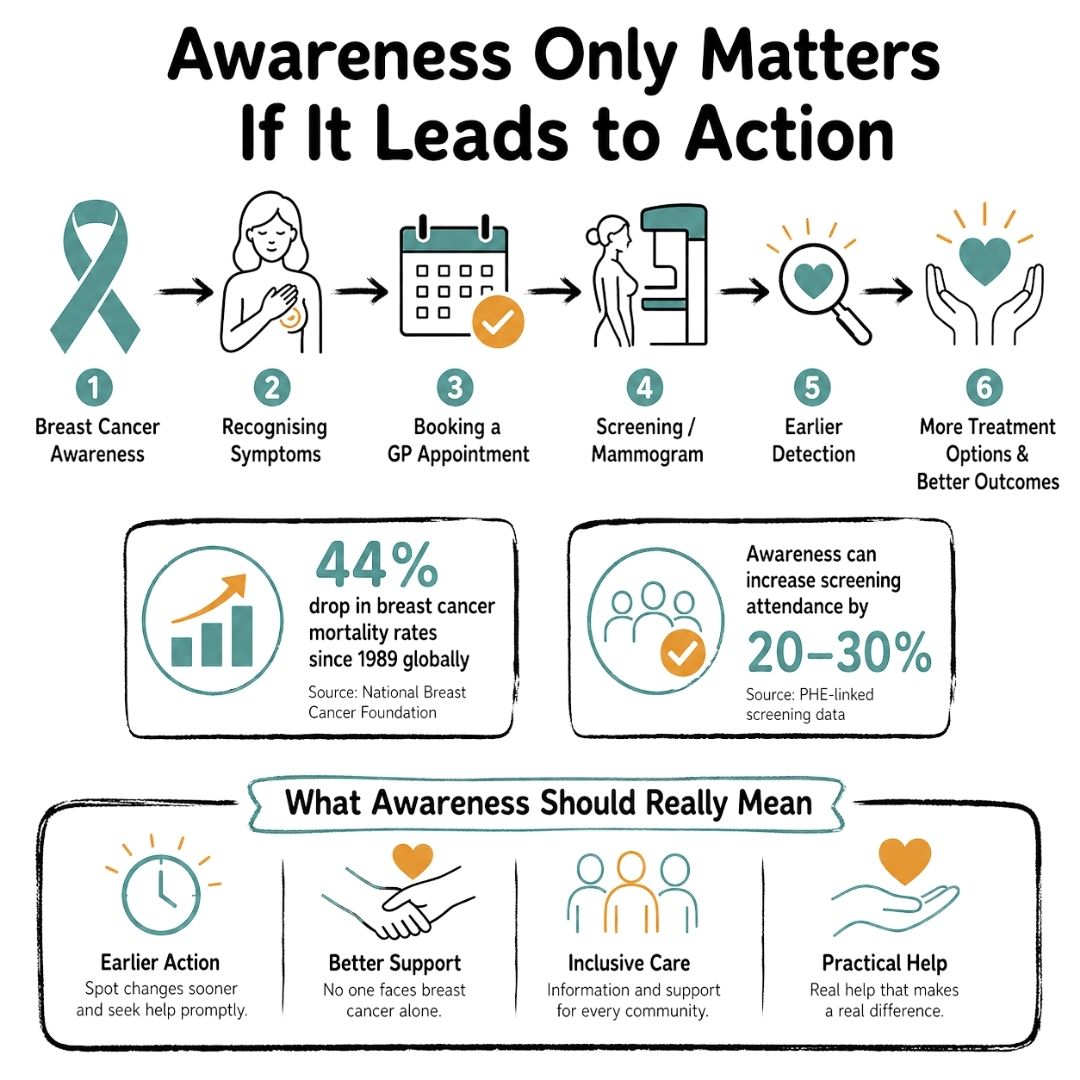
Awareness efforts linked to Breast Cancer Awareness Month have helped drive a 44% drop in breast cancer mortality rates since 1989 globally, with similar trends in the UK, according to the National Breast Cancer Foundation facts page. That doesn’t mean awareness alone cures cancer. It means education, screening, faster diagnosis, research, and better support change what happens after a person notices a symptom or attends a routine appointment.
That’s why breast cancer awareness month matters when it’s done well. It should do more than sell pink products or repeat slogans. It should help people recognise changes, understand screening, support loved ones properly, and make sure awareness reaches communities that are too often left out.
This guide is written for people living with a diagnosis, people who love and support them, and anyone who wants to take part in a way that’s useful rather than symbolic. If you value practical, careful guidance, this broader collection of evidence-led insight into cancer support that helps rather than harms is a strong place to keep learning.
Breast cancer awareness month has real weight because it changes behaviour. People book appointments. Families ask questions sooner. Clinicians get more chances to catch disease before it spreads.
The pink ribbon only matters if it leads to action. Awareness without follow-through can feel hollow. Awareness with screening, timely GP visits, clear information, and practical support can save lives.
At its best, awareness does three things at once.
Awareness is most useful when it turns uncertainty into a next step.
That’s the standard worth aiming for in October and beyond. Breast cancer awareness month should move people from vague concern to informed action.
Breast cancer awareness campaigns have been active for decades, but October matters for a specific reason. It gathers public attention, clinical messaging, fundraising, and community support into one visible period, which helps people act sooner instead of postponing concerns.
The modern movement is widely traced to a campaign launched in 1985 in the United States. In the UK, October awareness activity became more established through charity, NHS, and community efforts over the following years, as reflected in the history outlined by Breast Cancer UK. What began as a push to get more people talking about mammograms grew into something broader and more humane.
That shift matters.
A useful way to understand it is to picture awareness month as a front door, not the whole house. The pink ribbon may catch someone’s eye, but real purpose starts after that first moment of recognition. A patient may need help understanding a diagnosis. A partner may need guidance on how to provide day-to-day care. A friend may want to give support without saying the wrong thing. Someone facing surgery may start learning about options such as breast reconstruction after mastectomy.
Early campaigns focused heavily on recognition and screening. That remains important, but awareness now carries a wider responsibility.
Today, the month also creates space to:
That last point deserves attention. Awareness is less useful if it only reaches people who already have easy access to GPs, screening, time off work, and reliable health information. Strong campaigns include underserved communities, use language people can understand, and recognise that breast cancer affects women and some men, as well as trans and non-binary people who may otherwise feel excluded from public messages.
Health messages compete with everyday life. Symptoms get dismissed. Appointments get delayed. Questions stay private for too long.
A dedicated month works like a national reminder system. Charities repeat practical advice. Clinicians share guidance. Employers, schools, and community groups open conversations that may not happen at other times of year. Repetition helps, especially for people who need to hear a message more than once before taking the next step.
The strongest version of Breast Cancer Awareness Month does more than raise visibility. It gives people something useful to do today. Book the appointment. Ask about a change. Offer specific help to a friend in treatment. Check whether local information is accessible to people who are often left out.
That is the purpose of the month. Turn attention into earlier action, better support, and fairer care.
Breast cancer starts when cells in the breast grow in an abnormal way and don’t stop when they should. Some grow slowly. Others behave more aggressively. That difference is one reason a diagnosis can lead to very different treatment plans for different people.
In the UK, breast cancer is the most common cancer in women, with an age-standardised incidence rate of 153.3 per 100,000 women. The same Cancer Research UK resource reports 5-year net survival of 87% for females, but 29% for stage IV, which shows why stage at diagnosis matters so much, according to Cancer Research UK’s breast cancer statistics page.
A risk factor is best understood as something that may change probability. It is not a guarantee that cancer will happen. It is also not proof that someone caused their illness.
That distinction matters because people often get stuck in one of two unhelpful beliefs. Either they think, “I have no family history, so I’m safe,” or they think, “I have a risk factor, so this is inevitable.” Neither is accurate.
A lump can be a warning sign, but it isn’t the only one. Changes worth checking include:
These symptoms don’t always mean cancer. They do mean it’s worth speaking to a GP or other qualified clinician.
| Risk Factor Category | Examples | Can It Be Modified? |
|---|---|---|
| Non-modifiable | Age, sex, inherited genetic variants, personal history of breast conditions, family history | No |
| Partly modifiable or medically influenced | Some hormone-related exposures, screening attendance, follow-up after abnormal findings | Sometimes |
| Lifestyle-related | Alcohol intake, physical activity patterns, body weight patterns after menopause, smoking status | Yes, to varying degrees |
People often hear “genetic risk” and assume all breast cancer is inherited. It isn’t. Others hear “lifestyle matters” and wrongly conclude that lifestyle explains every diagnosis. It doesn’t.
Both biology and environment can matter. So can pure chance.
For some readers, surgery and reconstruction are part of the path after diagnosis. If you want a patient-friendly overview of options and recovery questions, this guide to breast reconstruction after mastectomy gives a clear explanation of what to expect.
A symptom deserves attention even if your overall risk seems low.
That simple principle helps people avoid the trap of waiting for certainty before seeking help.
The strongest argument for screening is simple. Earlier detection usually gives people more options.
Breast cancer awareness month often leads to a 20 to 30% spike in NHS breast screening uptake and GP symptom-check appointments, according to University Hospitals Birmingham’s summary of Public Health England-linked screening data. That matters because awareness is doing what it should do. It’s pushing people towards timely action.
A mammogram is an X-ray of the breast used to look for changes that may be too small to feel. For many people, the hardest part is uncertainty. They don’t know what the machine does, how long it takes, or whether discomfort means something is wrong.
In plain terms, the breast is placed on the imaging plate and gently compressed for a short time to get a clear image. It can feel uncomfortable, but the test is brief.
If you want a calm, practical explanation of what happens before, during, and after the appointment, this guide on a mammogram is useful.
When cancer is found before it has spread widely, treatment can be more targeted and outcomes are often better. That is the primary goal of screening. Its purpose isn't just to “check for cancer.” It’s to find disease at a point where intervention is more manageable.
People sometimes avoid screening because they’re afraid of what might be found. That fear is understandable. But delaying a test doesn’t remove risk. It only removes information.
Screening can feel frightening. Not knowing is often harder in the long run.
Breast self-awareness isn’t a replacement for screening. It is a helpful habit.
You don’t need a perfect monthly ritual or a memorised routine. What matters is knowing what’s normal for your own body, so a new change stands out.
A simple way to do that:
This short video may help if you prefer visual instruction.
Screening systems vary by country and by personal risk. In the UK, routine invitations come through the NHS programme for eligible groups. In the US, recommendations can differ between organisations and personal risk categories.
The safest approach is to ask two direct questions if you’re unsure:
Those questions are simple, but they can prevent years of uncertainty.
Many individuals want to help. Many still say the wrong thing because they panic, fill silence too quickly, or try to make the conversation less uncomfortable for themselves.
Supportive communication starts with one principle. The person with cancer doesn’t need you to solve it. They need you to be steady, respectful, and useful.
A newly diagnosed person may not want advice on day one. They may not want optimism served at full volume. They may only want someone to hear them without interrupting.
Helpful phrases often sound ordinary:
Less helpful phrases usually centre the speaker’s discomfort:
The last one sounds kind, but it puts the work back onto the person who is already overloaded.
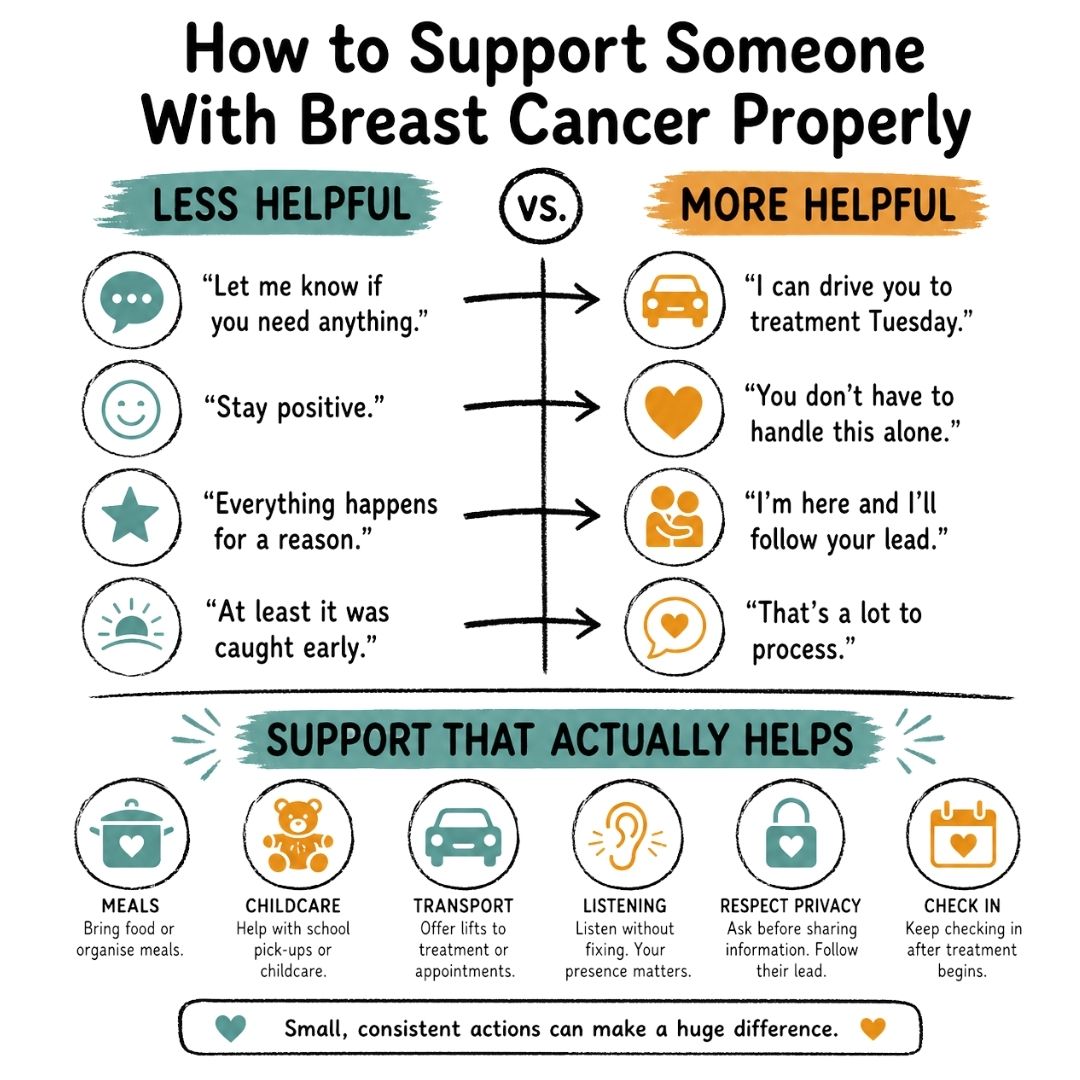
Specific offers are easier to accept than vague ones.
Try these instead:
| Less helpful | More helpful |
|---|---|
| “Let me know if you need anything.” | “I’m free to drive you to treatment on Tuesday if you want.” |
| “You’ve got this.” | “You don’t have to handle this alone.” |
| “At least it was caught.” | “That’s a lot to take in. I’m here.” |
Some people want to share updates widely. Others tell only a few people. Don’t assume access.
Ask before sharing any information, even with relatives, colleagues, or mutual friends. And remember that what someone needs in week one may be different from what they need during treatment or months later.
If you want more examples of language that comforts without minimising, this guide to comforting words for someone with cancer offers thoughtful prompts.
“I’m here, and I’ll follow your lead” is often more caring than a long speech.
Breast cancer awareness month is most effective when people match their effort to the role they hold. A patient needs something different from a spouse. A friend can help in ways a workplace cannot. An employer can remove friction that family members can’t.
That’s good news, because it means almost everyone can contribute.
Start by reducing information overload. You do not need to become an expert overnight.
A grounded approach looks like this:
Caregivers often disappear behind the patient story, but their wellbeing affects the whole household. Breast Cancer Now reports that 1 in 3 caregivers of breast cancer patients experience severe anxiety or burnout, yet only 15% access formal support, according to Breast Cancer Now’s reporting on isolation and support needs.
That gap matters. Burnout doesn’t mean you love the person less. It means the load is heavy.
Three practical ways to protect yourself:
For more practical ideas, this list of 34 ways to support your loved one living with cancer can help families share the load more realistically.
Good intentions are common. Useful planning is rarer.
Consider actions like these:
Choose action over performance. Donate thoughtfully. Share accurate information. Offer lifts, meals, admin help, or childcare. Check in after treatment starts, not only on diagnosis day.
Awareness month should widen support, not flatten it into one pink message.
A one-size-fits-all campaign doesn’t reach everyone equally. That’s one of the biggest blind spots in breast cancer awareness month.
In England, women from Black, Asian, and minority ethnic communities are up to 35% more likely to be diagnosed at stages 3 or 4, and 59% of Black women aged 50 to 70 attended screening compared with 75% of white women, according to The Pink Journey Foundation’s information on underserved populations and early detection.
Those figures point to a practical problem, not a cultural stereotype. If screening messages, clinic systems, and support services don’t feel accessible or trustworthy, people are more likely to arrive later in the diagnostic pathway.
Generic awareness campaigns often assume everyone receives health information in the same way. They don’t.
Barriers may include:
When those barriers are ignored, “awareness” can become something people see but can’t act on.
Inclusive outreach is more than translation. It means designing support around real communities.
That can include:
Equal information doesn’t always create equal access.
That’s why better awareness requires more than louder messaging. It requires targeted messaging, respectful partnerships, and a willingness to ask who is still being missed.
When breast cancer enters your life, the next right resource matters more than reading everything at once. Start with the kind of help you need.
Use your GP, breast clinic, or national health service guidance for symptoms, referrals, and screening eligibility. In the UK, NHS pathways are the starting point for individuals with new concerns or routine screening questions. In the US, primary care clinicians and accredited screening centres can help clarify local recommendations.
Major cancer charities can help with helplines, patient information, support groups, treatment explainers, and survivorship resources. Organisations such as Breast Cancer Now, Macmillan Cancer Support, Cancer Research UK, and Susan G. Komen are widely known and can help people find both information and community.
Cancer Care Parcel offers patient-friendly education, workshops, guides, and practical comfort-focused support from a UK base for a wider global audience. If you want ongoing help, you can explore the main site, sign up for updates through the newsletter, look for workshops on Eventbrite, or review membership and care package options if they’re available.
A simple rule can help when you’re stressed. Choose sources that are transparent, specific, and clear about what they do. Be careful with anonymous social posts, miracle claims, or advice that tells you to avoid qualified medical care.
| Question | Answer |
|---|---|
| Can men get breast cancer? | Yes. Breast cancer is much less common in men, but it can happen. In the UK, expected annual cases in the source data include around 420 in men. Any new breast or chest change deserves medical advice. |
| Does a family history mean I will get breast cancer? | No. Family history can increase risk, but risk is not certainty. Many people diagnosed with breast cancer do not have a strong known family history. |
| If I find a lump, does that mean it is cancer? | No. Many breast changes are not cancer. But a new lump or other breast change should still be assessed by a clinician. |
| Is a mammogram the same as a diagnosis? | No. A mammogram is a screening or imaging test. It can show an area that needs more assessment, but it does not by itself confirm every diagnosis. |
| Is breast self-checking enough on its own? | No. Self-awareness helps you notice changes, but it does not replace routine screening or medical assessment of symptoms. |
| Why does early detection matter so much? | In simple terms, cancers found earlier are often easier to treat and may allow more treatment options. That’s why screening and prompt symptom checks matter. |
| Is breast cancer awareness month only for patients? | No. It also matters for caregivers, families, friends, workplaces, clinicians, and communities working to improve access to screening and support. |
Awareness is most valuable when it leads to one clear action. Book the screening. Check the symptom. Offer the practical help. Share accurate information. Make room for people who are too often overlooked.
We strongly advise you to talk with a health care professional about specific medical conditions and treatments.
The information on our site is meant to be helpful and educational but is not a substitute for medical advice.
My appearance has definitely changed over the past twelve months that’s for sure but I’m getting to like the new me especially when I’m pain free.
Learn how surgical scars can affect movement, comfort, lymphatic health, and confidence long after cancer treatment.
None of us expects to get cancer. Cancer is what happens to someone else.