The future is not fast approaching; we are actually living in it. Artificial Intelligence is not limited to asking an AI chatbot to write you an email or give you ideas for your next post on any social media platform; it’s broader, creating ripples in the field of scientific research. Here’s what’s new: scientists have developed a new AI tool which may be able to detect early stages of laryngeal cancer (commonly known as voice box cancer). It looks for tiny changes in how a person talks, offering a simple, non-invasive way to catch the disease sooner, which could lead to better results and easier testing for more people.

Laryngeal cancer occurs in the larynx, the part of your throat that helps you talk, breathe, and swallow. It includes your vocal cords. This cancer develops when cells in the larynx grow out of control, forming malignant tumours that can invade tissues and harm your body.
Laryngeal cancer can develop in any of the three main areas of the larynx:
The early signs of laryngeal cancer can be mistaken for other conditions, such as a cold. People often describe their condition to the doctor as, ‘my voice has been hoarse for a few weeks now’. This symptom most likely hides the malignant cells and tissues in the voice box. The following are the symptoms of laryngeal cancer. If these symptoms are persistent and not improving, it is advised to visit your healthcare provider immediately.
The American Cancer Society lists the primary risk factors for laryngeal cancer as: smoking or tobacco use, heavy alcohol consumption, gastroesophageal reflux disease (GERD), Plummer-Vinson syndrome, anatomical issues, exposure to heat, chemicals, asbestos, nickel, or ionising radiation, and certain viral infections.
In 2022, it caused about 103,216 deaths worldwide, with age-standardised incidence and mortality rates of 3.9 and 2.1 per 100,000, respectively.1 Rates vary by region due to factors like tobacco and alcohol use, occupational exposures (e.g., asbestos, wood dust, industrial chemicals), and socioeconomic conditions.2 Tobacco is the leading risk factor, with alcohol amplifying the risk. Despite progress in early detection and medical technology, laryngeal cancer remains a major issue, especially in low- and middle-income countries, where limited healthcare access leads to delayed diagnoses and poorer treatment outcomes.
Laryngeal cancer survival rates vary widely, with five-year survival rates ranging from 35% to 78%, depending on the stage at diagnosis and the specific part of the larynx affected. Early-stage cancers, particularly those in the glottis, tend to have higher survival rates due to earlier symptom onset, like hoarseness, which prompts quicker medical attention. Advanced-stage cancers or those in less symptomatic areas, like the supraglottis or subglottis, often have less favourable results due to delayed detection.
A groundbreaking study offers hope for a new approach, suggesting that artificial intelligence could transform laryngeal cancer detection by analysing voice patterns. By identifying subtle changes in speech such as variations in pitch, hoarseness, or harmonic-to-noise ratio, AI could provide a non-invasive, accessible, and cost-effective screening tool.
Early detection of laryngeal cancer greatly improves a patient’s chances of successful treatment. Currently, diagnosing this cancer involves invasive and complex procedures like video nasal endoscopy and biopsies. These tests often require a specialist, which can delay diagnosis due to scheduling and access issues. However, a recent study published in Frontiers in Digital Health shows that vocal fold abnormalities can be identified by analysing voice patterns. These abnormalities, known as vocal fold lesions, may include benign conditions like nodules or polyps, but they can also signal early laryngeal cancer. These promising findings pave the way for a new use of AI: detecting early signs of laryngeal cancer through simple voice recordings, offering a non-invasive, faster, and a convenient approach to diagnosis. This technology has the potential to enable earlier detection, improve outcomes, and make screening more widely available, particularly for high-risk groups like smokers or those with occupational exposures.
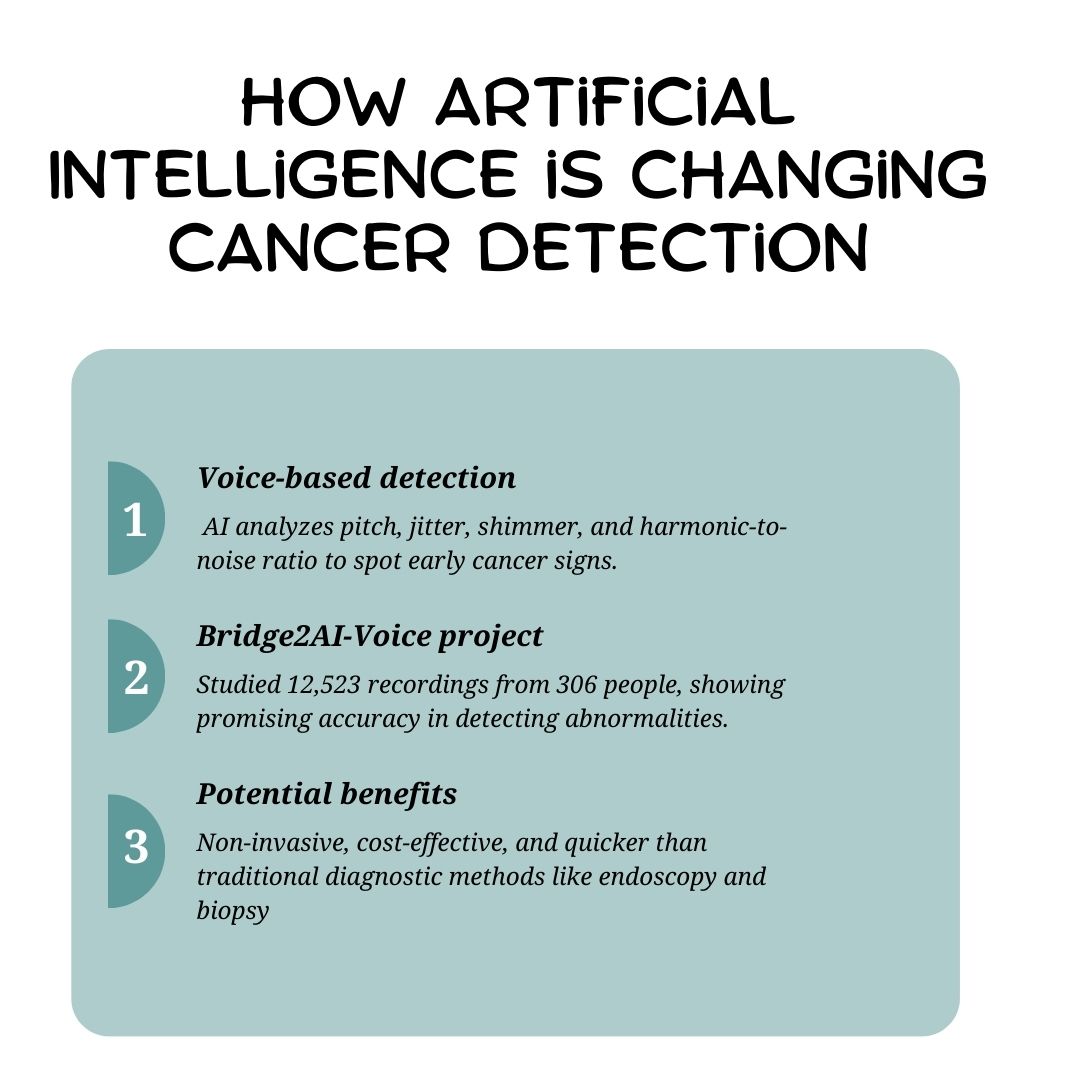
Dr Phillip Jenkins and his team are part of the "Bridge2AI-Voice" project, which is a part of a bigger U.S. National Institutes of Health program called "Bridge to Artificial Intelligence" (Bridge2AI). This program uses AI to tackle tough health problems. In this study, they looked at 12,523 voice recordings from 306 people across North America, stored in the first public version of the Bridge2AI-Voice dataset. Some of these recordings came from people with laryngeal cancer, non-cancerous vocal fold issues (like nodules or polyps), or two other voice box conditions: spasmodic dysphonia (which causes shaky or interrupted speech) and unilateral vocal fold paralysis (where one vocal cord doesn’t move properly).4
The team studied differences in voice qualities like pitch (how high or low the voice sounds), jitter (how much the pitch wobbles during speech), shimmer (how much the loudness varies), and the harmonic-to-noise ratio (a measure of how clear the voice is compared to background noise in the speech).
The researchers noticed clear differences in men’s voices when comparing those with no voice problems, those with non-cancerous vocal fold issues and those with laryngeal cancer. Specifically, they saw differences in the harmonic-to-noise ratio (how clear the voice is compared to background noise) and the fundamental frequency. They didn’t find any significant voice differences among women, but this might be because the dataset was too small. A larger dataset could show similar differences in women’s voices.
Dr Jenkins and his research team concluded that changes in the harmonic-to-noise ratio could be very useful for tracking the development of vocal fold issues, such as non-cancerous growths, and for catching laryngeal cancer early, especially in men. This means that by listening to how someone’s voice sounds, doctors might be able to spot problems sooner without needing complicated procedures. While the study focused on men, where these voice changes were more noticeable, the researchers believe that with more data, similar patterns might be found in women, too. This could lead to a simpler way of diagnosing early-stage laryngeal cancer.
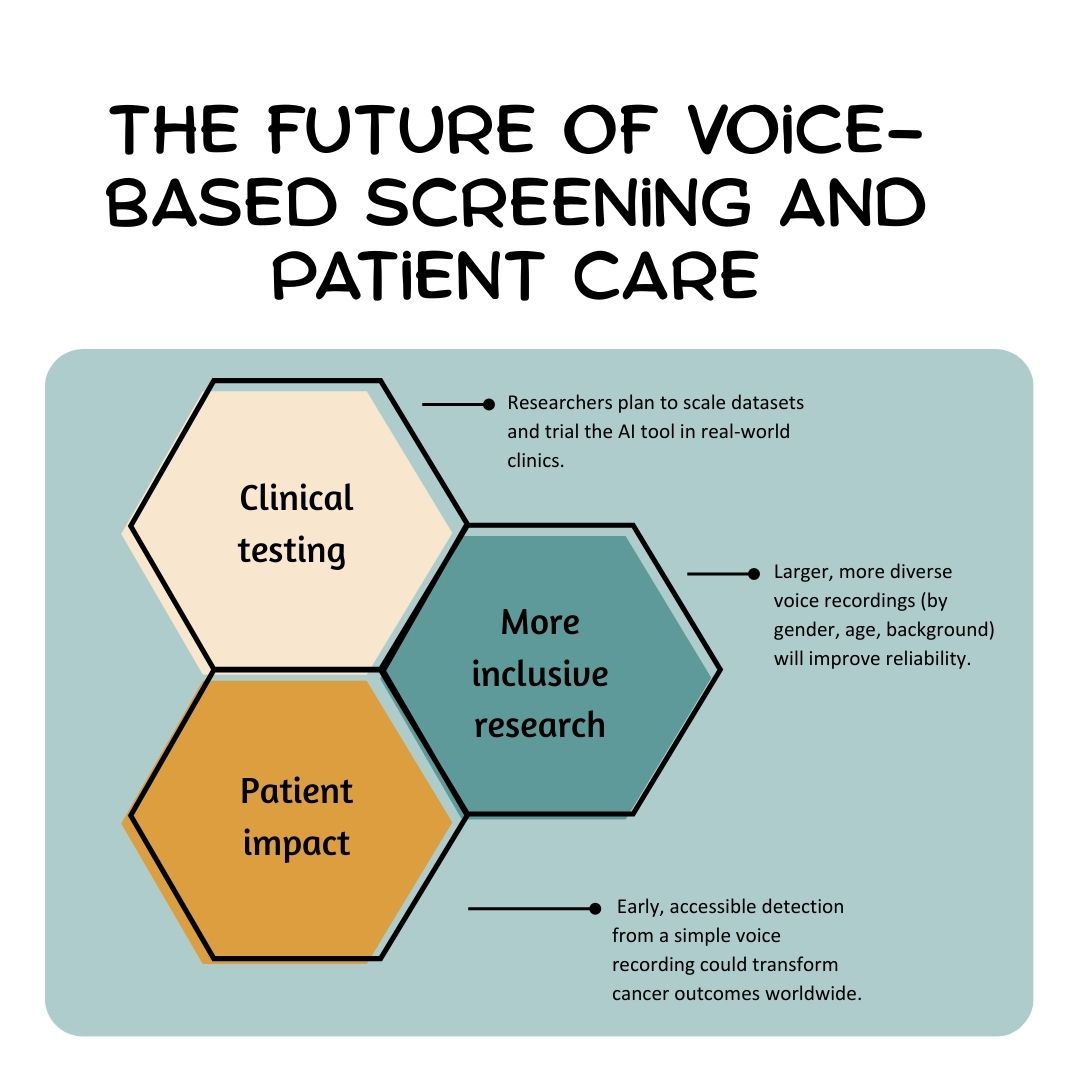
This research has shown that AI can identify vocal fold issues, such as non-cancerous growths or early laryngeal cancer, by analysing voice recordings. The next step is to test this approach with a larger, more diverse set of voice samples and in real-world medical settings, like clinics, to confirm its effectiveness with actual patients.
To develop this AI into a reliable tool for detecting vocal fold problems, the team plans to train it with thousands more voice recordings from varied groups, carefully labelled by medical experts to distinguish healthy voices from those with issues. They also aim to ensure the tool works equally well for women and men, as the initial study found clearer voice patterns in men, possibly due to limited data for women.
Some voice-based health tools are already in early trial stages. With more data and clinical testing, the researchers believe AI tools for detecting vocal fold issues could be ready for pilot testing in clinics within the next few years.
How important is this AI tool? The current diagnoses and treatment for cancer come with the expenses of travel, cost, and time. Through the positive use of AI, these barriers could be removed, and people can have easy access to healthcare without the cons.
For medical research, this tool opens new doors. It allows researchers to quickly analyse huge amounts of voice data, spotting patterns that might be missed by humans. This can deepen our understanding of throat cancer and vocal fold issues, such as what causes them or how they develop over time. To make the tool more accurate, researchers are motivated to collect larger, more diverse voice datasets, including people of different ages, genders, and backgrounds. This push for better data ensures future studies are more inclusive and reliable.
When it comes to patient care, this AI tool has the capacity to make a huge difference. Catching throat cancer early greatly improves treatment success, but misdiagnosed as early symptoms such as a cough or sore throat. This tool could detect problems sooner with just a voice recording, leading to faster treatment and better chances of recovery. Patients could potentially record their voice at home or in a doctor’s office, making testing less stressful and more convenient. It could also save time by reducing the need for long waits to see specialists, helping patients get diagnosed and treated more quickly. This is indeed the first step towards a better future for cancer treatment.
Edited by: Katheeja Imani
We strongly advise you to talk with a health care professional about specific medical conditions and treatments.
The information on our site is meant to be helpful and educational but is not a substitute for medical advice.
A clear guide to FOLFOX chemo. Understand how the treatment works, what to expect during each cycle, and how to manage common side effects effectively.
Cancer Memes And Inspirational Quotes For Cancer Patients To Provide Inspiration, Comfort, And Support For All Those Affected By Cancer
As a married mum of 2 young girls, it’s sad to say that we have nursed two of our parents through cancer.