If you, or someone close to you, has been diagnosed with cancer, you’ve already stepped into a world full of questions and new experiences. Some days may be filled with hope, while others bring uncertainty. In all of this, one thing that can help is understanding where your treatments come from and how science continues to make progress, often from sources you might never expect.
This article explores how the world’s oceans, and the diverse creatures living within them, are quietly playing a vital role in modern cancer treatment. Here, you’ll learn about real, approved cancer medicines that trace their roots back to marine life.
The Ocean: Nature’s Unexplored Pharmacy
Why do scientists spend so much time and energy exploring the ocean for new cancer medicines? The ocean is like a vast, untapped “pharmacy,” full of organisms that have survived for millions of years by developing unique chemicals quite different from those on land. The challenges of underwater life have refined these chemicals, and some have proven to be the very tools doctors need in the fight against cancer.
Marine creatures, such as sponges, sea squirts, shellfish, and even certain bacteria, often produce substances not found anywhere else. Researchers sometimes discover that these natural chemicals can fight cancer cells in ways traditional drugs cannot. For many patients, knowing that some of their medications may have origins in the deep sea adds both a sense of wonder and a fresh perspective on their healthcare journey.
Sea Life That Shaped Cancer Medicine
Letʼs look at the 4 W’s (where it comes from, what it treats, how it works, and why it matters) of real marine organisms that have already made a difference in cancer care. Each example highlights a currently approved medicine based on unique marine chemistry.
Sponges: Hidden Healers from the Sea Bed
Cytarabine (Ara-C, Cytosar-U)
Where it comes from: A Caribbean sponge called Cryptotethya crypta.
What cancer it treats:Leukaemia and lymphoma, cancers affecting the blood and immune system.
How it works: Imagine a puzzle piece that looks almost identical to the real one but is just different enough to spoil the final picture. Cytarabine acts as this kind of “imposter piece” when cancer cells use it to copy DNA and make new cells. The process stalls, and the cancer cells stop multiplying.
Why it matters: Cytarabine has been used for over half a century and remains a go-to drug for certain blood cancers. Its marine origins paved the way for a generation of ocean-sourced medicines.
Japanese Sponges: Traffic Controllers for Cancer Cells
Eribulin Mesylate
Where it comes from: Inspired by compounds found in the Japanese sponge Halichondria okadai.
What cancer it treats:Advanced breast cancer and liposarcoma (a rare cancer of fat and soft tissues).
How it works: Cancer cells need tiny “tracks” to divide and grow, like railways inside the cell. Eribulin causes a traffic jam on these tracks, halting cell division. Without growth, the cancer cells die.
Why it matters: Eribulin can work even when other treatments fail, giving doctors and patients more options.
Sea Squirts: Small, Simple, and Powerful
Trabectedin
Where it comes from: The Caribbean sea squirt Ecteinascidia turbinata.
What cancer it treats: Soft tissue sarcoma and ovarian cancer (especially in the EU).
How it works: Trabectedin inserts itself into the “gaps” of cancer cell DNA, the twisted ladder that holds life’s instructions, causing confusion. Unable to function or repair itself, the cell eventually self-destructs.
Why it matters: For rare or hard-to-treat cancers, trabectedin provides hope when options are limited.
Plitidepsin
Where it comes from: Another sea squirt, Aplidium albicans.
What cancer it treats: Approved in Australia for multiple myeloma, a blood cancer affecting plasma cells.
How it works: Plitidepsin targets an overactive protein in some cancer cells, creating so much internal stress that the cell can’t survive.
Why it matters: Plitidepsin’s success has inspired ongoing research into more cancers.
Molluscs: Tough Shells, Surprising Secrets
Brentuximab Vedotin
Where it comes from: A molecule (MMAE) based on dolastatin 10, first found in the sea hare (a large sea slug or mollusc).
What cancer does it treat:Hodgkin’s lymphoma and systemic anaplastic large-cell lymphoma.
How it works: This medicine acts like a precision-guided missile. An antibody seeks out a marker (CD30) on cancer cells and attaches the drug to it. Once absorbed, it destroys the cancer cell from within.
Why it matters: This is targeted therapy at its best, destroying cancer cells while sparing most healthy ones.
Why Marine Medicines Matter in Cancer Treatment
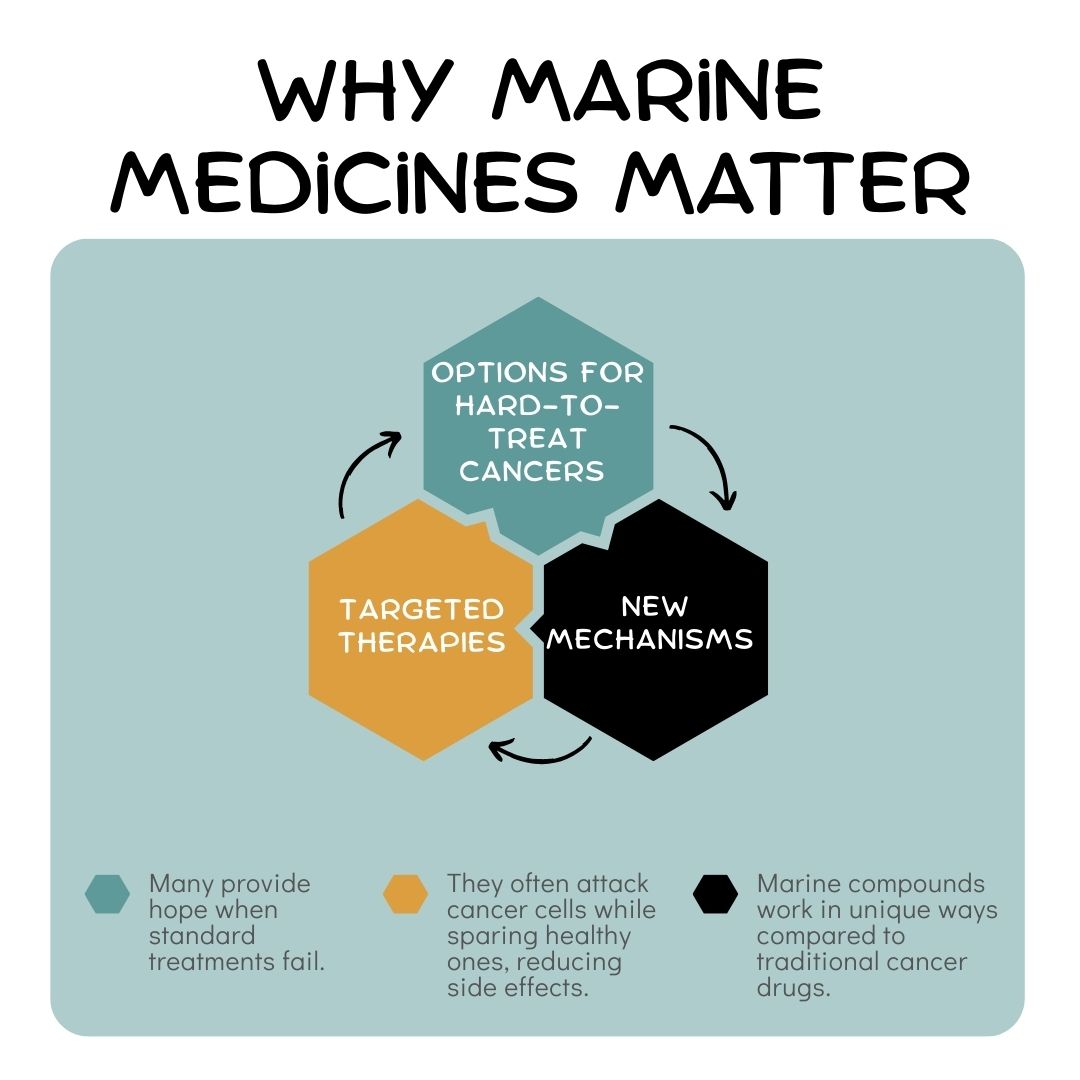
New Mechanisms: Because the chemical structures of marine-derived drugs are so unique compared to those from plants or synthetic sources, they often work in cancer-fighting ways that traditional medicines don’t. This means they can block cancer growth using different biological pathways, providing doctors extra treatment options for tough or resistant cancers.
Strong Targeting: Many marine-related medicines belong to a class called targeted therapies. These drugs are designed to specifically identify and attack cancer cells, reducing harm to healthy cells around them. This focused approach often leads to fewer side effects, making treatment more tolerable and helping patients maintain a better quality of life during therapy.
Choices for Difficult Cancers: When cancer doesn’t respond to usual treatments, it can feel like there are no options left. Marine-derived drugs provide newer alternatives that have already proven effective against some hard-to-treat cancers. These options give doctors and patients hope by offering additional ways to fight disease when other therapies fail.
The Journey: How a Marine Discovery Becomes Medicine
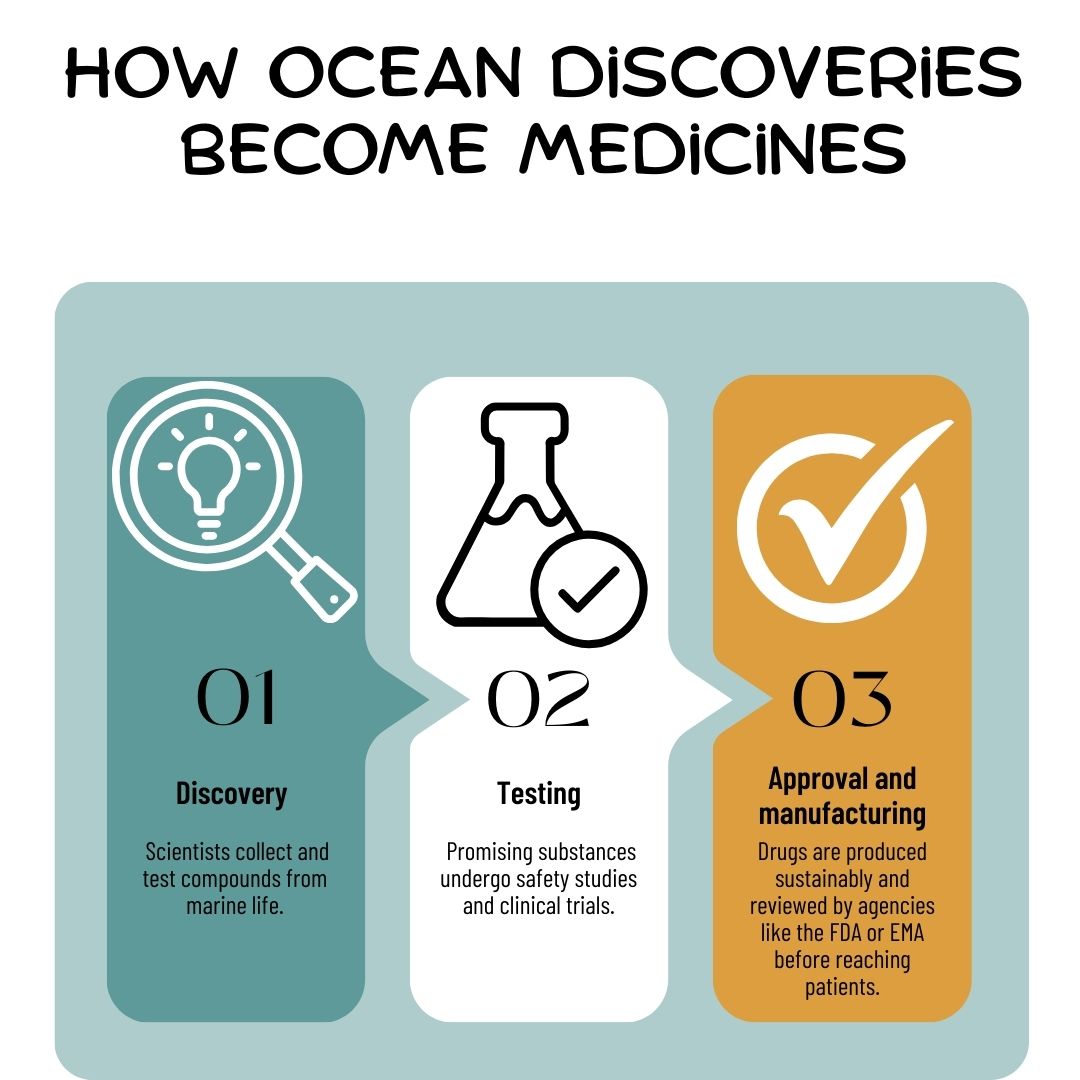
Discovery: Marine explorers and scientists who study ocean life collect samples from the sea, such as sponges, tunicates, and other creatures. Chemists then test these naturally occurring compounds in lab dishes against cancer cells to see if they have any ability to slow or stop cancer growth. This initial screening is crucial for finding promising candidates for further study.
Analysis: Once a compound shows potential, researchers analyse its chemical structure in detail to understand how it works. They develop ways to produce more of the compound in laboratories without depleting wild populations. Thanks to new technologies like underwater robotics and DNA sequencing, scientists can speed this process, ensuring discoveries are sustainable and environmentally responsible.
Testing: Before a marine compound can become a medicine, it must be tested extensively. This begins with animal studies to assess safety and initial effectiveness. If results are promising, the compound moves into phased clinical trials involving human volunteers, carefully monitored to verify dosage, safety, and how well the drug treats specific cancers.
Manufacturing: Because harvesting large quantities of marine organisms is not practical or ecologically sound, most marine-derived drugs are now produced synthetically or through biotechnological methodsin factories. This ensures a reliable supply of medicine without harming delicate ocean ecosystems, balancing medical needs with environmental protection.
Approval: After passing rigorous safety and effectiveness testing, marine-based drugs are submitted for review by health authorities like the FDA or EMA. Only when these agencies are confident that the medicine benefits patients and meets high safety standards do they approve the drug for clinical use, allowing doctors to prescribe it widely.
Ongoing Research: Whatʼs Next Beyond the Horizon?
Scientists worldwide are exploring marine resources for new cancer treatments. Over 30 marine-derived compounds are in clinical trials, targeting tough cancers in the lung and brain, and resistant tumours. With technologies such as DNA sequencing and microbial fermentation, researchers are uncovering novel molecules that could minimise side effects and overcome resistance, bringing new hope for patients everywhere.
The Bigger Picture: Hope from the Depths
With every new discovery, cancer care becomes more hopeful and comprehensive. The sea holds countless secrets, many that may lead to better treatments and improved survival. Even on difficult days, these advances remind us that progress never stops. Nature and science together show that some of the greatest breakthroughs come from the most unexpected places, deep beneath the waves.
Conclusion
Your healthcare team wants you to feel informed, empowered, and supported throughout your cancer journey. Taking things one day at a time, asking questions, and staying curious can provide strength and comfort. Behind every treatment are researchers, doctors, and even ocean organisms working together to bring hope. This collaboration reminds us that healing and innovation often begin in the vast, mysterious depths of the sea.
We strongly advise you to talk with a health care professional about specific medical conditions and treatments. The information on our site is meant to be helpful and educational but is not a substitute for medical advice.
Written by Vaibhavi Paranjape
Vaibhavi Paranjape is an undergraduate student pursuing a degree in Biotechnology. She has a strong interest in genetics, molecular biology, and cancer research. Passionate about scientific innovation, she is keen on exploring how research can be applied to real-world medical challenges. Vaibhavi also enjoys science communication and aims to contribute to the field by making complex scientific concepts more accessible to the general public.
There Was A Noticeable Lack Of LGBT Awareness Related To Oncology So I Created An Inclusive LGBT Platform For People With Cancer, Their Friends And Family.
Over the Christmas period, we donated several Cancer Care Parcel seasonal sacks for children with cancer. The CanSurvive team, pictured here donated three of these sacks to sick children. Thank you CAN SURVIVE for all the support that you give to people with cancer Can Survive Wigtownshire, is a pro-active social/activity group open to males and […]