When you hear the word “chemotherapy,” it’s easy to feel overwhelmed. It’s a term loaded with meaning, often bringing a rush of questions and anxieties. Our goal here is to cut through that noise and give you clear, straightforward answers about what chemotherapy is, how it works, and what to expect.
At its core, chemotherapy (often just called ‘chemo’) is a powerful medication-based treatment designed to find and destroy cancer cells. One of the defining features of cancer cells is their tendency to grow and divide much faster than most normal cells. Chemotherapy drugs are designed to hunt for this rapid growth and put a stop to it.
A good way to think about it is like a highly specialised weeding mission inside the body. Imagine a garden where aggressive weeds are growing much faster than the flowers you want to protect. Chemotherapy acts like a targeted weedkiller, seeking out those fast-growing cells.
Because these drugs travel through the bloodstream, they can reach nearly every part of the body. This systemic reach makes chemo a vital tool for treating cancers that may have spread (metastasised) from where they started.
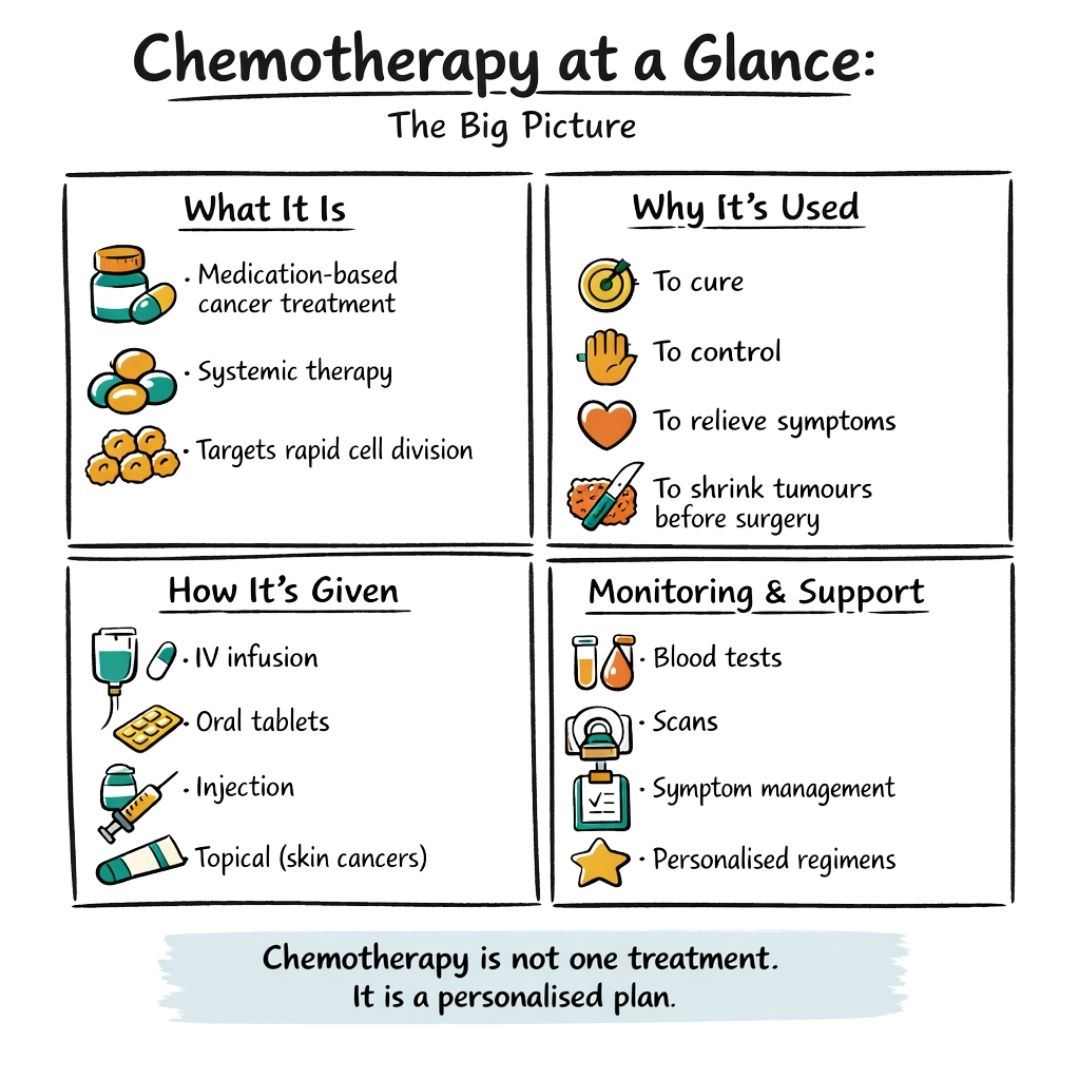
To give you a quick overview, here’s a simple breakdown of chemo’s role.
| Key Aspect | Simple Explanation |
|---|---|
| Main Goal | To kill or stop the growth of rapidly dividing cancer cells. |
| How It Works | Powerful drugs travel through the bloodstream to reach cancer cells throughout the body. |
| Type of Treatment | Systemic – meaning it affects the entire body, not just one specific area. |
| Role in Care | Can be used to cure cancer, control its spread, or relieve symptoms. |
This table shows just how central chemotherapy is to many treatment plans, but it rarely works alone.
Today, chemotherapy is almost always part of a broader, more strategic plan. Think of it as a key player on a team, working alongside other treatments to attack the cancer from different angles.
Your care team might pair chemo with:
The specific goal of your chemotherapy can also vary. For some, the aim is a complete cure. For others, it might be to control the cancer’s growth when a cure isn’t possible, or simply to ease symptoms and improve quality of life.
Chemotherapy has been a pillar of cancer treatment for decades. Its ability to attack cancer cells systemically has transformed the outlook for countless individuals, contributing to major advancements in cancer survival.
The results speak for themselves. The steady improvement in cancer survival rates is a testament to the effectiveness of comprehensive treatment plans, where chemotherapy often plays a crucial role.
In the UK, the data shows that nearly half of all people diagnosed with cancer now live for a decade or more. The latest statistics from Cancer Research UK show that nearly 50% of UK cancer patients survive for 10 or more years after their diagnosis. This figure represents a huge leap forward and highlights the incredible progress medicine has made in managing this disease.
To really get to grips with what chemotherapy is, it helps to understand what’s happening inside the body during treatment. At its core, the science behind chemo is built on a single, powerful principle: it targets cells that grow and divide quickly. This sharp focus is both its greatest weapon against cancer and, as we’ll see, the very reason for its most familiar side effects.
Imagine every healthy cell in your body as a well-behaved citizen, following a strict set of rules about when to grow, when to divide, and crucially, when to stop. This orderly process, known as the cell cycle, is what keeps everything running smoothly. Cancer cells, on the other hand, are rebels. They completely ignore these rules, and their defining trait is this chaotic, uncontrolled, and rapid division that leads to tumours.
Chemotherapy drugs are designed to be the ultimate disruption to this chaos. Once they enter the bloodstream, they travel throughout the entire body on the hunt for any cells that are actively dividing. Think of them as tiny agents programmed to halt this frantic multiplication wherever they find it.
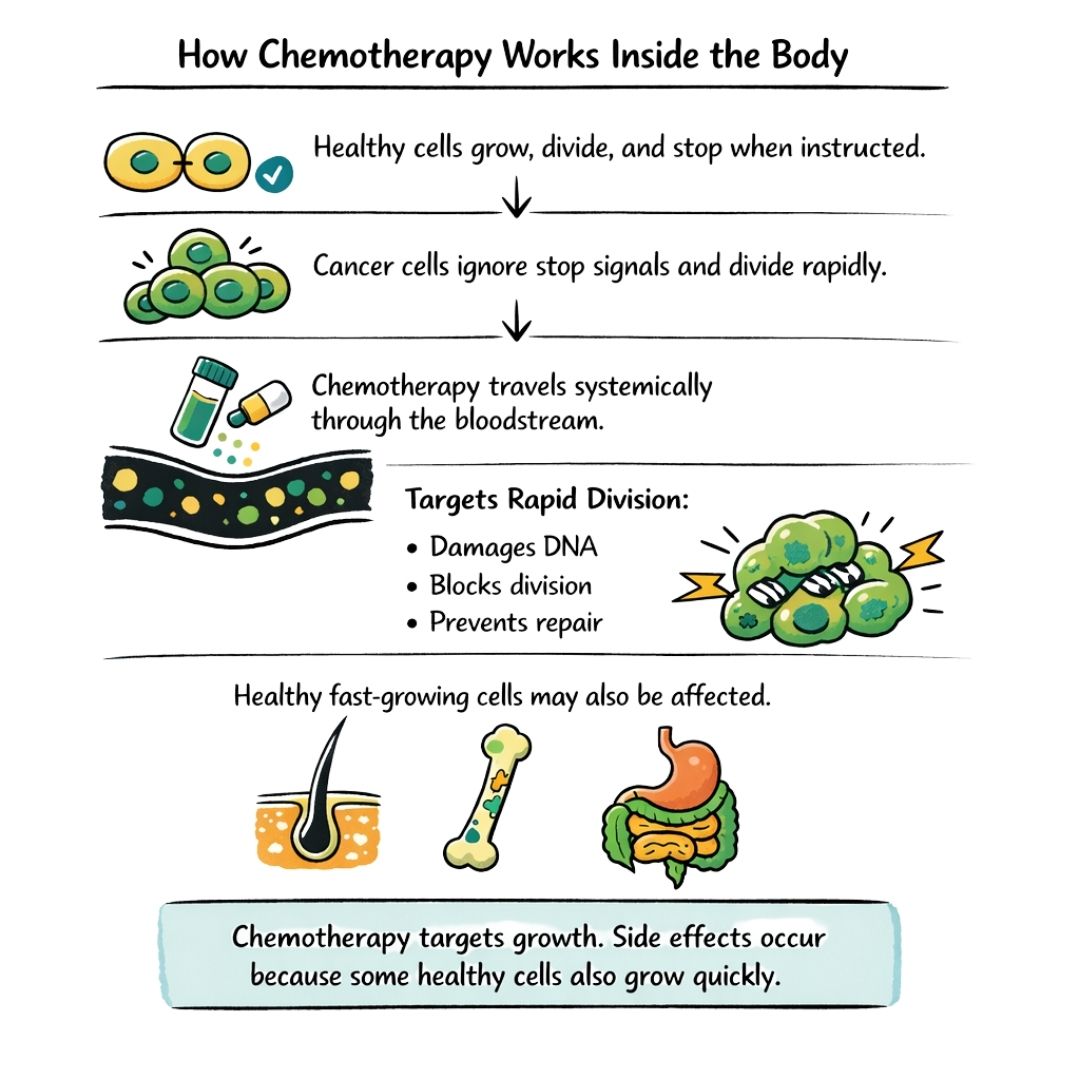
Chemo doesn't just put the brakes on cancer cells; it actively damages them at critical moments in their life cycle. How it does this really depends on the specific drug being used.
Different chemotherapy drugs have different jobs:
Because these drugs are systemic—meaning they circulate everywhere—they can track down and destroy cancer cells that have broken away from the original tumour. This is precisely why chemo is such a vital tool for treating cancer that has started to spread (metastasised).
At its core, chemotherapy disrupts the fundamental ability of a cancer cell to replicate. By attacking this process, it prevents the cancer from growing, spreading, and causing further harm.
Here’s the catch. The very quality that makes chemotherapy so effective against cancer—its ability to target rapidly dividing cells—is also what causes its side effects. The drugs simply aren’t clever enough yet to tell the difference between a rapidly growing cancer cell and a rapidly growing healthy one.
This means that while the chemo is busy attacking the cancer, it can also cause collateral damage to healthy cells in parts of the body where cell turnover is naturally high.
The main areas affected include:
Understanding this connection is key. It helps to reframe side effects not as a sign that something is wrong, but as proof that the treatment is active and doing its job throughout your body. The good news is that modern cancer care is increasingly focused on tailoring treatments to minimise this damage. Exciting research into personalised chemotherapy based on DNA is paving the way for far more precise approaches in the future.
By knowing how chemotherapy works and why it affects healthy cells, you’re building a solid foundation of knowledge. This empowers you to have much more informed and confident conversations with your healthcare team about the journey ahead.
Getting a diagnosis that points to chemotherapy can feel like being handed a complex puzzle without the picture on the box. It’s easy to think of ‘chemotherapy’ as a single, standard treatment, but that couldn’t be further from the truth. In reality, it’s a highly personalised plan, known as a regimen, designed just for you.
Your oncology team puts this plan together by looking at several critical pieces of your unique puzzle. They'll consider the specific type of cancer you have, how far it has progressed (its stage), and your general health and fitness. This careful approach is all about making the treatment as effective as possible while keeping side effects manageable, giving you the best chance of a good outcome.
This idea of a personalised regimen is central to modern cancer care. For example, while chemotherapy is still a key tool for treating early breast cancer in the UK, how it’s used has become much more precise. Current clinical guidelines often advise against chemo if a patient's predicted survival benefit is less than 3%. This change ensures people only undergo chemotherapy when the potential rewards clearly outweigh the challenges, which is a huge step forward in personalised medicine. You can read more about this evolution of prescribing practices on PMC.
Once your regimen is mapped out, the next big question is usually about the practical side of things: how will you actually receive the medication? There are a few different ways to administer chemotherapy, and the method your team chooses will depend on the specific drugs you need and what your treatment is aiming to achieve.
Each method offers a different experience. The most common ways are:
To help you get a clearer picture, this table breaks down what to expect from the most common administration methods.
| Method of Administration | What It Involves | Typical Setting |
|---|---|---|
| Intravenous (IV) | Drugs delivered via a drip into a vein. Sessions can last 30 minutes to several hours. | Hospital, infusion centre, or specialised clinic. |
| Oral (Pills/Capsules) | Taking medication by mouth on a set schedule. | At home, with regular check-ins at the clinic. |
| Injections | A quick shot under the skin or into a muscle. | Doctor's surgery or clinic. |
Knowing whether you’ll be spending a few hours at an infusion centre or taking pills at home can really help demystify the process. It allows you to prepare yourself, both mentally and practically, for the road ahead.
Understanding how your treatment will be delivered helps demystify the process. Knowing whether you'll be spending a few hours at an infusion centre or taking pills at home allows you to prepare mentally and logistically for the road ahead.
Just as there are various ways to give chemo, there are also many different types of chemotherapy drugs. You don't need to get bogged down in their complex scientific names; it's far more helpful to understand what they're designed to do. Some drugs are built to kill cancer cells directly, while others work by stopping them from growing and dividing. For a detailed look at a specific regimen, you can read our guide on FOLFIRAN and FOLFIRINOX chemotherapy.
Your treatment plan might use just one drug or, more commonly, a mix of several. This approach is known as combination chemotherapy. Hitting cancer cells with multiple drugs that work in different ways is often more effective than relying on a single one. This multi-pronged attack increases the odds of destroying a wider range of cancer cells and can help stop the cancer from developing resistance to any one medication. Your care team will walk you through the logic behind your specific drug combination, helping you feel more confident and informed about your treatment.
Let's talk about side effects. It’s often one of the first things people worry about when they hear the word "chemotherapy," and that’s completely understandable. The key is to remember that while the possibility of side effects is real, so are the many effective ways to manage them. My goal here is to give you practical, real-world strategies to help you feel more comfortable and in control.
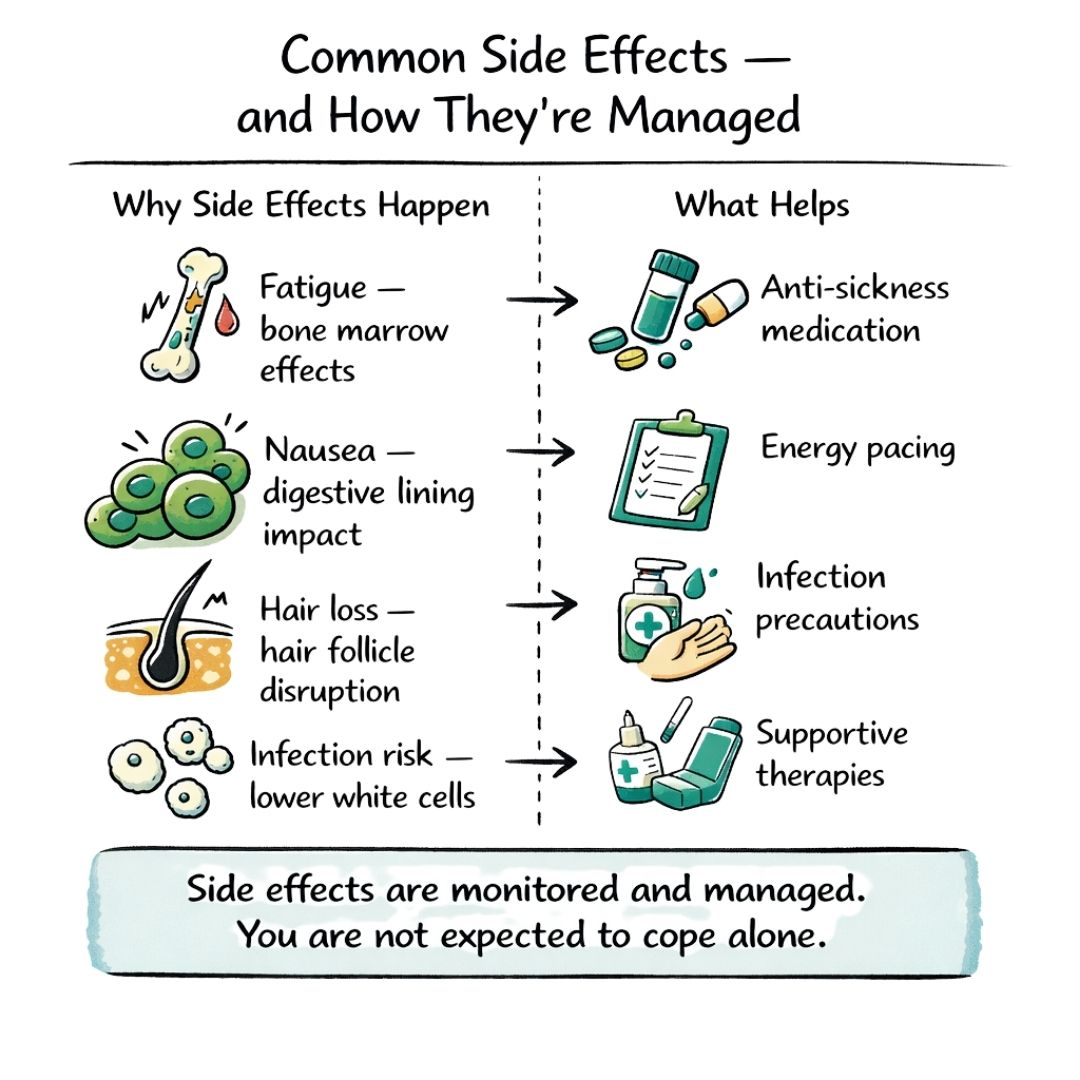
So, why do these side effects happen? Because chemotherapy is designed to target fast-growing cells, it can't always tell the difference between a cancer cell and a healthy, rapidly-dividing cell. This collateral damage is what causes common issues in areas like your hair follicles, digestive tract, and bone marrow.
It's crucial to know that not everyone gets the same side effects, and the intensity can vary massively. Your oncology team has a whole toolkit of supportive treatments to help you through it. Your most powerful tool, however, is your own voice. Speaking up about symptoms as soon as they start allows your team to step in early and adjust your care plan.
Chemo fatigue isn't just regular tiredness; it's a bone-deep exhaustion that sleep doesn't always seem to touch. This happens because your body is in overdrive, fighting the cancer while also working hard to repair the healthy cells affected by treatment.
The best approach is often a gentle balance of rest and activity. It sounds counterintuitive, but a short, gentle walk can sometimes give you more of a lift than staying in bed all day. Above all, listen to your body and don’t be shy about asking friends and family for a hand with daily chores.
Nausea is a classic fear associated with chemo, but the anti-sickness medications (known as antiemetics) we have today are incredibly effective. Your doctor will almost certainly prescribe them for you to take both before and after your treatment sessions, aiming to stop nausea before it even has a chance to start.
Simple changes to your diet can also make a world of difference:
Learning about common digestive issues can help you feel more prepared. For more on addressing digestive discomforts like bloating, this guide offers some helpful insights.
It can be helpful to reframe side effects as a sign that the treatment is working its way through your body. Your healthcare team is your partner in managing them, so never hesitate to tell them exactly how you're feeling.
Hair loss, or alopecia, can be one of the most visible and emotionally challenging side effects. It happens because chemo affects the fast-growing cells in your hair follicles. How you choose to deal with this is an entirely personal decision, and there's no right or wrong way.
Some people feel empowered by shaving their head, while others prefer the comfort of scarves, hats, or wigs. Another option, available at some hospitals, is the cold cap. It’s a tight, cooled cap worn during your infusion that chills the scalp, reducing blood flow to the hair follicles. This can limit how much of the chemotherapy drug reaches them, potentially reducing hair loss.
For a more detailed look, our guide on chemotherapy side effects as outlined by the NHS goes into greater depth.
Chemotherapy can lower your white blood cell count, which are your body's frontline soldiers against germs. This condition, called neutropenia, puts you at a higher risk of picking up infections. Your oncology team will keep a very close eye on your blood counts throughout your treatment.
In the meantime, there are simple, effective things you can do to protect yourself:
If you develop any sign of infection—like a fever, chills, or a sore throat—you must contact your medical team straight away. An infection during chemotherapy is a medical emergency that needs immediate attention. Taking these precautions and staying in touch with your care team are the best ways to stay on top of your health.
The thought of starting chemotherapy can feel overwhelming, but one of the most powerful things you can do is prepare. Taking practical steps to get your life organised before treatment begins can give you back a crucial sense of control. When you sort out the logistics, your home, and your support network ahead of time, you can free up your energy for what really matters: healing.
It’s worth remembering why this preparation is so important. Citing recent data, there were nearly 400,000 new cancer diagnoses across the UK in a single year. Tragically, cancer claimed over 168,000 lives in that same period, a stark reminder of the challenge we face. But there's also real hope in those numbers. Thanks to treatments like chemotherapy and advances in early detection, survival rates continue to improve. If you'd like to dive deeper, you can explore the UK cancer statistics from WCRF.
Getting the practical side of things sorted can make your treatment days far less stressful. The key is to think ahead about the repetitive parts of the process.
Creating this simple structure provides a reliable foundation, freeing you from worrying about the small stuff so you can focus on yourself.
Think of your comfort bag as your personal toolkit for getting through treatment days. It’s all about packing things that will keep you comfortable, occupied, and feeling as normal as possible.
Having these bits and pieces with you can genuinely improve your experience. We go into more detail in our guide on what you can expect at your first chemotherapy session.
Looking after your body and mind before you even start treatment is just as vital as sorting out the logistics. It's highly recommended to get a dental check-up before your first session. Chemotherapy can affect your mouth and gums, so it's best to sort out any potential issues beforehand.
In the days leading up to your first appointment, try to focus on good nutrition and stay well-hydrated. Your body will need all the resources it can get. Just as importantly, lean on your support system. Let friends and family know how they can help, whether that means cooking a meal or just sitting with you. This is a time when self-care is not a luxury but a necessity; you might find some useful ideas for quiet comfort in resources like the best self care gifts for women.
Arming yourself with information is one of the most empowering actions you can take. Go to your first appointment with a list of questions to ensure you feel like an active partner in your own care.
Finally, write down any questions you have for your oncology team. Feeling informed is the foundation of feeling in control.
Essential Questions for Your Doctor
Asking these questions right from the start helps set clear expectations and builds a strong, trusting relationship with your healthcare team.
Going through chemotherapy brings up a lot of questions—not just about the big picture, but about the practical, day-to-day stuff. Getting your head around these common concerns can make the whole process feel a bit less overwhelming, freeing you up to focus on your well-being. Here are some of the things people often ask as they start treatment.
This is probably one of the first questions on everyone's mind, but there’s no single, one-size-fits-all answer. How long your chemotherapy lasts is something your oncology team will map out specifically for you, based on a few crucial pieces of information.
They’ll be looking at things like:
You’ll often hear the term ‘cycles’. Chemotherapy is usually given in a cycle, which is a period of treatment followed by a break. This rest period is absolutely vital, as it gives your body’s healthy cells a chance to recover before the next round. A full course of treatment might involve several of these cycles spread over a number of months.
Whether you can continue to work is a very personal decision, and many people do, often with some changes to their routine. It really boils down to your individual circumstances.
The main things to consider are the type of job you do, how intense your chemotherapy regimen is, and—most importantly—how you feel. A physically demanding job is naturally going to be tougher to manage than an office role where you might be able to work from home or adjust your hours.
The best advice is simply to listen to your body. Some days you might feel fine, but on others, the fatigue can be all-consuming. It’s a good idea to have an open conversation with your employer early on. You might be able to figure out a plan together, like working reduced hours or shifting your responsibilities for a while.
This is a huge source of anxiety for many, so let’s clear it up: the process of receiving chemotherapy itself isn’t usually painful. If you’re getting it through an IV drip, you’ll feel a quick, sharp pinch when the cannula is put in—much like a blood test. After that, you shouldn't feel any pain as the drugs are administered.
It’s important, though, to separate the feeling of the infusion from the side effects it can cause later on. While the treatment itself doesn't hurt, some of the after-effects might cause discomfort.
The administration of chemotherapy is not typically painful. Any discomfort usually arises from the side effects it can cause, which is why it's so important to report any new symptoms to your medical team.
For example, some people find they develop:
The key takeaway is to tell your doctors or nurses about any pain or discomfort you experience, no matter how small it seems. They have plenty of ways to help manage these symptoms and make you feel better.
Figuring out if chemotherapy is doing its job is an ongoing process, not a one-off check. Your oncology team will be using a combination of tools to regularly track how the cancer is responding throughout your treatment.
They build up a picture of what’s happening inside your body using a few different methods.
These often include:
By piecing together the information from all these checks over time, your team gets a clear view of your progress. This allows them to make informed decisions and adjust your treatment plan to make sure it’s as effective as possible.
We strongly advise you to talk with a health care professional about specific medical conditions and treatments.
The information on our site is meant to be helpful and educational but is not a substitute for medical advice.
Prepare For Your First Day Of Chemo With Our Essential Packing Guide. Learn What To Bring To Stay Comfortable, Hydrated, And Entertained During Your Treatment.
Discover expert strategies for recovery from chemotherapy. Understand side effects nutrition emotional support and practical steps for a healthier future
Flowers may seem thoughtful, but they can pose risks for chemotherapy patients. Learn why they’re discouraged and discover safer, more supportive gift options.