When it comes to testicular cancer, the first sign most men notice is a painless lump or swelling on one testicle. Finding something new or different down there can be unsettling, but it’s vital to remember that testicular cancer is very treatable, especially when caught early. Knowing what to look for is the first step in taking charge of your health.
Discovering a change in your testicles can feel isolating and spark immediate worry. But knowledge is power. While many lumps and bumps are benign (non-cancerous), understanding the potential testicular cancer symptoms helps you know when it’s time to see a doctor.
The most important thing to remember is that spotting it early makes all the difference. Think of it like a slow puncture in a car tyre, the sooner you sort it, the easier the fix. It’s the same with your health. The best tool you have is being familiar with your own body.
Testicular cancer is most common in younger men. It's most frequently diagnosed in men aged 30 to 34, with around 1 in 5 (19%) of all new cases falling into this age group. This statistic is a powerful reminder that it can appear during what many consider the prime of their life, often starting with a subtle change that's easy to ignore.
Because the most common sign is often a painless lump, it can go unnoticed for a while. This is exactly why getting into the habit of regular self-checks is so valuable. It helps you establish what’s normal for you, making any new developments stand out immediately.
The good news is that testicular cancer is one of the most treatable cancers out there. When diagnosed early, the survival rate is over 95%. This fantastic success rate is directly tied to people acting quickly after noticing that first sign.
Trying to figure out health symptoms can be overwhelming, particularly when you’re not sure what’s a red flag and what isn’t. Differentiating between frequent signs and those that are less common can bring some clarity. It's also incredibly important to know how to discuss these changes with a doctor; our guide on how to make yourself heard by medical professionals can help you feel more confident.
The table below breaks down the potential signs to help you quickly identify what might be a common symptom versus a less frequent one. Early recognition is key.
| Symptom Category | What to Look or Feel For | Commonality |
|---|---|---|
| Changes to the Testicle | A hard lump, swelling, or an increase in firmness. It's often painless. | Most Common |
| Scrotal Sensation | A feeling of heaviness or a sudden collection of fluid in the scrotum. | Common |
| Pain or Discomfort | A dull ache in the lower abdomen, groin, or scrotum. | Common |
| Hormonal Changes | Tenderness or growth of breast tissue (gynaecomastia). | Less Common |
| Advanced Signs | Lower back pain, persistent cough, or unexplained fatigue and weight loss. | Rare (Advanced) |
Ultimately, no matter where a symptom falls on this list, any new or lasting change is your cue to book an appointment with your doctor.
Now that we’ve looked at the bigger picture, let’s zoom in on the most common signs of testicular cancer. Knowing exactly what to look for when it comes to lumps and swelling can take you from a place of worry to a position of informed action.
So, what does a lump actually feel like? What sort of swelling is a cause for concern? Understanding these details is the first step in knowing when something isn’t right and having the confidence to speak up about it.
The word ‘lump’ can conjure up all sorts of images, but in the context of testicular cancer, it often has a very particular feel. The lump is almost always found directly on the testicle itself.
A crucial point is that most cancerous lumps are painless. Because there’s no immediate discomfort, it's all too easy to ignore a new lump or simply not notice it for a while. These lumps are also typically firm or hard to the touch. A helpful analogy is the difference between a cooked pea and a small, smooth pebble; a cancerous lump is much more like the pebble.
A lump caused by testicular cancer often feels like a firm, hard nodule on the otherwise smooth surface of the testicle. It can be as small as a grain of rice or a pea but can also grow to be larger or more irregular in shape.
This lump will feel like it’s part of the testicle and won't move separately from it. This is a vital distinction from other, less worrying things that can crop up in the scrotum.
One of the biggest sources of anxiety during a self-exam is mistaking a normal part of your anatomy for a cancerous lump. Let's introduce the epididymis: a soft, coiled, rope-like tube that sits at the back of each testicle. Its job is to store and carry sperm.
It is completely normal to feel the epididymis, and learning what it feels like is a game-changer for self-checks. It feels very different from a typical cancerous lump.
Grasping this difference is a huge step toward performing an effective self-exam. If you find a lump on the testicle itself, that’s your cue to see a doctor. If you're ever unsure, the safest bet is always to get it checked out. If a doctor does find something suspicious, you will likely be referred for further investigation. You can learn more about how medical professionals investigate these symptoms by reading our guide on whether an ultrasound can show cancer.
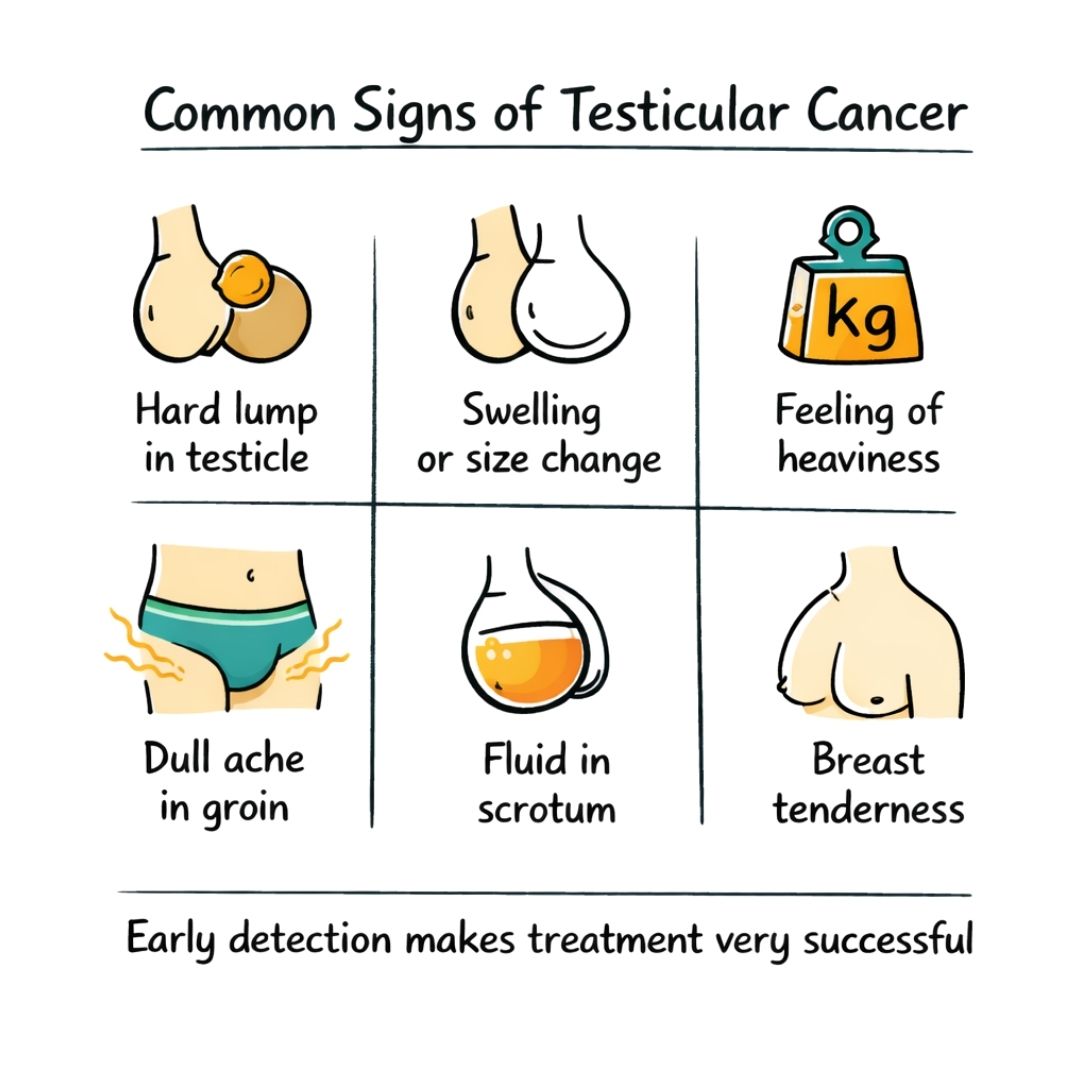
Beyond a distinct lump, other common symptoms involve changes to the whole testicle or scrotum. You might not feel a specific nodule, but instead, notice a more general change in size or sensation.
Scrotal Swelling: You may find that one testicle has become noticeably larger or more swollen than the other. While it's normal for one testicle to be slightly bigger or hang lower, a new and significant change in size is a red flag. This swelling can be a direct result of a tumour growing inside the testicle.
A Feeling of Heaviness: Another tell-tale symptom is a persistent feeling of weight or heaviness in the scrotum. Some men describe it as a dragging sensation. This can happen if a tumour adds mass to the testicle, or it could be due to a sudden collection of fluid (a hydrocele), which can sometimes accompany testicular cancer. This feeling of weight might be present even without any obvious swelling.
Knowing your own body is one of the most powerful things you can do for your health. A testicular self-exam is a quick and simple check you can do at home to get familiar with what’s normal for you. Once you know your baseline, it’s much easier to spot any changes, like new lumps or swelling, which are often the first signs of testicular cancer.
Think of it as a bit of routine maintenance, like checking the tyres on your car. It's a small habit that helps you catch potential issues before they become bigger problems. Making this a monthly check-in can bring you peace of mind and the confidence to take action if something ever feels off.
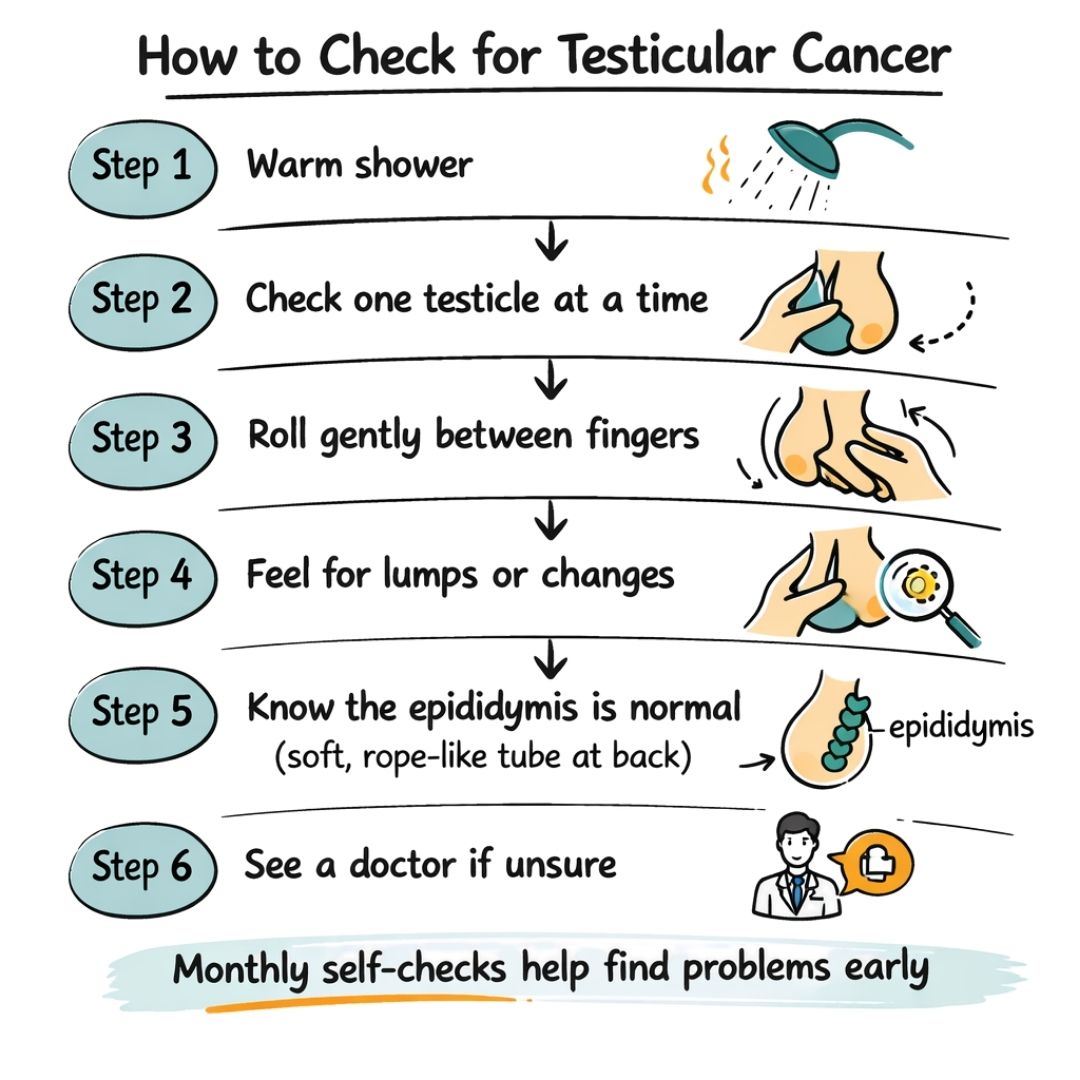
The best time for a self-exam is during or just after a warm bath or shower. The heat relaxes the scrotum, making the skin more pliable and the testicles easier to feel. This allows you to check for any irregularities without the skin getting in the way.
Try to do a check once a month. To make it a habit, pick a day that’s easy to remember, like the first day of the month. Consistency is what really matters here, as it helps you notice even subtle changes over time.
A self-exam only takes a minute or two. The key is to be gentle but thorough. Just follow these simple steps to check yourself correctly.
Examine One Testicle at a Time: It’s much easier to focus on one side at a time. If it helps, stand in front of a mirror to look for any visible changes on the scrotum itself, such as swelling or unusual redness.
Support and Roll: Use one hand to gently support your scrotum. With the thumb and fingers of your other hand, carefully roll the testicle between them. You’re aiming for a smooth, firm but gentle motion that covers the entire surface.
Feel for Changes: As you roll the testicle, you're feeling for any hard lumps, smooth round bumps, or any changes in the size, shape, or consistency. A healthy testicle should feel smooth and oval-shaped, and be fairly firm without feeling rock-hard.
A crucial part of the exam is learning to tell the difference between a normal structure and a potential lump. At the back of each testicle is a soft, rope-like tube called the epididymis. It can feel a bit lumpy and tender to the touch, but it’s a perfectly normal part of your anatomy. Getting to know it will stop you from mistaking it for something worrying.
By getting to know the feel of your testicles and epididymis, you establish what’s normal for you. Don't be surprised if one testicle is a bit larger or hangs lower than the other, that’s completely normal. For personal stories and more insights into navigating health checks, you might find our article about understanding your body and health helpful.
If you feel a hard lump, notice any swelling, or find another change that’s new or worrying, the next step is simple: book an appointment with your doctor. It’s completely natural to feel a bit of anxiety, but remember that most testicular lumps are not cancerous.
That said, only a doctor can figure out what’s going on. Acting quickly is the best thing you can do for your peace of mind and for getting the best possible outcome if any treatment is needed. This proactive approach is a huge reason why testicular cancer has become one of the most treatable forms of cancer.
In fact, one of the most reassuring statistics is that testicular cancer mortality rates have dropped significantly over the past few decades. This incredible success is directly linked to people recognising the symptoms early, seeking prompt medical attention, and receiving highly effective treatments. This progress really underscores why a monthly self-exam is such a vital habit for catching things early.
While we often think of testicular cancer as a painless lump, that’s not the whole story. Some symptoms are far more subtle and can show up in places you wouldn’t expect, making them easy to brush off as something else entirely.
Learning to recognise these less obvious signs is so important. They’re another way your body might be trying to tell you something is wrong, giving you a chance to catch things early.
Sometimes, the first sign isn't a sharp pain but a vague, persistent discomfort that seems disconnected from the testicles themselves.
A dull ache in the lower abdomen or groin is a key symptom to watch for. It might feel like a pulled muscle or just a nagging soreness that comes and goes, but there’s no clear reason for it.
Another sign can be a sudden collection of fluid in the scrotum, known as a hydrocele. This can cause swelling and a feeling of tightness. While hydroceles are often harmless, if one appears out of the blue or alongside other changes, it’s a definite reason to get it checked by a doctor.
Certain testicular tumours can actually produce hormones, throwing your body's natural chemistry out of balance. This can lead to some truly confusing symptoms that don't seem to have anything to do with your testicles.
One of the most surprising of these is breast tenderness or growth (gynaecomastia). Some tumours release a hormone called hCG (human chorionic gonadotropin), which can cause breast tissue to swell and feel sore.
Profound, unexplained fatigue is another potential red flag. This isn't just feeling tired after a busy week; it's a deep exhaustion that rest doesn’t seem to fix. It can have many causes, but it's sometimes linked to cancer-related issues like anaemia. If you're worried about this, you can learn more about the connection in our detailed guide on anaemia and cancer.
It's important to understand that your body might be sending you signals from unexpected places. Hormonal changes like breast growth or persistent, deep-seated fatigue can be early warnings. Listening to these subtler cues is just as important as checking for lumps.
In some instances, testicular cancer isn't caught right away. If it has time to spread (metastasise) to other parts of the body, the symptoms will be related to those new areas. While this is far less common, knowing the signs is vital.
Symptoms can evolve over time. For example, what started as a feeling of heaviness in the scrotum might progress to back pain as the cancer affects nearby lymph nodes. It’s a stark reminder of why early detection is so critical, especially as global testicular cancer incidence has been rising for several decades. The good news is that the survival rate is over 95%, but that incredible statistic depends on people acting on symptoms early.
When testicular cancer has spread, you might notice:
These advanced signs are serious and need immediate medical attention. But remember, they are not the norm. Testicular cancer remains one of the most treatable cancers, even when it’s found late. The most important thing is to act on any symptom, common or not, without delay.
So, you’ve done a self-exam and found a lump, some swelling, or another change that doesn't feel right. The next step is simple, but it’s also the most important one you can take: book an appointment with your doctor without delay.
It’s completely understandable to feel worried or even to hope it will just go away on its own. But ignoring a change won’t give you any answers. Taking action is the only way to get clarity and peace of mind, whether it turns out to be nothing serious or something that needs attention.

The thought of that first appointment can be nerve-wracking, but knowing what’s involved can help take some of the anxiety away. Your doctor's main goal is to listen to your concerns and do a quick physical check.
First, they’ll ask you some questions about what you've noticed – things like when you first felt the lump or how long you’ve had the discomfort. Then, they will perform a physical examination. This is a gentle process where they’ll feel your testicles and scrotum to check for any lumps, swelling, or unusual firmness.
The key message here is straightforward: any new lump, swelling, or persistent change in your testicles needs to be checked out by a professional. Waiting only allows potential problems to progress, whereas getting seen provides a clear path forward.
Your doctor might also check other areas, like your abdomen, just to be thorough. Think of this consultation as the essential first step in figuring out what’s going on.
If your doctor has any concerns after the physical exam, the next step is almost always a referral for a scrotal ultrasound. This scan is the most reliable way to get a clear picture of what’s happening inside your scrotum.
An ultrasound is a completely painless and non-invasive procedure. It works by using high-frequency sound waves to create a live image of your testicles. A technician will apply a cool gel to your scrotum and move a small, handheld probe over the skin.
This scan is incredibly useful and helps doctors:
Along with the ultrasound, your doctor will likely order some blood tests. These look for specific proteins called tumour markers, which are sometimes released into the bloodstream by testicular cancer cells.
The two main tumour markers they’ll be looking for are:
Raised levels of these markers can strongly suggest testicular cancer and even help pinpoint the specific type. It’s worth remembering that not all testicular cancers produce these markers, so a normal blood test doesn’t completely rule it out. But when you combine the blood test results with the ultrasound findings, you get a much clearer picture.
For those wanting to be proactive, discussing options like private cancer screening with a healthcare provider can be another part of your approach to health and early detection.
It’s completely normal to have questions swirling around your mind after learning about health symptoms. When it comes to testicular cancer, a few specific concerns tend to pop up again and again. This section is designed to tackle those common queries head-on, giving you straightforward answers from an expert perspective.
Our aim here is to add some much-needed clarity around topics like pain, age, and what else might be causing a lump. By addressing these points directly, we hope to leave you feeling more informed and confident about what to do next.
While the textbook sign of testicular cancer is a painless lump, it's a huge misconception that pain automatically rules it out. The reality is, for about one in five men, pain or discomfort is actually one of the very first things they notice.
This pain might feel like a sharp, sudden sensation or, more commonly, a persistent dull ache in the testicle, scrotum, or groin. Some men describe it as a nagging feeling of heaviness that just doesn’t seem to shift. It's also fairly common for a minor injury to the area to draw attention to a lump that was already there but hadn't been noticed, which can muddle the picture.
The most important thing to remember is this: never dismiss a lump or swelling just because it hurts. Pain is a valid symptom of testicular cancer for a significant number of men. Any ongoing ache or discomfort in your testicles is worth a conversation with your doctor.
Putting off a check-up because of a painful symptom could mean delaying a diagnosis. The presence of pain doesn't make a lump any less serious—it just adds another reason to get it looked at properly and promptly.
Finding a lump down there is bound to be unnerving, but it’s important to know that the vast majority of testicular lumps are not cancer. There are several benign (non-cancerous) conditions that can cause lumps, bumps, or swelling in the scrotum. The catch is that you can't tell them apart by feel alone, which is why a professional medical opinion is non-negotiable.
Here are some of the usual suspects for benign lumps:
Since there's no way to self-diagnose what’s causing a lump, the only safe move is to let a doctor examine it. They can figure out the cause, often with a quick and painless ultrasound, and either give you peace of mind or get you on the right path for treatment.
Yes, age is a very significant factor. Testicular cancer is quite unusual in the world of oncology because it predominantly affects younger men. Its peak incidence is between the ages of 15 and 49, which actually makes it the most common cancer for men in this age group in many countries.
However, and this is a crucial point, it doesn't mean older or younger men are completely in the clear. Testicular cancer can and does occur at any age, from infants right through to elderly men. While it's less common outside of that peak age bracket, it’s certainly not unheard of.
No matter your age, the golden rule is exactly the same: if you find a lump, swelling, or any other change that doesn’t go away, get it checked by a doctor. The principles of early detection apply to everyone. Acting fast is the key to successful outcomes, whether you're 25 or 65. To get a clearer picture of what follows a diagnosis, you can learn more about the journey through testicular cancer treatment in our detailed guide.
The short answer is as soon as possible. After finding a lump or noticing any other unusual change, make an appointment to see your doctor without delay. There is absolutely zero benefit to a 'wait and see' approach. It’s natural to feel anxious and hope it might just disappear on its own, but hesitation can have serious consequences if the cause does turn out to be cancer.
In many healthcare systems, like the NHS in the UK, there are urgent referral pathways for suspected cancer. This means if your doctor has even the slightest concern, you should be seen by a specialist within a very short timeframe.
Getting checked promptly does two things. First, if it's something benign, you get immediate reassurance and stop the worrying. Second, if it is cancer, you are on the fastest possible track to starting treatment, which gives you the best chance of a positive outcome. Taking swift action is the single most powerful thing you can do for your health.
We strongly advise you to talk with a health care professional about specific medical conditions and treatments.
The information on our site is meant to be helpful and educational but is not a substitute for medical advice.
Navigate your testicular cancer treatment with confidence. This guide explains surgery, chemotherapy, and surveillance to help you understand your path forward.
After Cancer In My Balls I Started An NGO To Encourage Lads To Put Their Hands In Their Pants, Check For Irregularities And Act Upon Them.