At its heart, cancer research is the global scientific quest to find better ways to prevent, diagnose, and treat cancer. It’s a relentless, ongoing process of discovery, all with one central aim: to turn a life-altering diagnosis into a manageable condition and, ultimately, save and improve lives.
Charting the Path to Progress
When you or a loved one is dealing with a cancer diagnosis, the world of medical science can feel incredibly remote and complicated. But the truth is, every single treatment plan, diagnostic scan, and piece of advice from an oncology team is built on the shoulders of decades of tireless research. This field isn’t about a single magic "cure"; it's a huge, collaborative mission to understand and outmanoeuvre one of medicine's most complex challenges.
Think of it as drawing a detailed map of a vast, unexplored land. Each study, whether in a lab dish or a hospital ward, adds a new landmark. It might chart a safer path or simply mark a dead end to warn others away. Some researchers are mapping the most basic terrain—figuring out exactly how a normal cell turns cancerous. Others are busy exploring new routes by designing therapies that zero in on a cancer’s unique weak spots.
Building Hope, One Step at a Time
Progress in cancer research rarely comes in a single, dramatic breakthrough. Instead, it’s about steady, incremental gains. Each new discovery builds on the last, forging a chain of knowledge that directly leads to better results for patients. For instance, once scientists understood the specific genetic mutations driving a particular tumour, they could create 'smart' drugs that attack those cancer cells while leaving healthy tissue alone.
These gradual steps have a huge real-world impact. Over the past 50 years, cancer death rates in the UK have fallen by more than a fifth (22%). That’s a powerful testament to this persistent, patient work. Even as diagnoses rise, this drop in mortality proves that research is working. For patients and their families, that's not just an abstract number; it means more birthdays, more holidays, and more precious time together.
Why This Matters for Your Journey
Getting to grips with the basics of cancer research can empower you to be a more active participant in your own care. It helps to demystify the language around treatment options, clinical trials, and the latest medical headlines you might see.
This knowledge gives you a solid foundation for:
Having more informed conversations with your doctors about your diagnosis and the plan ahead.
Making sense of news and information you come across online with a bit more clarity.
Understanding the science behind the care you receive, which can foster a sense of real, grounded hope.
"Every step forward in cancer research, no matter how small it seems, contributes to a larger map of understanding. This map guides doctors and gives hope to millions of patients, showing that we are constantly finding better ways to navigate this disease."
Ultimately, the goal isn't to find just one path forward, but to create many effective routes that extend lives and, just as crucially, improve the quality of those lives. Our guide to navigating cancer care research centres can offer more insight into where this vital work happens. This guide will walk you through the key concepts, helping you understand the entire process and its profound importance.
The Three Main Pathways of Cancer Research
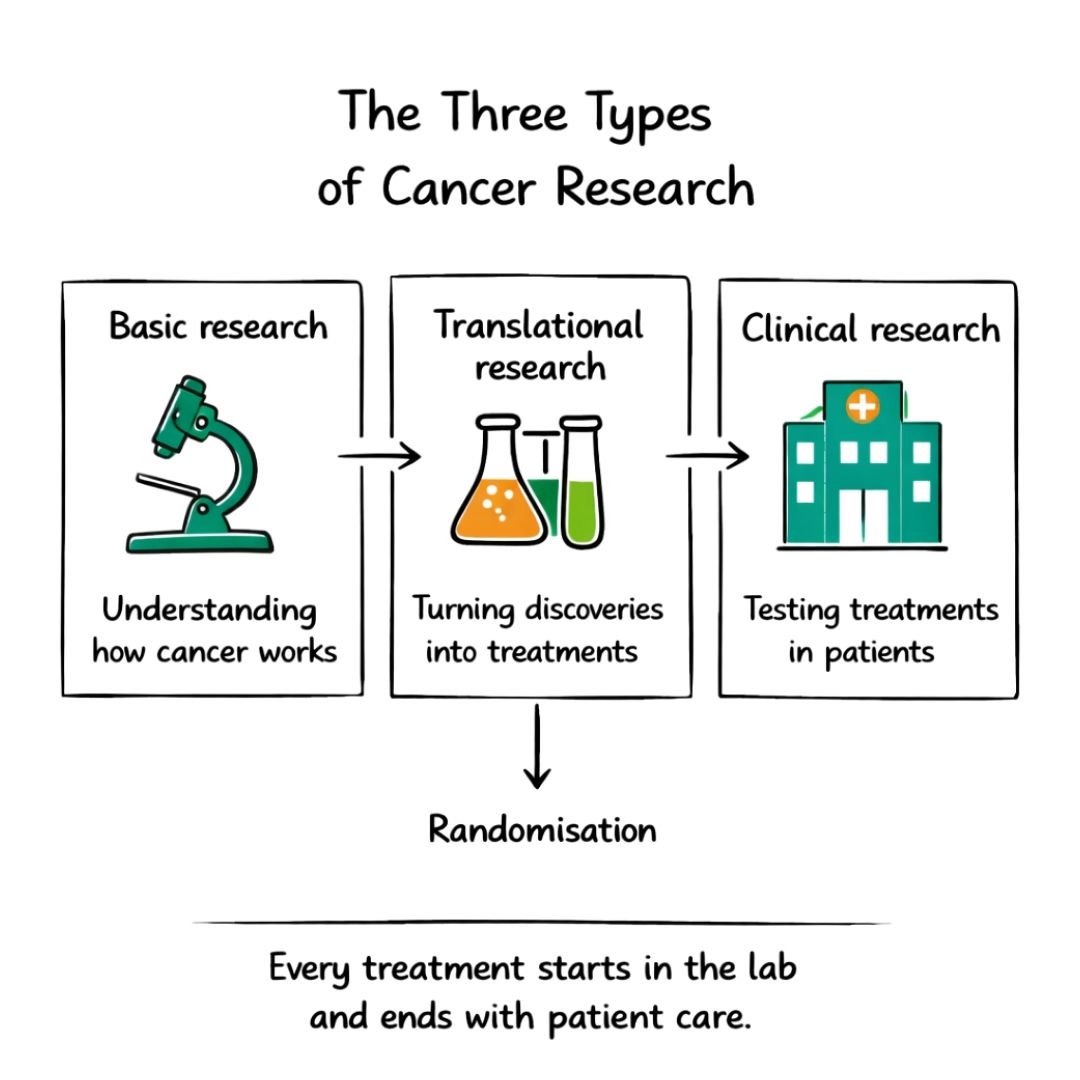
The journey from a promising idea buzzing in a laboratory to a life-changing treatment in a clinic is a long and carefully planned one. It's not a single leap, but a series of deliberate steps. To make sense of it, we can think of cancer research as following three main pathways, each one building on the last. This step-by-step approach ensures every new therapy is understood, tested, and proven to be both safe and effective before it reaches a patient.
You could think of it like developing a new recipe. First, you have to discover and understand your core ingredients. Then, you test them out in a controlled kitchen environment. Finally, you serve the dish to others to see if they like it and if it's genuinely better than what they’ve had before. These stages are what scientists call basic, translational, and clinical research.
The Three Pillars of Cancer Research
This table gives you a quick summary of the main types of cancer research, their primary goals, and where they typically take place, helping you grasp the key differences.
Type of Research
Primary Goal
Where It Happens
Basic
To understand the fundamental biology of cancer. It's about asking "why" and "how."
University laboratories and research institutes.
Translational
To "translate" basic discoveries into potential treatments that could be tested in people.
Research centres, often with links to hospitals.
Clinical
To test the safety and effectiveness of new treatments in volunteer patients.
Hospitals, clinics, and specialised cancer centres.
Each pillar is essential. Without the foundation of basic science, there would be no new ideas to test, and without rigorous clinical trials, we would never know which ideas truly work.
Basic Research: The Foundation of Discovery
This first stage is all about pure discovery. Basic research is the bedrock of all medical progress, where scientists work to understand the fundamental rules of biology. In the world of cancer, they’re tackling the most essential questions: What makes a healthy cell turn cancerous? How do cancer cells manage to grow, multiply, and spread? Why do some cells become resistant to treatment?
Think of it this way: a chef has just discovered a brand-new, exotic spice. Before they can even think about cooking with it, they need to understand its properties. What does it taste like? Is it spicy, sweet, or bitter? What other flavours does it complement? In the same way, basic researchers in a lab might discover a specific protein that seems to help a tumour grow. Their goal isn't to create a drug right away, but to understand that protein so thoroughly that others can build upon their work.
This foundational knowledge is absolutely crucial. Without it, we wouldn’t have many of the modern treatments we rely on today.
Translational Research: From Lab Bench to Bedside
The second pathway, translational research, acts as the vital bridge connecting the laboratory to the clinic. This is where scientists take those fascinating discoveries from basic research and start asking, "How can we turn this knowledge into something that could actually help a patient?" It’s the "test kitchen" phase of our recipe analogy.
Here, researchers might develop a new drug designed to block that cancer-fuelling protein identified earlier. They'll test it on cells grown in a dish and in animal models to see if it works as expected and, just as importantly, to check for any potential safety issues. This phase is all about translating a scientific idea into a practical, promising medical approach.
This bridge is where science meets application. It's the critical process of transforming a fundamental biological discovery into a potential treatment that is safe enough to be tested in people, ensuring that promising ideas don't just stay in the lab.
Clinical Research: Testing with People
Finally, we arrive at clinical research, where a potential new treatment is carefully evaluated in people. This stage is best known for its clinical trials. Sticking with our recipe analogy, this is the official taste test. You invite volunteers to try your new dish to find out if it is safe, effective, and truly an improvement on the current menu.
Clinical trials are meticulously organised into a series of phases, each with a different goal. Early phases focus on safety and finding the right dosage, while later phases compare the new treatment against existing ones in larger groups of people. This rigorous process, which can take many years, is the final and most important step to prove that a new therapy genuinely helps patients.
Groundbreaking tools are now helping to personalise treatments like chemotherapy, which you can learn more about in our article on decoding DNA for personalised chemotherapy. Each successful trial represents a major victory in the collective fight against cancer.
How Scientists Design Trustworthy Studies
When a news headline announces a promising new cancer treatment, it’s natural to feel a surge of hope. But it’s also wise to ask, "How do we know this is real?" The answer lies in the careful, methodical way scientists design their studies.
A well-designed study is the difference between a real breakthrough and a false alarm. It ensures that progress is built on solid evidence, not just wishful thinking.
To get reliable answers, researchers must be as objective as possible. This means designing experiments that prevent bias, both conscious and unconscious, from skewing the results. Think of it like a judge who must hear all the evidence impartially before reaching a verdict. Scientists use specific, rigorous techniques to make sure their findings are fair, accurate, and trustworthy.
In their quest for robust data, scientists are increasingly using advanced tools, like an AI agent specifically designed for medical research, to help navigate complex information and spot key trends. These methods are the gold standard for creating reliable medical knowledge.
Observational versus Interventional Studies
The first major distinction to grasp is between watching and doing. This is the core difference between observational and interventional studies.
Observational Studies are like being a detective gathering clues at a scene. Researchers observe groups of people and collect data without stepping in to change anything. For example, they might track the health of thousands of people over many years to see if those with a certain diet are more or less likely to develop a particular cancer. This kind of research is brilliant for finding links and potential risk factors.
Interventional Studies, better known as clinical trials, are more like conducting a direct experiment. Here, researchers actively introduce an "intervention"—a new drug, surgical technique, or type of radiotherapy—to a group of participants to see what effect it has. This is the most direct way to determine if a new treatment is both effective and safe.
While both types are valuable, interventional studies provide the strongest evidence for whether a treatment actually works. You can find out more about the behind-the-scenes processes supporting these studies by exploring the role of laboratory medicine in cancer care.
The Key Ingredients of a Strong Clinical Trial
To ensure their results can be trusted, scientists build specific safeguards into their interventional studies. You'll often hear these terms when reading about new cancer research, and understanding them helps you spot high-quality science.
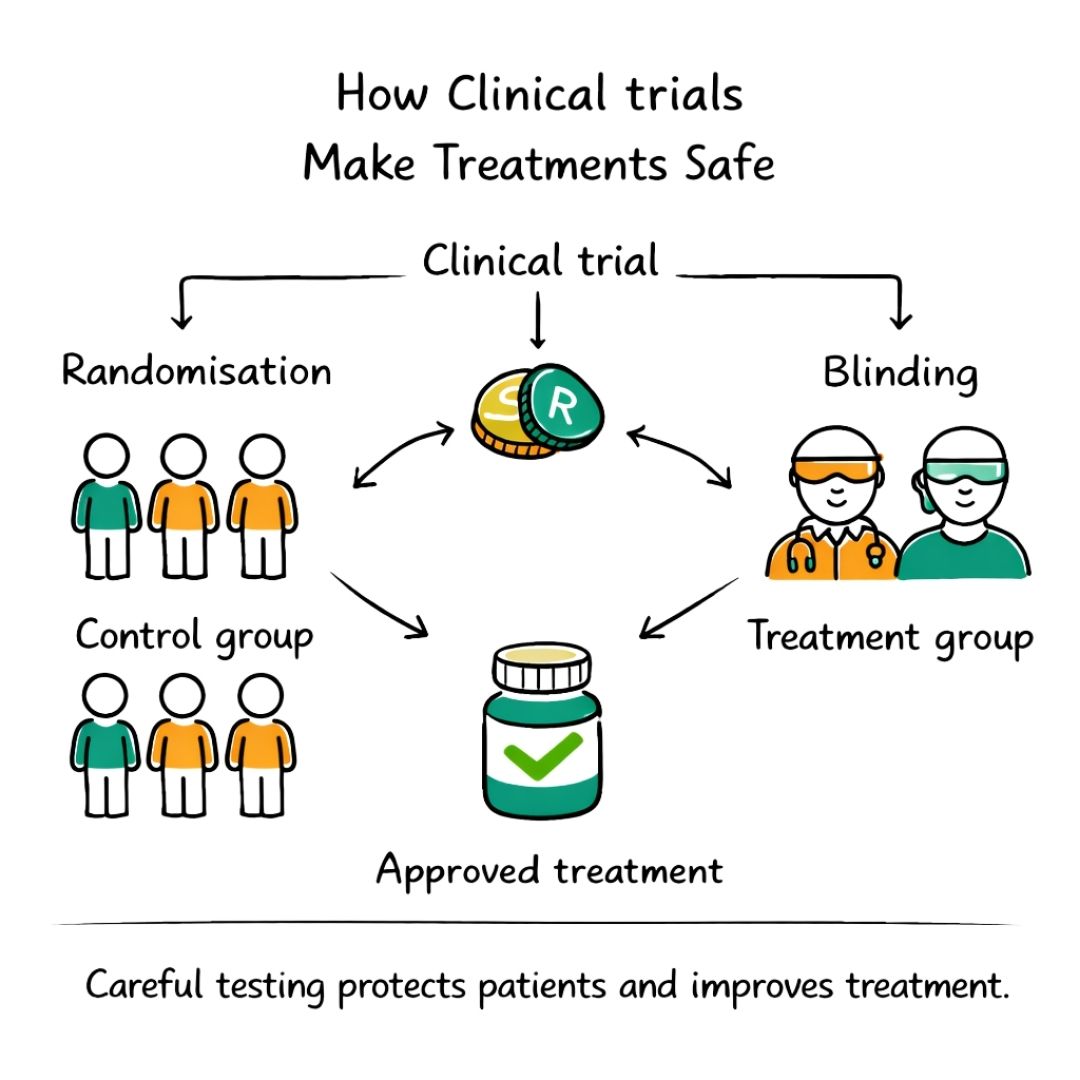
Control Groups are absolutely essential for comparison. Imagine you want to know if a new fertiliser helps plants grow taller. You couldn't just use it on one plant; you’d need a second, identical plant that doesn't get the fertiliser. This second plant is your control group. In cancer research, a control group receives the current standard treatment (or a placebo, if no standard exists) so scientists can measure the new treatment against it to see if it truly performs better.
A control group is the scientific measuring stick. Without it, researchers can’t tell if a patient's improvement is due to the new treatment, the existing standard of care, or simply chance.
Randomisation is all about assigning participants to different groups (like the treatment group or control group) by chance, much like flipping a coin. This prevents bias. If researchers could choose who gets the new treatment, they might subconsciously pick patients they believe will have the best outcomes, which would completely skew the results. Randomisation makes sure the groups are as similar as possible right from the start.
Blinding is another clever technique to stop bias from creeping in. In a single-blind study, the participants don’t know which treatment they are receiving. In a double-blind study, the gold standard, neither the participants nor the researchers interacting with them know who is in which group. This stops anyone's expectations from influencing the outcomes.
This methodical approach ensures that when a study shows a positive result, we can rely on it. These principles help explain why we see continuous, real-world improvements in patient outcomes.
For instance, according to recent statistics from England, breast cancer incidence was at 167.9 per 100,000. Despite these rising numbers, mortality rates have improved, with breast cancer deaths falling from 41.5 to 34.1 per 100,000. That’s a clear sign that trustworthy research and better screening are saving lives. You can find more detail on these trends and read the full report from the Office for National Statistics.
Exciting Advances Changing Cancer Treatment Today
The world of cancer research is buzzing with progress, turning discoveries made in the lab into real, life-changing treatments for patients. It’s not always about one giant leap; often, it’s a series of steady, thoughtful steps forward. Right now, though, several areas are making a huge impact, fundamentally changing how we think about and treat cancer.
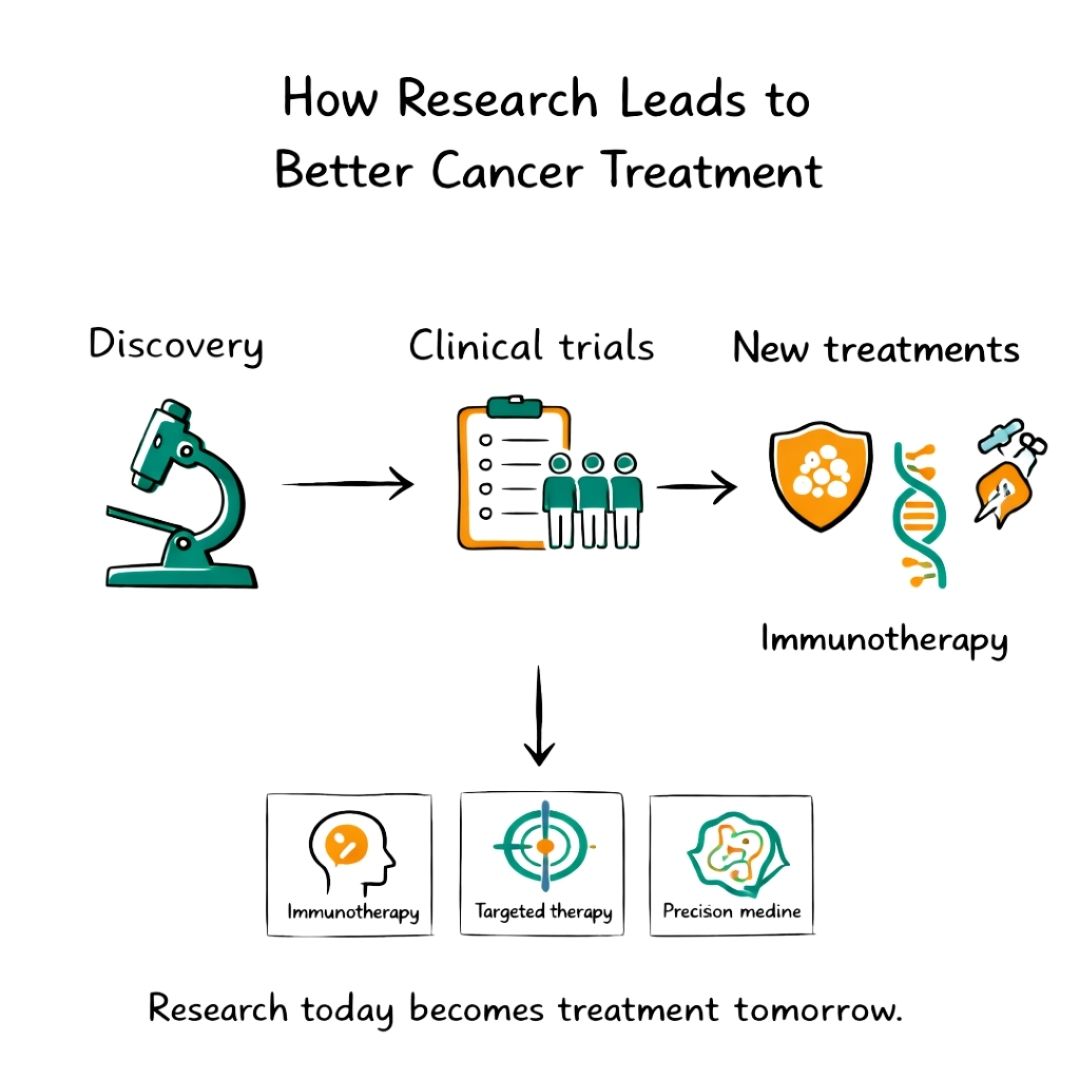
We’re moving beyond theory and into smarter, more effective therapies that are reshaping patient care. Three of the most exciting frontiers are immunotherapy, targeted therapy, and precision medicine. Each one represents a shift away from older, one-size-fits-all methods towards strategies that are far more personal and intelligent.
Immunotherapy: Training Your Body to Fight
One of the most remarkable breakthroughs in recent memory has been immunotherapy. Instead of using drugs to poison cancer cells directly, this approach cleverly harnesses the power of your own body. It essentially re-energises your immune system to do the job it was meant to do.
Think of your immune system as a dedicated security team, always on patrol for threats. The problem is, cancer cells can be masters of disguise, finding ways to hide in plain sight. Immunotherapy acts like an updated intelligence briefing, giving your security team the information it needs to spot and attack these hidden cancer cells.
"Immunotherapy has fundamentally changed the outlook for many types of cancer. By unleashing the power of a patient's own immune system, we are seeing long-lasting responses in cancers that were once very difficult to treat."
Drugs known as checkpoint inhibitors are a great example of this. They work by "taking the brakes off" the immune cells, freeing them up to launch a full-scale, sustained attack on tumours. This has been a genuine game-changer for people with certain types of melanoma, lung cancer, and many others.
Targeted Therapy: A Smart Key for Cancer Cells
Traditional chemotherapy can be a bit of a blunt instrument, it's often effective, but it can harm healthy cells in the process. Targeted therapy is different; it's much more precise. You can think of it as a smart key designed to fit a very specific lock found only on cancer cells.
First, scientists identify what makes cancer cells unique, like certain proteins or genetic mutations that fuel their growth. Then, they create drugs that home in on these specific targets, disrupting the cancer's ability to function while leaving most of your healthy cells alone.
Because of this precision, targeted therapies often come with fewer side effects than conventional chemotherapy. This approach has led to incredible progress in treating cancers with known genetic drivers, including certain types of breast cancer, lung cancer, and leukaemia.
Precision Medicine: The Ultimate Personalised Approach
Precision medicine takes the idea of targeted therapy one step further to create a truly bespoke treatment plan. It’s built on the understanding that every person—and every cancer—is unique right down to the molecular level. This approach involves analysing the genetic profile of a patient's tumour to pinpoint its exact weaknesses.
Armed with this detailed genetic map, doctors can select treatments that are most likely to work for that specific individual. This might mean choosing a targeted drug known to be effective against a particular mutation or identifying that someone is an ideal candidate for immunotherapy.
This tailored strategy helps move cancer treatment away from a trial-and-error process and towards a more evidence-based, individualised plan from day one. As our understanding of cancer genetics deepens, precision medicine is quickly becoming a cornerstone of modern cancer care.
These exciting fields are constantly developing, fuelled by dedicated cancer research. To learn more about how science is pushing these boundaries, you might find our article on the role of technology in modern cancer research interesting. These advances are a powerful reminder of how far we've come and offer real hope for the future of cancer treatment.
How You Can Contribute to Medical Progress
Every single advance we see in cancer care is built on the contributions of countless people who chose to take part in research. If you're feeling a pull to get involved, you should know there are some very real, practical ways to play a part in shaping the future of treatment.
Let's walk through two of the most powerful opportunities available: joining a clinical trial and donating to a research biobank. It's a deeply personal decision, of course, but understanding what's involved is the first step to making a choice that feels right for you.
Partnering with Science Through Clinical Trials
Joining a clinical trial is one of the most direct ways you can help move medicine forward. Participants are, quite simply, essential partners. They help researchers figure out if new treatments are safe, if they work, and if they’re better than what we currently have.
Every single trial is meticulously planned and has to pass a strict ethical review before anyone can enrol. Patient safety is always, without exception, the top priority. If you’re thinking about this, the most important thing is to have a completely open chat with your healthcare team.
They can help you make sense of what a specific trial involves and whether it might be a good fit for your situation. Reading up on future cancer treatments can also give you a better feel for the kinds of studies that are happening right now.
Before you decide anything, make sure you get clear answers to these key questions:
What is the main goal of this study? Knowing the purpose helps you see how your contribution fits into the bigger picture.
What are the potential risks and benefits for me? Your doctor should lay out all possible outcomes, good and bad, with total transparency.
How will this affect my daily life? Ask about the practical stuff – how many hospital visits, how long it lasts, and any side effects you might expect.
Can I leave the trial if I change my mind? Absolutely. You always have the right to withdraw from a study at any time, for any reason.
"Clinical trial volunteers are heroes of modern medicine. Their participation is a generous act that provides the vital evidence needed to improve treatments for today's patients and all who will come after them."
The need for this kind of partnership has never been greater. For men in Great Britain born after 1960, the lifetime risk of cancer is now 53.5% (more than 1 in 2), and for women, it’s 47.5%. This rise is partly due to people living longer and better diagnostics, with experts predicting a significant increase in new cancer cases in the coming years. These numbers really highlight why patient participation is so vital for developing better treatments. If you're interested, you can read the full research about these cancer risk projections to get a deeper understanding.
The Power of Biobanks: Tissue and Data Donation
Another incredibly valuable way to support cancer research is by donating to a biobank. Think of a biobank as a library, but instead of books, it stores biological samples like tissue, blood, or saliva for future scientific study.
Often, samples left over from a routine procedure like a biopsy or surgery can be donated with your consent. These donations are typically made anonymous to protect your privacy and provide researchers with the raw materials they desperately need to make new discoveries.
By studying these samples, scientists can learn more about the genetic and molecular nuts and bolts of cancer. This work helps them identify new drug targets and develop better diagnostic tests. A single donation can end up supporting dozens of different research projects for years, making it an incredibly powerful and lasting contribution. If this sounds like something you'd like to do, have a word with your care team about local opportunities for tissue donation.
Your Cancer Research Questions Answered
When you or someone you love is navigating a cancer diagnosis, the world of research can feel both hopeful and overwhelming. It's only natural to have questions. Let's walk through some of the most common ones to help clear things up and build your confidence in the science behind cancer care.
How Can I Tell If a Cancer Study Is Reliable?
First, always check the source. Solid, trustworthy information about cancer research will almost always come from major cancer charities, university medical centres, government health bodies, or respected, peer-reviewed scientific journals.
Be wary of flashy headlines that promise a "miracle cure." Real scientific progress is usually a story of small, steady steps forward, not one giant leap. The best thing you can do is bring any study or article you find to your oncology team. They have the training to see the bigger picture and can explain what it might mean for you, if anything.
Are Clinical Trials a Safe Option?
Patient safety is, without question, the number one priority in any clinical trial. Before a single person can enrol, the study plan has to pass a strict ethical review by an independent board. Their entire job is to make sure any potential risks are as low as possible and are balanced by the potential benefits.
Throughout a trial, you're monitored incredibly closely by a dedicated medical team. You'll also go through a very thorough "informed consent" process, where every detail of the study is laid out for you, the good and the bad. And remember, you can choose to leave a trial at any time, for any reason, and it won't impact your standard care.
A clinical trial is a carefully controlled partnership between researchers and patient volunteers. The entire structure is built around a primary commitment to participant safety, with multiple layers of oversight to protect the people who make medical progress possible.
Why Does It Take So Long for New Treatments to Become Available?
The journey from a lab discovery to a standard treatment is a long and careful one, and for very good reason: we have to be sure a new treatment is both safe and actually effective. Any promising therapy has to prove itself across several clinical trial phases.
Early-phase trials are small, focusing on safety and finding the right dose. Later, much larger trials involve hundreds or even thousands of patients to confirm the new treatment is a genuine improvement over what we already have. This process can easily take many years, but it’s the only way to protect patients and ensure that every new approved treatment is a real step forward.
Can I Help Research Without Joining a Clinical Trial?
Absolutely. There are many vital ways to contribute to cancer research that don't involve testing a new treatment. A common and incredibly helpful option is allowing leftover tissue from a biopsy or surgery to be stored in a "biobank" for researchers to study. These samples are a priceless resource.
You could also take part in studies that use questionnaires to explore things like lifestyle factors or the patient experience. And of course, supporting reputable cancer research charities through donations or fundraising is another powerful way to fuel the science that helps everyone touched by cancer.
We strongly advise you to talk with a health care professional about specific medical conditions and treatments. The information on our site is meant to be helpful and educational but is not a substitute for medical advice.
Written by Cancer Care Parcel
In a world full of conflicting and sometimes misleading information about cancer, Cancer Care Parcel stands out by offering resources backed by solid facts. Funded entirely by the sale of our products and donations, we ensure that every resource on our site is accurate, trustworthy, and focused on supporting the cancer community.
Luis A. Gomez-Sarosi discusses how cancer therapies interact with cancer and non-cancerous cells and the development of early cancer detection methods.