Coping with a cancer diagnosis isn't about immediately finding answers or making a grand plan. It starts with something much quieter and, frankly, much more important: giving yourself permission to feel whatever you’re feeling, without any judgement.
Hearing the words "you have cancer" can feel like the world has suddenly stopped turning. It’s a profoundly personal and often shattering experience that can unleash a torrent of emotions, from shock and disbelief to intense fear and anger. And everyone responds differently.
In those first few hours and days, it’s crucial to remember that there is no ‘right’ or ‘wrong’ way to react. You don’t need to have everything figured out. The pressure to "be strong," to know what comes next, or to put on a brave face for everyone else can feel immense. The kindest and most helpful thing you can do for yourself is to show yourself some grace. This isn't the time for big decisions; it’s about carving out a small pocket of calm in the middle of a storm.
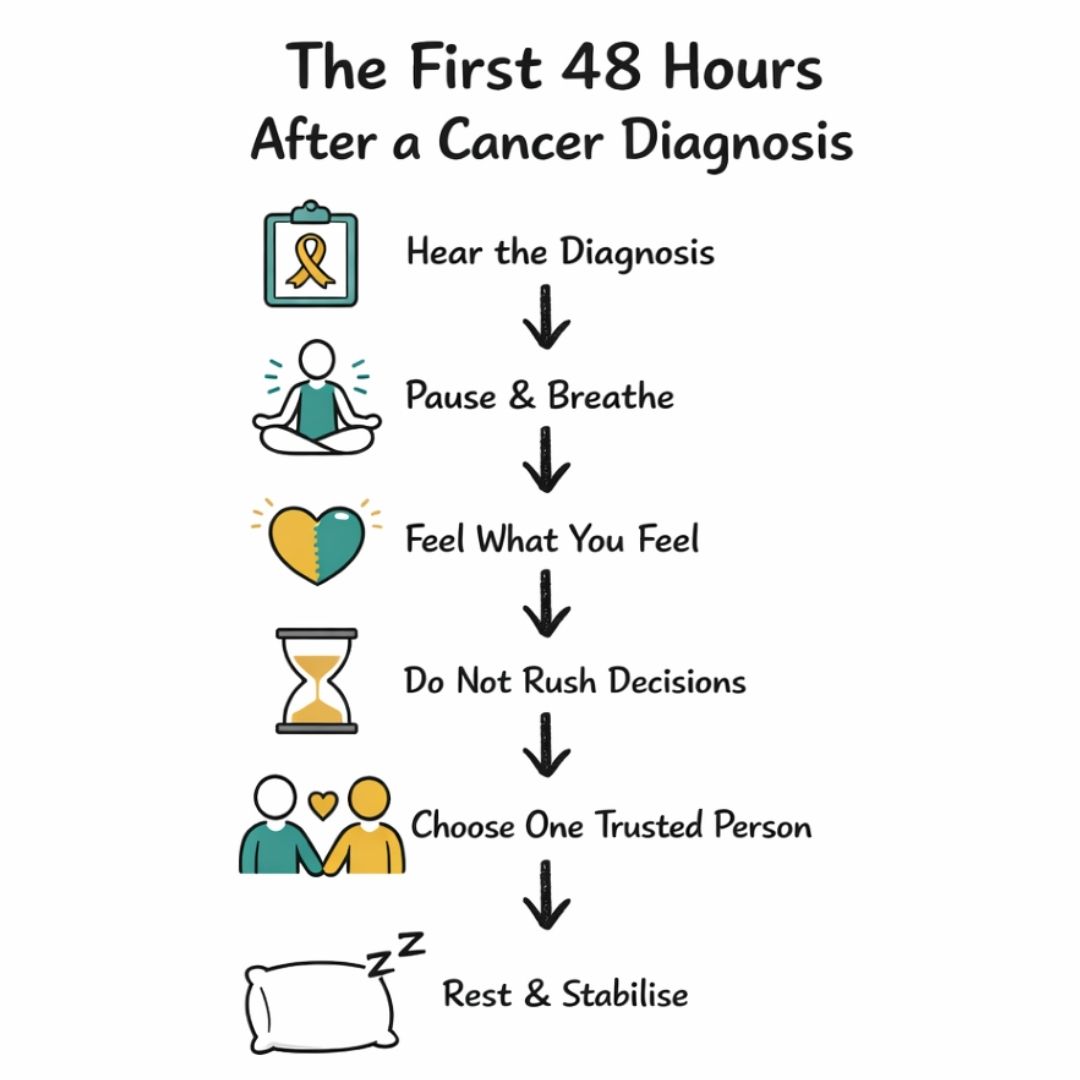
Try to think of this initial period as a time for emotional first aid. The goal isn't to map out the entire journey ahead but simply to steady yourself for the first few steps. Sometimes, rushing into research or trying to plan can make that feeling of being overwhelmed even worse. Instead, it’s often better to focus on small, grounding actions that help you regain a sense of control.
As the diagram shows, coping often begins not with a flurry of activity, but with a moment of stillness. It’s about giving yourself a chance to process before you feel you have to move forward.
When you're reeling from the shock of a diagnosis, having a simple, practical framework can feel like a lifeline. The table below outlines a few immediate actions you can take to manage those first overwhelming feelings.
| Action | Purpose | Simple First Step |
|---|---|---|
| Pause & Breathe | To calm your nervous system and create a moment of stillness. | Take three slow, deep breaths. Focus only on the air moving in and out. |
| Acknowledge Feelings | To validate your emotional response without judgement. | Say to yourself, "It's okay to feel scared/angry/confused." |
| Ground Yourself | To reconnect with the present moment and reduce feelings of panic. | Press your feet firmly on the floor. Notice the sensation. |
| Limit Information | To prevent information overload and increased anxiety. | Decide not to Google anything about your diagnosis for the next 24 hours. |
| Reach Out Selectively | To get immediate support without feeling overwhelmed by others' reactions. | Choose just one trusted person to call or message. |
This isn't a checklist you have to complete, but rather a set of tools you can turn to when you don't know what else to do. Each small action is a step toward regaining your balance.
Your mind is likely a whirlwind of thoughts and questions right now, and that is completely normal. Coping is a process, not a destination, and it starts with small, manageable steps.
Here are a few gentle actions to consider in these early days:
Coping with a cancer diagnosis is not a test of your strength. It is an exercise in self-compassion. The most courageous thing you can do right now is to be kind to yourself and take the time you need.
Remember, the only goal in these early moments is to get through them. Each quiet minute you give yourself is a building block for the resilience you'll draw on later. You are not alone in this, and taking it one day, or even one breath, at a time is more than enough.
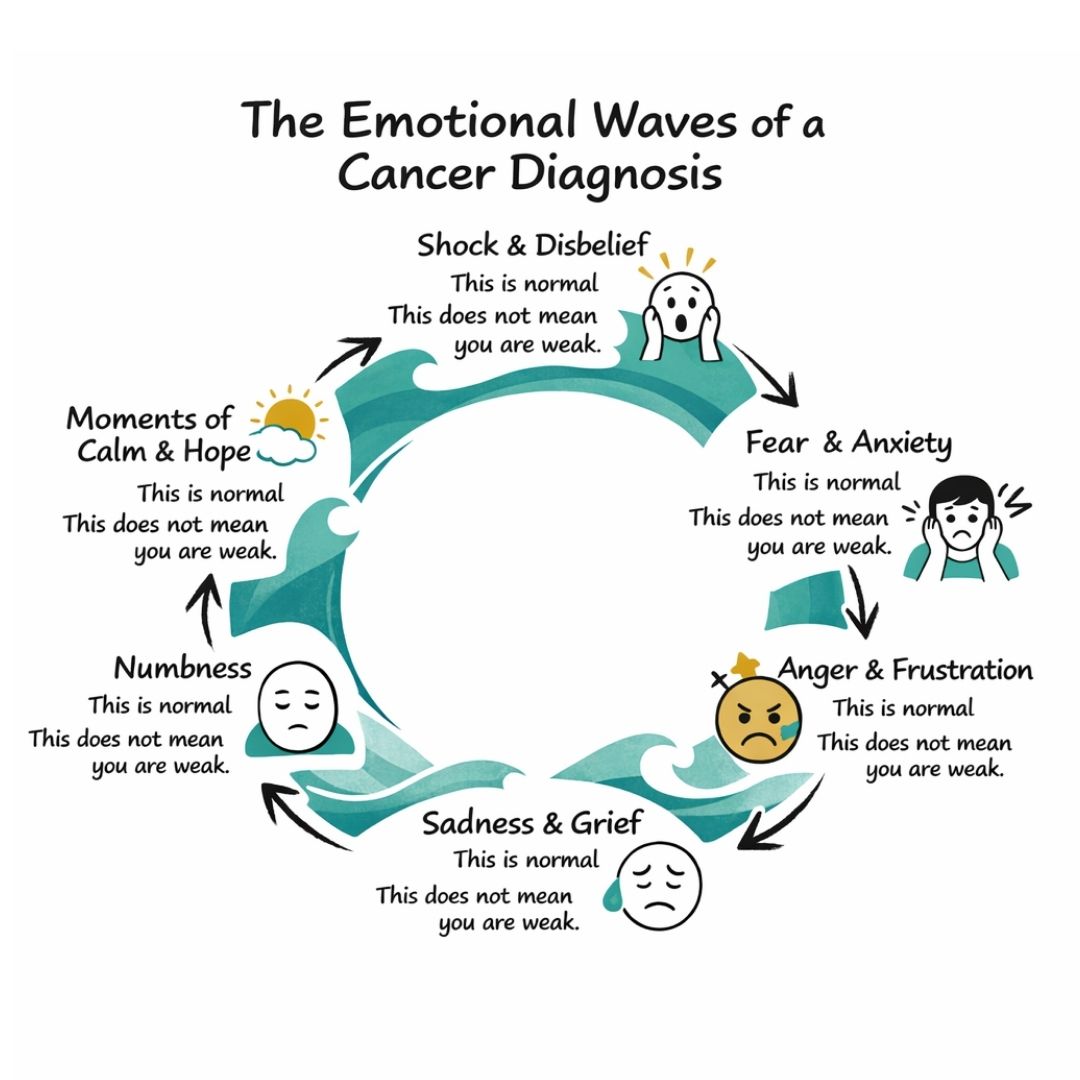
The journey through cancer is as much an emotional one as it is physical. Once the initial shock of a diagnosis begins to wear off, you might find yourself navigating a sea of complex, often contradictory feelings. One moment you could feel a surge of anger, the next a profound sadness, and then suddenly, a strange sense of numbness.
It’s so important to know that this emotional rollercoaster isn’t a sign of weakness. It’s a completely normal and human response to a life-altering event.
Think of it like being caught in a stormy sea. The waves of emotion are powerful and unpredictable, but they're a natural part of the weather system you're in. The goal isn't to stop the waves, but to learn how to stay afloat until the waters calm. Simply recognising and accepting these feelings without judging yourself is the first, most crucial step toward building resilience for the path ahead.
This is a challenge faced by thousands. Globally, millions of new cancer cases are diagnosed each year, and the emotional toll is significant. Research suggests that up to 40% of patients experience anxiety or depression. Thankfully, support systems have grown in response, with national health services and various charities now providing specialist counsellors and resources to help people manage the stress and fear a diagnosis can bring.
Your emotional landscape after a diagnosis can feel unfamiliar and overwhelming. Let's gently explore some of the most common feelings you might encounter and why they are a completely valid part of your experience.
Understanding where these feelings come from can help to demystify them. For a deeper dive, you can read our guide on the emotional impact of cancer, which offers more context on why these reactions happen.
You don’t need complicated psychological tools to start making sense of your emotional world. A simple practice often called "Name It to Tame It" can be incredibly effective. It’s a gentle way of acknowledging your feelings without letting them take over.
Here’s how to try it:
This simple act of naming creates a small space between you and the emotion. It helps you see that you are not your anger or your fear; you are the person experiencing these feelings, and they will pass.
By practising this, you begin to change your relationship with your emotions. Instead of being pulled under by the waves, you start to learn how to observe them from a place of greater calm. This self-awareness isn't about fixing or getting rid of your feelings, but about holding them with compassion. It is a foundational skill in coping with a cancer diagnosis and a powerful way to reclaim a sense of inner stability, one feeling at a time.
Just as cancer treatment is tailored to you, your way of coping needs to be just as personal. It’s time to move beyond generic advice and start assembling what I call a ‘coping toolkit’—a collection of practical, proven strategies you can reach for whenever you need them.
Think of it like putting together a first-aid kit for your emotional health. You won't use every single tool every day, but simply knowing they’re there can bring a profound sense of security and control back into your life. The real goal is to discover what genuinely works for you and create a go-to set of resources that support both your mind and body.
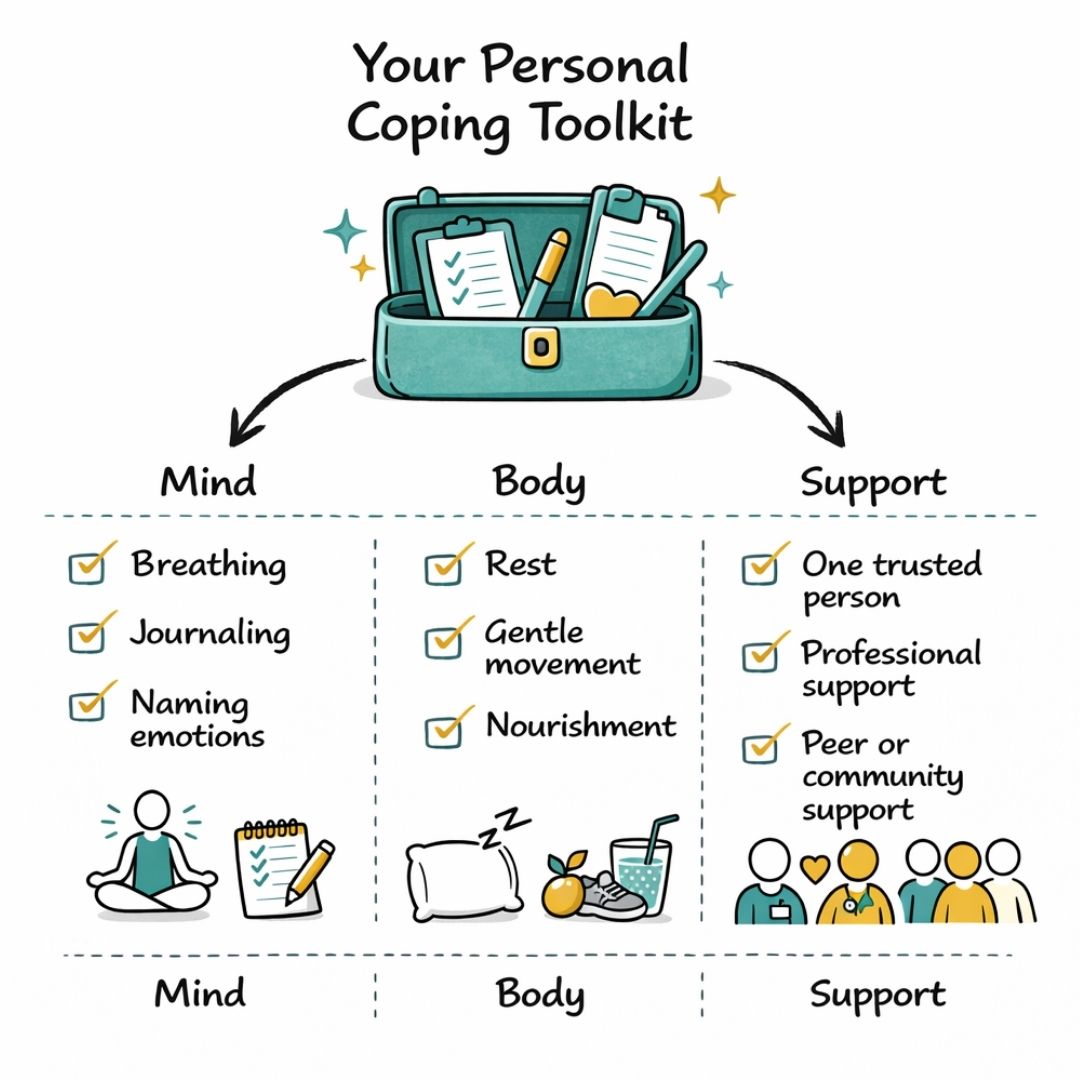
When you’re navigating a cancer diagnosis, your mind can feel like it’s constantly racing, stuck in overdrive. The good news is that simple, accessible practices can act as an anchor, pulling you back to the present moment and calming that internal storm. These techniques don't need any special equipment, just a little bit of your time and a willingness to try.
One of the most powerful tools is mindful breathing. This isn't just about taking a big sigh; it’s about intentionally focusing your full attention on the physical sensation of air entering and leaving your body. That simple act can slow your heart rate and quieten those rising feelings of panic, giving you a quick, effective way to reset.
Another fantastic tool is journaling. You absolutely do not need to be a writer to get something out of this. Writing things down gives you a completely private, judgement-free space to untangle the messy web of thoughts and feelings a diagnosis can create. It can help you pinpoint specific fears, work through anger, or even notice small moments of gratitude. It's really just a conversation with yourself on paper.
"Survival really does feel like a creative act for me, and journaling is just one of the ways that I’ve found my way through it." - Suleika Jaouad, author and cancer survivor.
These practices aren't about trying to get rid of stress completely—that's an impossible task. They're about learning to manage its intensity. Building a solid personal coping toolkit is crucial, and exploring different coping strategies for stress can help you discover what feels right for you.
Coping with cancer isn’t just a mental game; it’s also about looking after yourself physically. Your body is working incredibly hard, and supporting it with gentle self-care can make a huge difference to your emotional resilience and how you feel day-to-day.
Gentle movement is a brilliant place to start. This doesn't mean you have to suddenly start training for a marathon. It could be a short, slow walk around the garden, a few simple stretches first thing in the morning, or even some chair yoga. Movement releases endorphins, helps with fatigue, and can be a powerful emotional release. The key is to listen to your body and do what feels good, not what you think you should be doing.
Here are a few other ways you can support your physical well-being:
For a more structured approach, you might find it helpful to explore our guide on specific cancer psychological tools designed to help you weave these practices into your daily life.
A cancer diagnosis can feel like it has taken over every part of your life. One of the most powerful things you can do is intentionally carve out space for activities that remind you of who you are outside of being a patient.
This means making time, however little, for hobbies and interests you enjoyed before. It could be listening to music, pottering in the garden, painting, or just watching your favourite film again. These aren't frivolous distractions; they are vital for holding onto your sense of self and giving your mind a much-needed break from the world of appointments and treatments.
By actively choosing to do these things, you're reclaiming a piece of your life. You are exercising control over your own time and focus. That act of making your own choices, no matter how small they seem, can be incredibly empowering and is a crucial part of your coping toolkit.
Talking about your cancer diagnosis can feel just as overwhelming as hearing the news yourself. It’s often one of the toughest parts of the journey, demanding huge emotional energy right when your own reserves are at their lowest.
Here, we want to give you a practical guide for sharing your news, communicating your needs, and setting boundaries with the people who matter most. The aim is to give you tools that protect your well-being and help you build a support system that actually supports you, rather than adding to your stress.
Let's be clear: there is no single "right" way to tell people you have cancer. The most important thing is to do it in a way that feels manageable and right for you. You are in the driver's seat—you decide who you tell, when you tell them, and how much you want to share.
It can be helpful to first think about who needs to know straight away and who can wait. Many people find it easier to start with one or two trusted individuals. They can become your inner circle, and can even help you share the news more widely if you choose, saving you from having the same draining conversation again and again.
Here are a few simple ways you could start that conversation:
Once you start sharing your news, you'll find that people react in all sorts of ways. Most people mean well, but their responses—from overwhelming pity to a flood of unsolicited advice—can sometimes be more draining than helpful.
This is where setting clear, kind boundaries becomes a vital act of self-care. It isn't rude; it's absolutely necessary for preserving your emotional and physical energy for your treatment and recovery.
A boundary is simply a line you draw to protect your own well-being. It teaches others how to support you in a way that truly helps, rather than harms, your state of mind.
Think of it as putting up a gentle fence, not a solid wall. You’re not trying to push people away; you’re just guiding them on how to best be there for you. Learning to handle these interactions is a real skill, and we explore more strategies for navigating difficult conversations during cancer in our dedicated guide.
How many times have you heard, "Let me know if you need anything"? While well-intentioned, this vague offer puts the work back on you to figure out what you need and then find the courage to ask for it.
One of the most powerful things you can do is to get specific. People often genuinely want to help but simply don't know how. By giving them clear, practical tasks, you make it much easier for them to show their support in a meaningful way.
Take a moment to think about what would honestly make your life a little easier right now.
By clearly communicating your needs, you turn those vague offers into real, tangible support. This doesn't just lighten your load; it also strengthens your relationships by allowing your loved ones to feel they are contributing in a way that truly matters.
You absolutely do not have to go through this alone. In fact, one of the most powerful and proactive things you can do right now is to reach out for help. Building a support system isn't about admitting you can't cope; it's about recognising your own strength and gathering the people and resources you need to face what's ahead.
This section is here to help you make sense of the different kinds of support out there. We’ll look at everything from professional psychological services to the incredible comfort that comes from talking to people who just get it. Knowing who to turn to and how to find them is a vital part of your toolkit for coping with cancer.
Often, the best place to start is with the healthcare team you already know. Beyond your oncologist or surgeon, most hospitals have professionals on staff whose entire job is to help you with the wider, non-medical impact of a cancer diagnosis. These are the people you can rely on for trusted guidance.
Never feel hesitant to ask your doctor or anyone on your cancer care team for a referral. Getting this kind of professional support is a key part of your overall treatment plan, designed to look after your emotional wellbeing just as carefully as your physical health.
While your medical team provides crucial expertise, there's a unique and profound comfort that only comes from connecting with others who are walking a similar path. Peer support groups offer a space where you don’t have to waste energy explaining yourself, because everyone else in the room already understands.
These groups take all sorts of forms. You can find them online, in local community halls, and everywhere in between. Some are for anyone with cancer, while others are very specific, focusing on a certain type of cancer, an age group, or even a particular stage of treatment. This shared experience creates a powerful bond that can massively reduce feelings of isolation.
Connecting with peers who truly understand what you're going through can validate your feelings in a way nothing else can. It’s a powerful reminder that while your journey is your own, you are not on it by yourself.
As you look for a group, it can be helpful to know what makes a supportive community tick. You can find some useful insights into building a thriving online community that might guide you in finding the right fit for you.
Sadly, we know that access to support isn't always equal. Socioeconomic factors can play a significant role in how people cope with a cancer diagnosis, creating stark inequalities. For instance, research in some countries shows that people living in more deprived areas can face higher cancer death rates than those in the least deprived areas. This is often down to unequal access to early diagnosis and care, which makes the challenge of coping that much harder. You can learn more about the work being done to tackle these health inequalities from research by Cancer Research UK.
Beyond national health services and peer groups, a huge number of charities worldwide are dedicated to helping people affected by cancer. These organisations offer a massive range of services—often completely free—that cover your emotional, practical, and financial needs.
Here are just a few of the things they can often help with:
Organisations like Macmillan Cancer Support in the UK or the American Cancer Society in the US are fantastic places to start. Building your support system is all about creating a network that fits your specific needs, making sure you feel held and understood from every possible angle.
Getting through cancer treatment is one thing, but learning how to look towards tomorrow is another challenge entirely. It’s about more than just surviving the difficult days; it’s about actively cultivating hope and finding a new sense of meaning.
This process isn’t about pretending your reality hasn't changed. Instead, it’s about choosing to build a rich, meaningful life right alongside the challenges you’re facing. It’s a gentle shift in focus, moving from what you feel you've lost to what you can still create.
When the future feels like a huge, uncertain question mark, bringing your focus back to the immediate present can be incredibly grounding. It gives you back a sense of control. Setting small, manageable goals creates a bit of forward momentum, a quiet reminder that you are still in the driver's seat of your life.
These goals don't have to be life-changing. Think small.
Every small task you tick off is a victory. Each one is a building block of purpose, proving to yourself that you are so much more than your diagnosis. These moments anchor you in the now, which helps the future feel a whole lot less intimidating. This is a huge part of finding meaning in life's uncertainty and carving out a new path for yourself.
Hope is not the conviction that something will turn out well, but the certainty that something makes sense, regardless of how it turns out. - Václav Havel
This idea completely changes how we see hope. It’s not just a passive wish for things to get better; it becomes an active practice. It’s about finding value in what you do today, which in turn builds a foundation for a future you can actually believe in.
It might sound strange, but navigating a huge crisis like cancer can actually trigger positive psychological changes. It’s a concept known as post-traumatic growth, and it’s very real. The core idea is that facing profound adversity can lead to a deeper appreciation for life, stronger relationships, and a completely new sense of personal strength.
This doesn't in any way diminish the pain or difficulty of the journey. Not at all. It simply acknowledges that sometimes, the biggest challenges are the ones that clarify what truly matters in life. You might find your priorities have shifted, discover a resilience you never knew you had, or feel a much deeper connection to the people you love.
There’s more good news, too. The outlook for people diagnosed with cancer has improved dramatically over the last few decades in many parts of the world. Better survival rates mean that more people are living longer, fuller lives after their diagnosis.
For example, looking at breast cancer, incredible advances in screening and treatment have led to significantly improved outcomes. You can discover more insights about breast cancer statistics in the UK on breastcancernow.org.
When you combine this medical progress with your own personal resilience, redefining your future becomes a truly achievable goal. Living with hope isn’t about pretending the hard stuff doesn’t exist; it’s about having the courage to build a meaningful life in spite of it.
When you're trying to find your feet after a cancer diagnosis, it's only natural for questions to pop up. We've gathered some of the most common ones we hear, offering clear answers to help you along the way.
Absolutely. It’s completely normal to feel a whirlwind of emotions. One minute you might be angry, the next terrified, and then suddenly feel numb to it all.
Think of it as your mind’s way of processing something enormous. There's no "right" way to feel, so giving yourself permission to experience these emotions without judgement is a vital first step.
Looking after your mental wellbeing is just as important as your physical treatment. It’s a key part of your overall care.
Reaching out for psychological support isn't a sign of weakness. It’s a proactive and powerful way to build your resilience for the road ahead.
Most people genuinely want to help but often have no idea where to start. The key is to be specific.
Instead of a vague "I might need something," try being direct: "Could you possibly pick up a few bits from the shop for me this week?" or "Would you be free to drive me to my appointment on Tuesday?"
Clear, practical requests make it so much easier for loved ones to give you the support you actually need. It removes the guesswork for them and makes life that little bit more manageable for you.
We strongly advise you to talk with a health care professional about specific medical conditions and treatments.
The information on our site is meant to be helpful and educational but is not a substitute for medical advice.
A Breast Lump Discovered While Showering Sends Life Into A Spin. Doctor Confirms, Referral To Breast Clinic. Appointment Set For 20th March, Anxiety Builds. Follow Anita's Story Here.
"Since My Diagnosis I Have Had Many Conversations With Men About Their Risk, The Need To Be Screened And Prostate Cancer Survival".
A Moving Cancer Survival Story Highlighting Love, Resilience, And The Miraculous Power Of Hope In Healing.