When you hear the word "colostomy," it can sound daunting. But at its core, it's a surgical procedure that creates a new way for waste to leave your body when the usual path is blocked or damaged. It involves creating an opening, which is called a stoma, from the large intestine (your colon) out onto the surface of your tummy.
This procedure is a medical solution that is often life-saving and, for many, life-enhancing.
Think of your digestive system as a long road that waste travels down to exit your body. Sometimes, a part of that road, usually the lower colon or rectum, gets blocked, damaged, or needs to be removed because of an illness.
When this happens, surgeons create a clever detour. They bring a healthy end of the colon through a small opening they make in the abdominal wall, forming the stoma. From then on, waste passes through this new opening and is collected in a discreet, specially designed pouch worn on the outside of the body. It’s important to remember that a colostomy doesn't change how your body digests food; it just reroutes the final exit.
A colostomy isn't the end of the road; for thousands of people, it's the start of a much healthier and more comfortable life. It’s a way to manage serious medical conditions affecting the lower gut, offering relief from often debilitating symptoms and giving people their quality of life back.
The procedure is much more common than most people think. It's estimated that one in every 335 people in the UK is living with a stoma, which works out to around 205,000 individuals. While bowel cancer is a well-known reason for surgery, it's worth noting that fewer than 10% of these patients in the UK end up needing a permanent stoma. You can find more insightful statistics about the various reasons for stoma surgery here.
So, what are the specific conditions that might lead to a colostomy? Let's take a look.
To give you a clearer picture, here’s a quick summary of the main medical reasons a colostomy might be needed.
| Condition | Brief Description |
|---|---|
| Colorectal Cancer | Removing a tumour may require a temporary stoma to let the area heal, or a permanent one if the rectum is removed. |
| Inflammatory Bowel Disease (IBD) | Severe Crohn's disease or ulcerative colitis can damage the colon, making a colostomy necessary to bypass the inflamed section. |
| Diverticulitis | In serious cases, infected pouches in the colon wall may require surgery, often with a temporary colostomy. |
| Abdominal Injury or Trauma | A severe injury can damage the colon, needing a stoma to divert waste safely while it heals. |
| Bowel Obstruction | A complete blockage in the colon is a medical emergency that can be resolved with colostomy surgery. |
Each of these situations presents a unique challenge, but a colostomy provides a safe and effective way to manage the problem and help the body recover.
Here's a bit more detail on each of those conditions:
Just as no two people are the same, no two colostomies are identical. They vary depending on your specific medical needs and which part of the colon is involved. Getting to grips with these differences is a massive step towards feeling in control and prepared for what lies ahead.
The main ways to think about a colostomy are how long you’ll need it for and where exactly the stoma will be on your tummy.
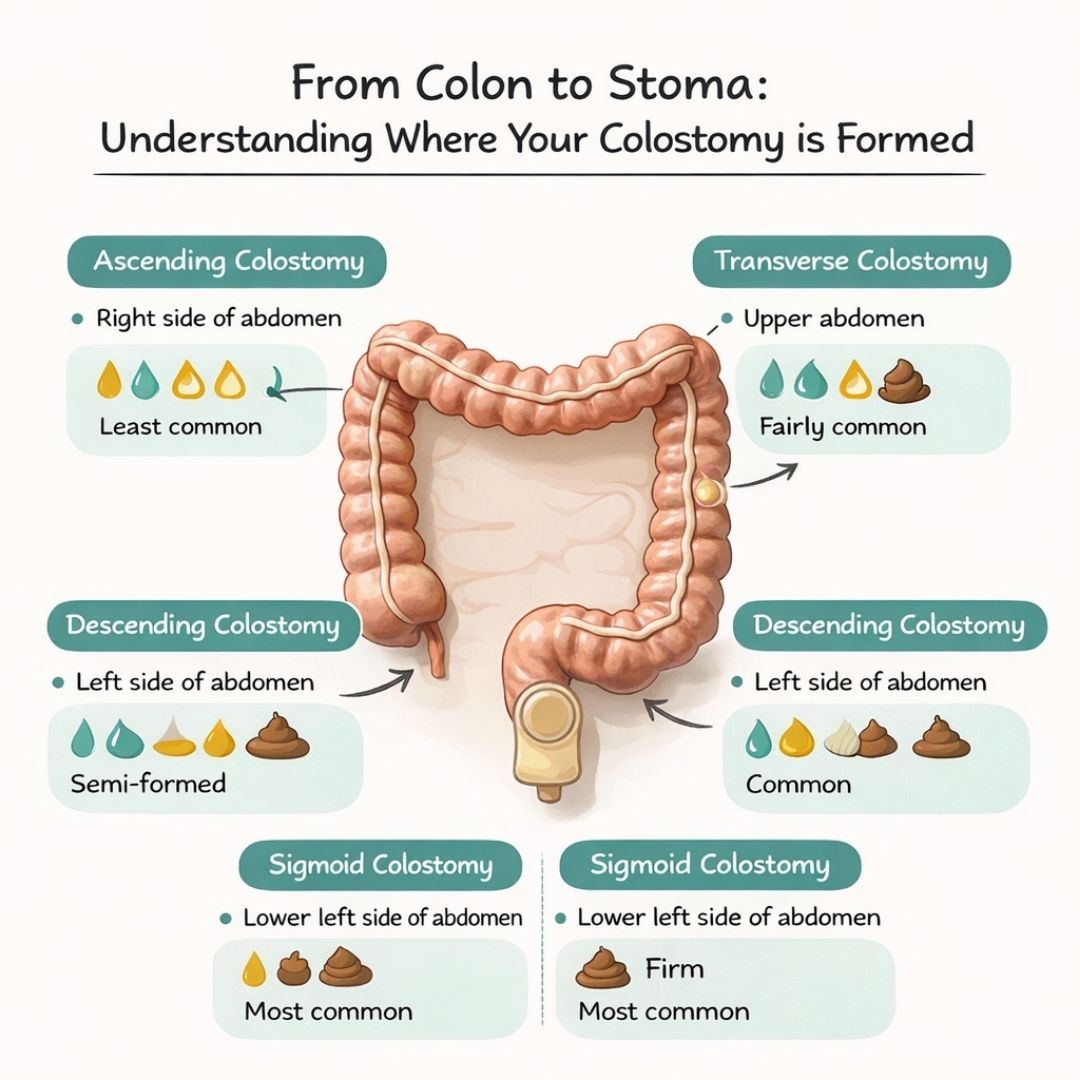
This information is crucial because it shapes everything about your care plan, from what to expect in the first few weeks to how you’ll manage things long-term.
The first big question is whether the colostomy is for a short time or for good. Your surgeon will have a clear reason for recommending one over the other based on your health.
Temporary Colostomy: Think of this as giving a part of your bowel a much-needed holiday. It’s created to divert waste away from a section that needs time to heal after surgery or illness, like diverticulitis or inflammatory bowel disease. Once everything has recovered—which can take a few months—you'll have another operation to reverse the stoma and reconnect your bowel.
Permanent Colostomy: This is the solution when the rectum or anus has been removed or is too damaged to function, often as a result of cancer or a severe injury. Because reconnecting the bowel simply isn’t an option, the stoma becomes a permanent part of your body.
Knowing if your stoma is temporary or permanent is fundamental. It helps you and your care team map out your journey, setting realistic expectations for recovery and life beyond.
The other key factor is where the stoma is made along the path of your colon. This not only determines its position on your abdomen but also has a big impact on the consistency of your poo. The further along the colon the stoma is, the more formed your waste will be.
A helpful way to picture it is to think of the colon as a water-absorbing conveyor belt. The earlier the exit point (your stoma), the more liquid the output. The later the exit, the more time the "belt" has had to draw out water, making the output much more solid.
Let's break down the four main locations:
This is the most common type of colostomy by a long shot. It’s made using the sigmoid colon, the very last S-shaped section of your large intestine.
This is the next stop up from the sigmoid colon. The stoma is created from the descending colon.
As the name suggests, this stoma is created from the transverse colon, the part that runs horizontally across the top of your abdomen.
This is the least common type. The stoma is formed from the ascending colon, which is the very first part of the large bowel on your right side.
Understanding your specific type of colostomy isn’t just medical trivia—it’s empowering. It helps you anticipate your body's new normal and manage your stoma care with much greater confidence.
Facing the prospect of colostomy surgery can feel overwhelming, but understanding what’s ahead can make the journey feel much less daunting. Knowing what to expect before, during, and after the operation can help replace some of that uncertainty with a sense of clarity and control. Think of this as your friendly guide, walking you through the process from hospital admission to your first few steps on the road to recovery.
In the days leading up to your operation, you'll go through several important preparations. The medical team will run some final checks, and you’ll chat with your surgeon and anaesthetist about the plan for the day. This is also when you'll likely meet a specialist Stoma Care Nurse. They are a fantastic source of support and will work with you to find the best place on your tummy for the stoma, marking the spot based on your body shape and daily routines.
Once you’re sound asleep under general anaesthetic, the surgeon will get to work. The procedure can be done in two ways: either as traditional open surgery, which uses a single, larger incision, or as laparoscopic (keyhole) surgery, which involves a few very small cuts. The method they choose will depend entirely on your individual circumstances and what’s safest for you.
The surgeon then brings a healthy part of your colon through the opening they’ve made in your abdominal wall. They neatly fold the edge of the intestine back on itself, a bit like turning down the cuff of a sleeve, and stitch it to the surrounding skin. This creates the stoma, which is now the new exit point for waste to leave your body.
When you wake up, you’ll be in a recovery room for a little while before heading to a hospital ward. It’s normal to feel quite tired and a bit sore, but the nursing team will be right there to manage any discomfort and keep you comfortable. You’ll notice a clear colostomy pouch is already fitted over your stoma, which allows the nurses to keep a close eye on it.
The first few days are all about healing and letting your body gently readjust. You may have a drip for fluids and medication, and possibly a catheter for a short time. Your new stoma will likely look quite swollen and a deep reddish-pink colour – this is perfectly normal. It has no nerve endings, so touching it doesn’t hurt at all.
Your Stoma Care Nurse will quickly become your go-to person during your hospital stay. They'll pop in regularly to:
You'll start off with clear fluids and slowly progress to more solid foods as your digestive system begins to wake up. It can take a couple of days, and at some point during this time, your stoma will start to work.
Recovering from major surgery is a marathon, not a sprint. Giving your body the time it needs to heal is absolutely essential. Proper rest isn't just a nice idea; it's a vital part of managing pain, lowering the risk of complications, and supporting your emotional health.
A typical hospital stay following a colostomy is somewhere between 3 and 10 days. The main goal is to make sure you feel confident looking after your stoma on your own before you head home. Down the line, as you think about returning to work or your usual activities, a functional capacity evaluation might be suggested to assess your physical abilities. Getting enough quality rest is the foundation for all of this, and there are some brilliant strategies to improve your https://cancercareparcel.com/sleep-and-rest-after-cancer-surgery/ that can make a huge difference.
Leaving the hospital and taking charge of your stoma care at home is a huge milestone in your recovery. This is where you really start to find your feet and build a new, confident routine. Try to think of it less as a daunting medical task and more like a new part of your daily self-care, just like brushing your teeth.
It’ll probably feel a bit awkward at first, and that’s completely normal. But with a bit of practice and patience, you'll get the hang of it. Your Stoma Care Nurse is your best guide, and soon enough, you’ll be changing your pouch quickly and easily, feeling completely in control.
The colostomy pouching system is now your go-to piece of kit. It’s cleverly designed to be secure, discreet, and comfortable, collecting waste while keeping the skin around your stoma healthy and protected. There are lots of different makes and models out there, but they all boil down to two core components.
These two parts come in a couple of main setups. Your Stoma Care Nurse will have a chat with you to figure out which one suits your stoma and your lifestyle best.
Changing your pouch is a skill you’ll master in no time. A good tip is to do it when your stoma is less active—often first thing in the morning before breakfast is a great time. As a general rule, you’ll be changing the entire appliance every 1-3 days.
Here’s a straightforward routine to follow:
This flowchart shows how these practical steps fit into the bigger picture of your surgical journey, from getting ready for the operation to your recovery afterwards.
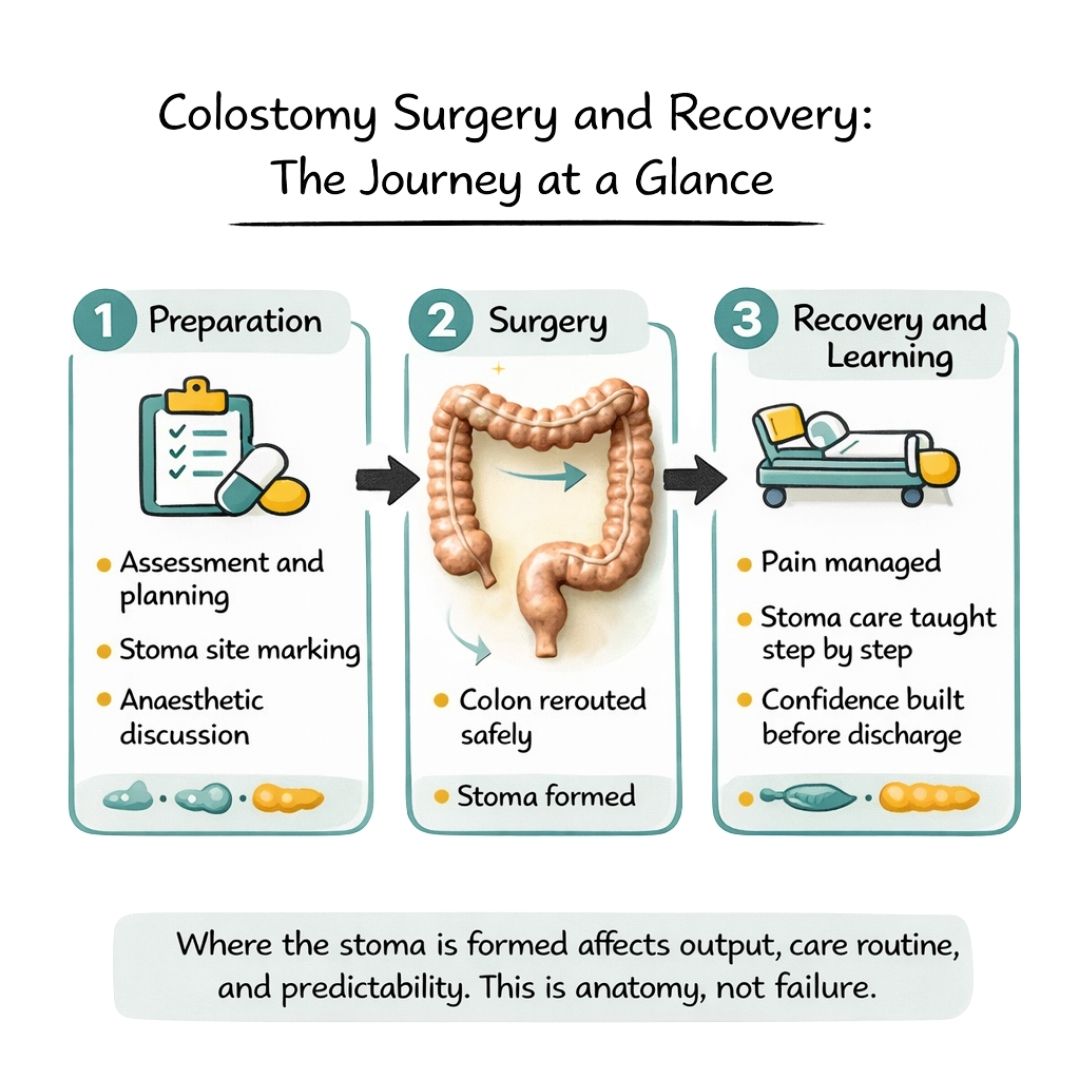
Seeing where you are on this path helps put your new stoma care routine into context as a key part of your complete recovery.
Beyond changing the pouch, a couple of other things will become part of your daily life. The most common one is simply emptying your bag.
It’s best to empty your pouch when it is about one-third to one-half full. This stops it from getting too heavy and pulling on your skin, and it also means it stays nice and flat under your clothes.
Looking after the skin around your stoma, what’s known as the peristomal skin, is your other top priority. If that skin is healthy, your pouch will stick properly, and you’ll stay comfortable. Don’t forget that a healthy diet and staying hydrated are also massive factors in managing your output and feeling your best. You can dive deeper into this connection by reading our guide on the importance of gut health during cancer treatment and beyond.
By following these steps, you’re not just managing a stoma, you’re taking fantastic, positive control of your health and wellbeing.
Living with a colostomy is usually a very manageable experience, but like anything in life, it’s good to be prepared for the occasional hiccup. Knowing what to look for and how to handle common stoma issues is the best way to feel confident and in control. Think of this as your practical guide to troubleshooting.
Most of these problems are small and easily sorted at home. The trick is knowing the difference between a minor issue and something that needs a quick call to your Stoma Care Nurse. This knowledge helps turn worry into action, so you can handle any bumps in the road.
The skin right around your stoma is called the peristomal skin, and keeping it healthy is your top priority. It’s what the stoma bag sticks to, so a happy bit of skin means a secure bag and a comfortable you. Skin irritation is probably the most common challenge people face, but the good news is it's almost always preventable and treatable.
You’ll know your skin is irritated if you see:
The usual culprit? Waste (output) has snuck underneath the barrier and is sitting on your skin. To fix this, check that your baseplate is cut to the perfect size, you want no more than a 2-3mm gap around the stoma itself. If your tummy isn't perfectly flat, using a barrier ring or a bit of paste can fill in any dips and create a much better seal. A barrier spray can also add a helpful protective film.
A leak can feel like a disaster, but trust me, it happens to most of us at some point. The key is to play detective and figure out why it happened so you can stop it from happening again. Leaks usually mean the bag's seal against your skin wasn't quite right. Sometimes this is caused by "pancaking," a frustrating issue where your output gets stuck at the top of the bag instead of dropping down.
If you have a leak, the first rule is to change your entire bag and baseplate straight away. Give the skin a gentle but thorough clean with warm water, and make sure it’s completely dry before putting on a new bag. A leak is a clear signal that your skin has been exposed to output, and that can lead to irritation very quickly.
Keep an eye on any changes in your stoma’s size or the shape of your abdomen. Gaining or losing weight can change the landscape of your tummy, which might mean the bag you’ve been using is no longer the best fit. You might need to try something different, like a convex baseplate, to get a more secure, leak-proof seal.
A stoma blockage is when food gets stuck in the bowel, stopping waste from passing into your bag. It can cause some pretty uncomfortable cramps and bloating. It's often caused by high-fibre foods that are a bit tougher to digest, think nuts, sweetcorn, or mushrooms, especially if you haven't chewed them really well.
If you think you might have a blockage:
If you start having severe pain, you're vomiting, or your stoma hasn't produced any output for several hours, it's time to get medical advice straight away. A bit of discomfort can be normal, but intense or persistent pain is your body's way of saying it needs help. We cover this topic in more detail in our guide to managing cancer pain.
A parastomal hernia is simply a bulge that appears around your stoma. It happens when a bit of your intestine pushes through a weaker spot in your tummy muscles. They are actually very common, so seeing one isn't usually a reason to panic.
In fact, one major review found that end colostomies have a complication rate of 62.6%, with parastomal hernias being the most frequent of all at 59.3%. You can read more about these findings in the full study from the Royal College of Surgeons.
Wearing supportive underwear or a specially designed support belt can make a big difference. It helps to manage the hernia and can stop it from getting any bigger. Your Stoma Care Nurse is the best person to ask for advice on the right kind of support garments and can even show you some gentle exercises to safely strengthen your core muscles.
To help you quickly identify and act on these issues, here's a handy table summarising what to do.
This table is a quick-reference guide to help you identify what's going on with your stoma and what your next steps should be.
| Complication | Signs to Look For | What to Do |
|---|---|---|
| Skin Irritation | Red, itchy, or sore skin around the stoma. A rash or weeping spots. | Check the fit of your baseplate (no more than a 2-3mm gap). Use barrier rings or sprays. Ensure skin is fully dry before applying a new bag. |
| Pouch Leakage | Output seeping from under the baseplate. Wetness or odour. | Change the entire pouching system immediately. Clean and dry the skin well. Consider trying a convex bag or support belt for a better seal. |
| Stoma Blockage | Little to no output, cramping, bloating, or watery output. Swollen stoma. | Stop eating solids, drink clear fluids. Gently massage your tummy and try a warm bath. Seek urgent medical help if you have severe pain or are vomiting. |
| Parastomal Hernia | A noticeable bulge or lump under the skin around your stoma. | Wear supportive underwear or a hernia support belt. Avoid heavy lifting. Talk to your Stoma Care Nurse about core exercises. |
Remember, this is just a guide. You know your body best, so if something doesn't feel right or you're worried, never hesitate to contact your Stoma Care Nurse or GP for advice. They are there to help you live confidently and comfortably with your stoma.
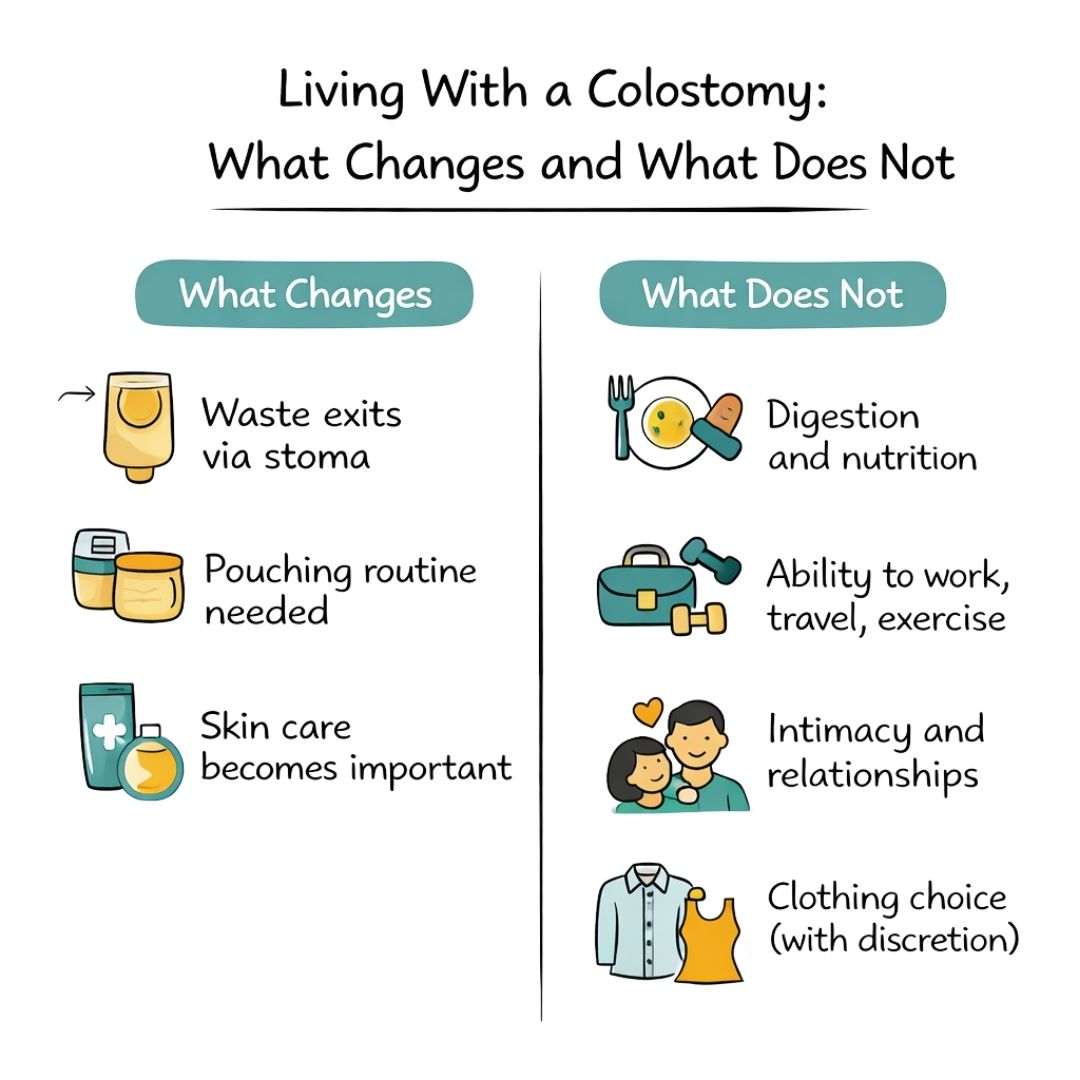
One of the biggest questions people have after colostomy surgery is whether life can ever feel “normal” again. The answer, from countless people who have walked this path, is a resounding yes. A stoma is a change, not a life sentence, and with a few adjustments, you can confidently get back to all the things you love.
This isn't just about managing a colostomy; it's about proving to yourself that you can thrive. Your stoma becomes a part of your story, but it certainly doesn't get to write the whole book.
After the initial recovery period, most people are delighted to find they can go back to a varied and enjoyable diet. The real key is to reintroduce foods slowly and simply pay attention to how your body responds.
Keeping a food diary for a few weeks can be a huge help. It doesn't have to be complicated – just jotting down what you ate and how you felt can help you spot which foods make you feel great and which might cause a bit more gas or looser output.
You might notice that certain things, like beans, cabbage, or fizzy drinks, create more wind. On the other hand, foods like marshmallows, rice, or ripe bananas can often help to thicken your output. It’s a very personal journey of discovery, and there are very few hard and fast rules that apply to everyone.
Staying well-hydrated is one of the most important things you can do. Drinking plenty of water throughout the day helps your digestive system work smoothly and keeps your stoma output at a manageable consistency.
Modern stoma bags are designed to be slim, discreet, and virtually invisible under most clothes. You absolutely do not need a whole new wardrobe. Many people find that high-waisted trousers or jeans offer a bit of gentle support and a welcome sense of security. Patterned fabrics can also be a great friend when you're first building your confidence.
Sometimes, simple accessories can make all the difference:
Ultimately, you can wear the same styles you've always loved. It's all about finding what makes you feel comfortable and self-assured.
Getting back to exercise is a fantastic way to rebuild your strength and give your wellbeing a massive boost. Once your surgeon gives you the all-clear, you can gradually return to the activities you enjoy, from walking and swimming to yoga and even more strenuous sports.
The best advice is to start slowly and listen to your body. It's wise to avoid very heavy lifting for the first few months to lower the risk of developing a hernia around your stoma. While specialised swimwear is available, you’ll find that for most water activities, your standard stoma bag works perfectly well. An active life is completely achievable.
A colostomy doesn't have to be a barrier to intimacy or a fulfilling relationship. The most important first step is open and honest communication with your partner. Smaller, more discreet pouches are available, and using a pouch cover can add a layer of comfort and confidence. Your Stoma Care Nurse is an excellent resource for sensitive and practical advice on this topic.
Travelling with a stoma just takes a little bit of forward planning. A golden rule is to always pack more supplies than you think you’ll need in your hand luggage – never in your checked-in bags, just in case they get delayed. Pre-cutting your stoma bags at home also saves a lot of time and hassle while you’re away.
There are so many inspiring stories of people exploring the world with a stoma. You can find powerful examples in personal accounts like this one about sharing a colon cancer story.
Connecting with others who have been on the same journey can be incredibly valuable. Patient care was transformed by the establishment of support organisations like the Ileostomy and Internal Pouch Association in 1956, Colostomy UK in 1967, and the Urostomy Association in 1976. These charities helped turn stoma surgery into a well-supported treatment, backed by a strong community network that is still there for you today.
It's completely normal to have a few questions lingering, even after taking in a lot of new information. Let's tackle some of the most common ones we hear, giving you that extra bit of clarity and peace of mind.
This is often one of the first worries people have, but the short answer is no. Today's stoma bags are worlds away from what you might imagine. They’re designed to be incredibly discreet, lying flat against your skin so they are practically invisible under your clothes.
They're also made from advanced odour-proof materials, and many have clever built-in filters to neutralise any gas. As long as your bag is fitted properly, smell is simply not an issue. This means you can step into any social situation, whether it's the office or a crowded restaurant, with complete confidence.
Yes, absolutely! Once you’ve healed from the operation and your doctor gives you the all-clear, you can get back to doing the activities you love. This covers everything from a gentle swim or a walk in the park to more demanding sports.
You can even get specialised pouches and support wear, like stoma guards, designed to give you extra security and protection during physical activity. The trick is to start slowly and listen to your body, but having a stoma doesn't mean you have to hang up your trainers.
You are not alone on this journey. Excellent support is available from organisations like Colostomy UK in the UK and the United Ostomy Associations of America (UOAA) in the US. These groups offer helplines, online forums, local meetups, and valuable resources to connect you with others who share your experience.
Right after your surgery, you’ll likely be advised to stick to a low-fibre diet for a little while. This just gives your bowel a chance to heal without being overworked. For most, this is only a temporary measure.
Over time, you'll gradually be able to reintroduce foods and get back to a normal, balanced diet. You might notice that some specific foods affect your stoma's output or create a bit more gas, keeping a food diary for a few weeks can be a great way to pinpoint what they are. The most important thing? Staying well-hydrated is crucial. But for the vast majority of people, long-term food restrictions are minimal.
We strongly advise you to talk with a health care professional about specific medical conditions and treatments.
The information on our site is meant to be helpful and educational but is not a substitute for medical advice.
The Thoughts Of Cancer Returning Still Seep Back In My Brain Upon Occasion, But I Quickly Replace Them With Gratitude That I Am Still Here
Learn the key colon cancer symptoms, from early warning signs to less common indicators. Find out when to see a doctor for early detection and peace of mind.
Anaemia is common during cancer and treatment. Learn why it happens, how to recognise symptoms, and how anaemia is managed safely during cancer care.