Few ideas are as well-intentioned and as quietly damaging as the belief that a positive mindset can cure cancer. It is rarely stated so bluntly. Instead, it appears in softer, more socially acceptable forms: “You have to stay positive.” “Your attitude matters.” “Mind over matter.” “Stress causes illness.”
These phrases are usually offered with care. They are meant to encourage, to comfort, to restore a sense of agency at a time when life feels frighteningly uncertain. Yet beneath the reassurance sits an implication that deserves closer examination. If positivity is framed as a driver of outcomes, then illness begins to look like a failure of mindset. Recovery becomes a measure of optimism. Progress becomes a reflection of emotional discipline.
Cancer does not work that way. And insisting that it does carries consequences, particularly for people already navigating diagnosis, treatment, and survival.
This article is not an argument against hope. It is an argument against misinformation, misplaced responsibility, and the subtle pressure placed on people with cancer to manage not only their disease, but everyone else’s discomfort with it.
The belief that mindset influences health is not new. For centuries, illness has been linked to moral character, emotional states, or spiritual alignment. In modern culture, this thinking has been repackaged through self-help movements, wellness industries, and selective interpretations of psychology and neuroscience.
Positive psychology, for example, has made valuable contributions to understanding resilience, coping strategies, and emotional wellbeing. Stress research has shown that chronic stress can influence immune function and overall health. None of this is controversial. The problem arises when these ideas are overstretched and misapplied to complex diseases such as cancer.
Somewhere between “stress can affect how we feel” and “positivity improves quality of life,” a leap is made to “positivity influences cancer outcomes.” From there, it is a short step to believing that insufficient positivity may hinder recovery.
That leap is not supported by evidence.
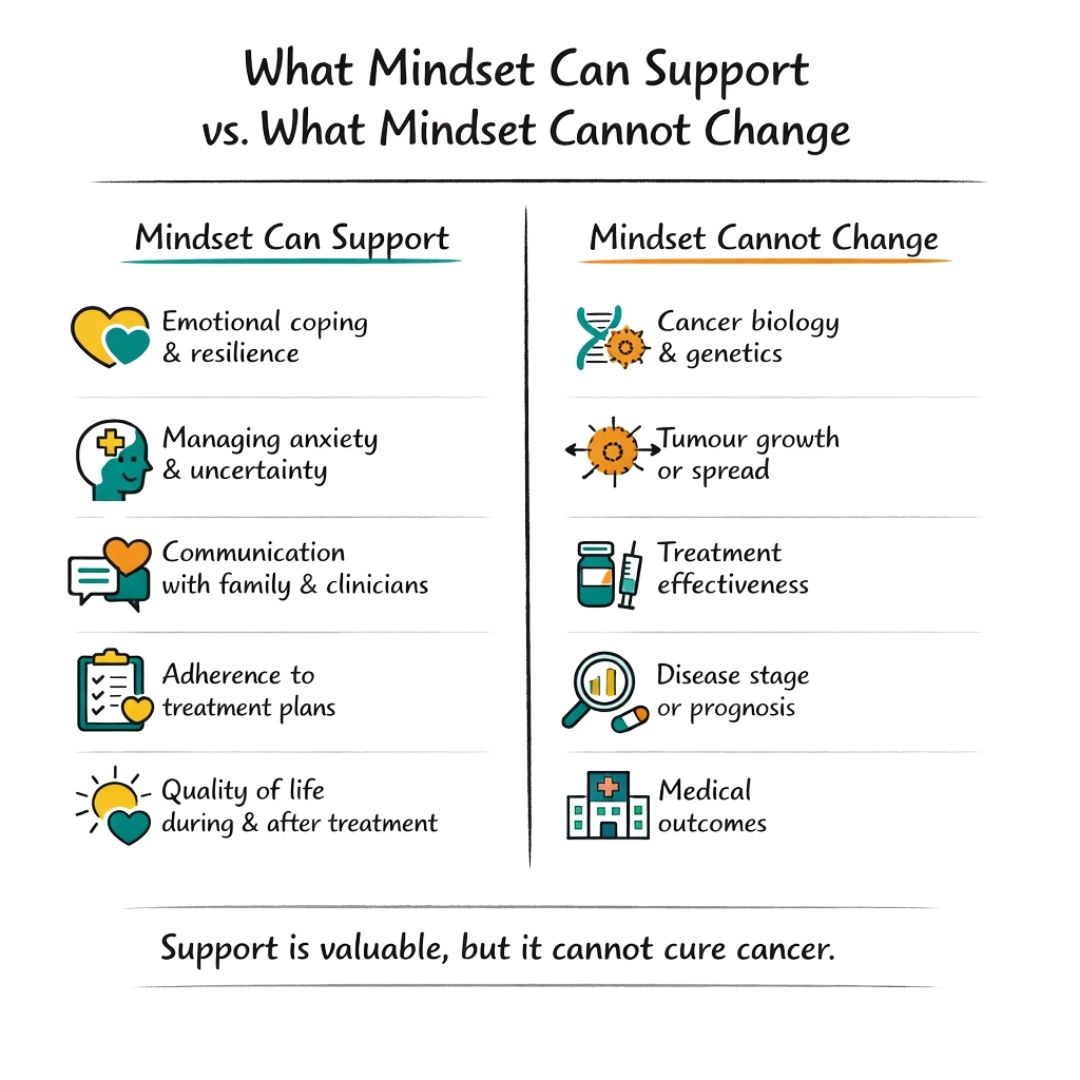
Cancer is not a single disease. It is a broad category encompassing hundreds of distinct conditions, each with different causes, behaviours, genetic drivers, and treatment responses. Tumour growth, metastasis, and treatment effectiveness are governed by biology: genetics, cellular signalling pathways, immune interactions, and the pharmacodynamics of therapy.
Large-scale studies examining personality traits, optimism, or emotional outlook have repeatedly found no reliable evidence that a positive mindset alters cancer progression or survival rates. People with cancer do not fare better because they are cheerful, calm, or relentlessly hopeful. They fare better because their cancer is detected early, responds well to treatment, and is managed within a robust clinical framework.
This does not diminish the value of emotional wellbeing. It clarifies its role.
Mental health support can reduce anxiety, depression, and distress. It can help people cope with side effects, navigate uncertainty, and maintain relationships. It can improve sleep, decision-making, and adherence to treatment. These are meaningful outcomes. They matter deeply. But they are not the same as curing cancer.
Conflating the two is not only inaccurate. It is unfair.
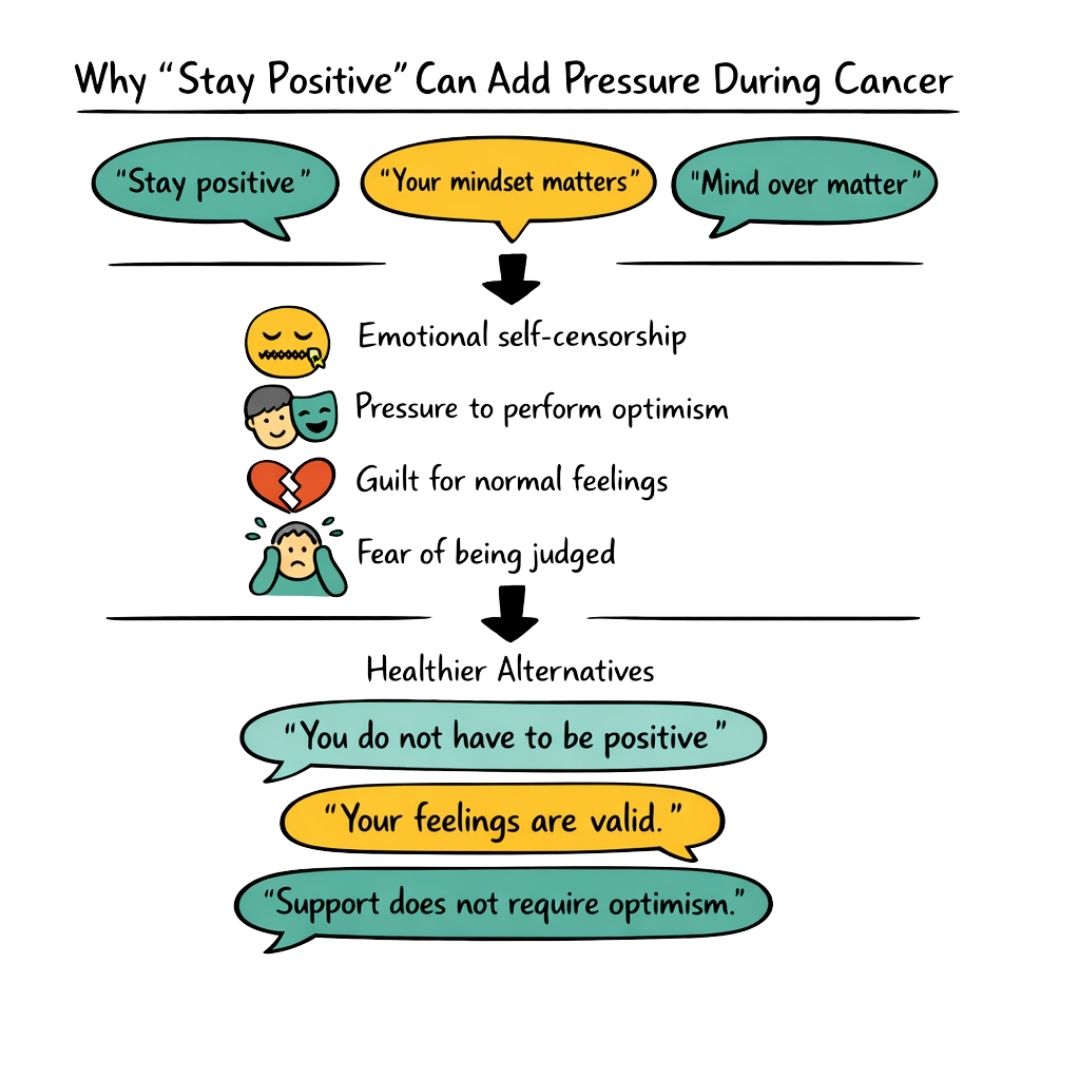
When positivity is framed as a moral obligation, it becomes a form of emotional labour imposed on people with cancer. Patients quickly learn which emotions are acceptable and which make others uncomfortable.
Fear is tolerated briefly. Sadness is allowed in small doses. Anger, grief, exhaustion, and despair are quietly discouraged. They disrupt the narrative. They remind others that cancer is unpredictable, unjust, and uncontrollable.
As a result, many people with cancer begin to self-censor. They reassure others. They minimise their own distress. They perform optimism not because it reflects how they feel, but because it makes conversations easier.
This performance can be exhausting.
Worse still, when treatment fails or disease progresses, the language of mindset turns cruelly inward. People begin to question themselves. Did I think the wrong things? Was I too negative? Did I let myself down?
These questions do not arise because the person believes them at the outset. They arise because the culture around them has repeatedly implied that thoughts influence outcomes.
The appeal of the “positive mindset” narrative lies in its promise of control. Cancer is frightening precisely because it resists personal effort. It does not yield to good behaviour, discipline, or virtue. For those watching from the outside, that lack of control is deeply unsettling.
Mindset-based explanations restore a sense of order. They suggest that outcomes are shaped by internal qualities rather than chance or biology. If positivity protects, then illness feels less arbitrary. If attitude matters, then tragedy can be rationalised.
But this sense of control is illusory, and it comes at a cost.
When responsibility is shifted onto the individual’s mindset, the randomness of cancer is obscured. Structural factors such as access to care, early diagnosis, treatment availability, and research funding fade into the background. Biology is replaced by belief. Support is replaced by instruction.
The person with cancer is left holding a burden they cannot carry.
Rejecting the idea that positivity cures cancer does not mean dismissing emotional resilience. It means placing it where it belongs.
A supportive mindset can help someone endure treatment. It can help them communicate their needs. It can reduce isolation. It can provide moments of meaning and connection in the midst of disruption. It can coexist with fear, grief, and uncertainty without denying them.
Crucially, it should be self-directed, not imposed.
Some people find comfort in optimism. Others find strength in realism, humour, anger, or quiet acceptance. There is no single emotional profile associated with coping well. There is only authenticity.
When people are allowed to feel what they feel, without correction or judgement, psychological wellbeing improves. When they are told how they ought to feel, distress often increases.
For friends, family members, colleagues, and even healthcare professionals, this distinction matters. Support is not about fixing emotions or redirecting thoughts. It is about listening without agenda.
Telling someone to “stay positive” often serves the speaker more than the listener. It reassures the person offering comfort that things will be all right, or at least that they have done something helpful. In reality, it can shut down conversation.
A more constructive approach is simple, though not always easy. Ask open questions. Accept uncomfortable answers. Resist the urge to reframe, reassure, or motivate unless invited.
Presence is more valuable than encouragement. Understanding is more useful than optimism.
Hope does not depend on false promises. It does not require the belief that thoughts can shrink tumours or that optimism determines survival. Hope can exist alongside realism. It can be grounded in treatment, research, support networks, and moments of quality and connection.
For some, hope means focusing on the next appointment. For others, it means planning months ahead. For others still, it means concentrating on comfort and dignity. None of these approaches is more correct than the others.
What matters is that hope is chosen, not prescribed.
Challenging the myth of the curative mindset is not about negativity. It is about honesty. It is about removing an unnecessary layer of pressure from people already managing something profoundly difficult.
Cancer is not caused by insufficient positivity. It is not cured by optimism. It is not worsened by fear, sadness, or realism. These truths do not make the experience bleaker. They make it fairer.
When society lets go of the idea that mindset determines outcomes, it creates space for genuine support. It allows people with cancer to be human rather than inspirational. It shifts attention back to where it belongs: evidence-based medicine, equitable care, and compassionate presence.
A positive mindset can make a hard day more bearable. It can help someone feel less alone. It can support mental wellbeing in meaningful ways. But it is not a treatment, and it should never be framed as one.
Acknowledging that is not pessimistic. It is respectful.
We strongly advise you to talk with a health care professional about specific medical conditions and treatments.
The information on our site is meant to be helpful and educational but is not a substitute for medical advice.
It’s probably one of the worst things for someone to be told: “You have cancer,”
“I’m One Of The Many Lucky Ones Who Have Survived Cancer And Although I Still Have Days Where I Just Enjoy Existing, I Really Try And Live Life To The Full.” Sarah Vaughan
Discover the latest on Lynch syndrome cancers with our guide. Learn about risks, testing, prevention, and support. Together, we empower and inform you.