
Subtotal: £89.50
When someone you care about is diagnosed with cancer, most people want to do the right thing. They want to help, to comfort, to say something that makes the situation feel lighter or less frightening. Out of that instinct often comes a familiar phrase: “Stay positive.”
It is usually said with warmth. It is rarely meant to dismiss or minimise. Yet for many people living with cancer, those words land very differently from how they are intended.
This article is not about criticising good intentions. It is about understanding impact. Because when someone is facing cancer, the language used around them can either reduce the emotional load they are carrying, or quietly add to it.
Before looking at why the phrase can be harmful, it is worth understanding why it appears so often.
For the person offering support, cancer is uncomfortable. It introduces uncertainty, fear, and a lack of control. Saying “stay positive” does several things at once. It expresses hope. It signals care. It offers a sense of direction in a situation that feels overwhelming.
It can also act as a form of emotional self-protection. Optimism reassures the speaker that things will be all right, or at least that they have contributed something helpful. It gives the conversation a sense of closure.
The problem is that cancer rarely fits neatly into reassuring narratives.
For someone living with cancer, “stay positive” can feel less like encouragement and more like instruction. It suggests that there is a correct emotional response, and that anything outside it is unwelcome.
People with cancer often describe feeling pressure to manage not just their illness, but everyone else’s reaction to it. They become aware of which emotions are acceptable to share and which make others uncomfortable. Fear may be tolerated briefly. Sadness, anger, or exhaustion often less so.
Over time, this can lead to emotional self-censorship. People stop speaking honestly because they do not want to disappoint, worry, or burden others. They perform optimism instead of expressing reality.
That performance is tiring. And it can be isolating.
Even when it is not intended, “stay positive” carries an implication: that attitude influences outcomes. If positivity is repeatedly emphasised, it can suggest that recovery is linked to mindset, and by extension, that struggling emotionally is a risk.
This can create guilt. People begin to question themselves for perfectly normal reactions. They may feel they are failing if they are frightened, low, or overwhelmed. Some worry that expressing distress will be seen as giving up.
Cancer already removes a sense of control. Adding responsibility for maintaining the “right” emotional state takes something else away.
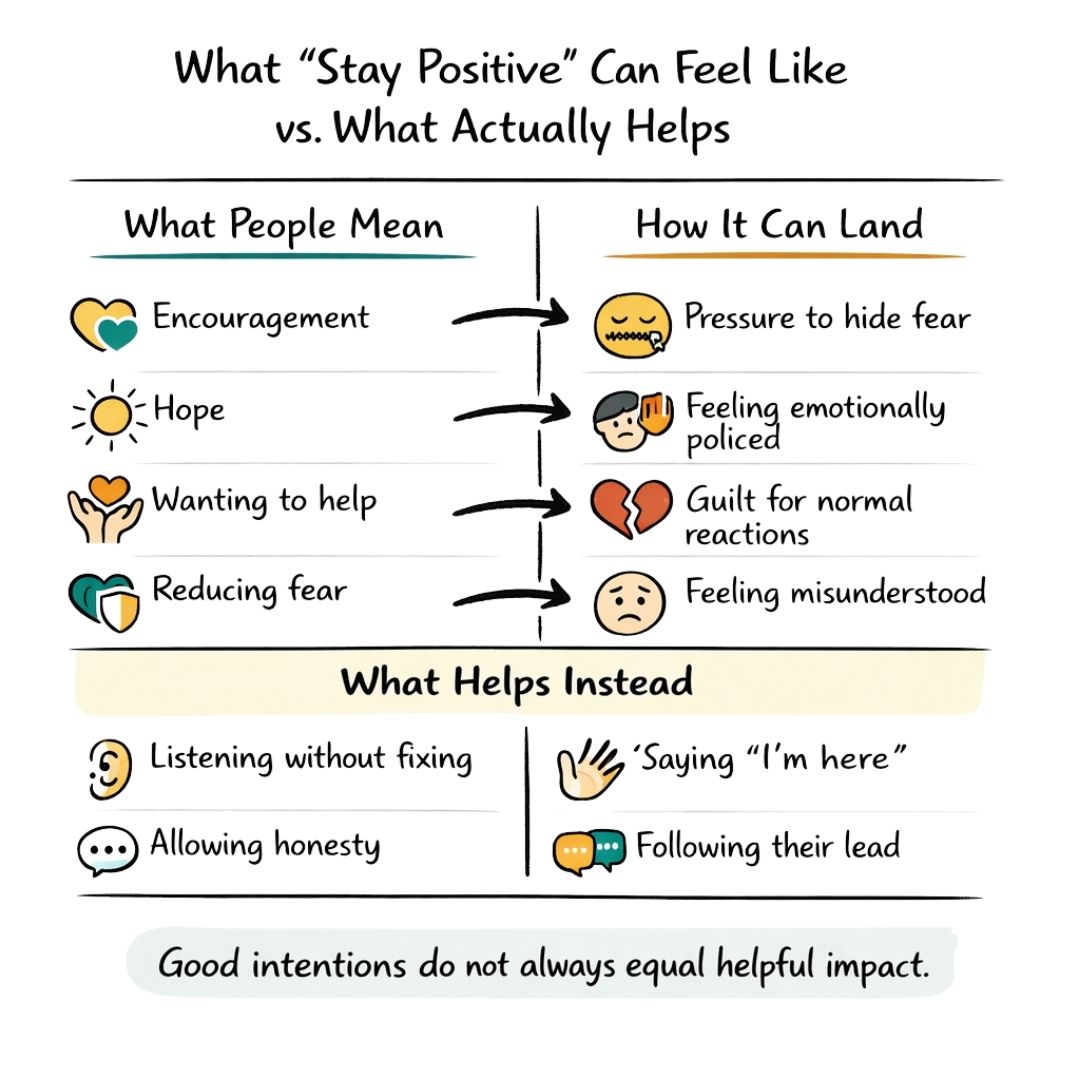
One of the most helpful things you can offer someone with cancer is permission to be real.
Realism does not mean pessimism. It means allowing space for the full range of human responses without trying to steer them. It means accepting that some days will be manageable and others will not be, and that neither reflects strength or weakness.
When people are allowed to speak honestly, they are less alone. When they are told how they should feel, they often retreat.
Support is not about lifting someone out of their emotions. It is about meeting them where they are.
Many people supporting someone with cancer worry about saying the wrong thing. That fear can lead to default phrases that feel safe but are not always helpful.
In reality, most people with cancer are not looking for motivation or reassurance. They are looking for understanding.
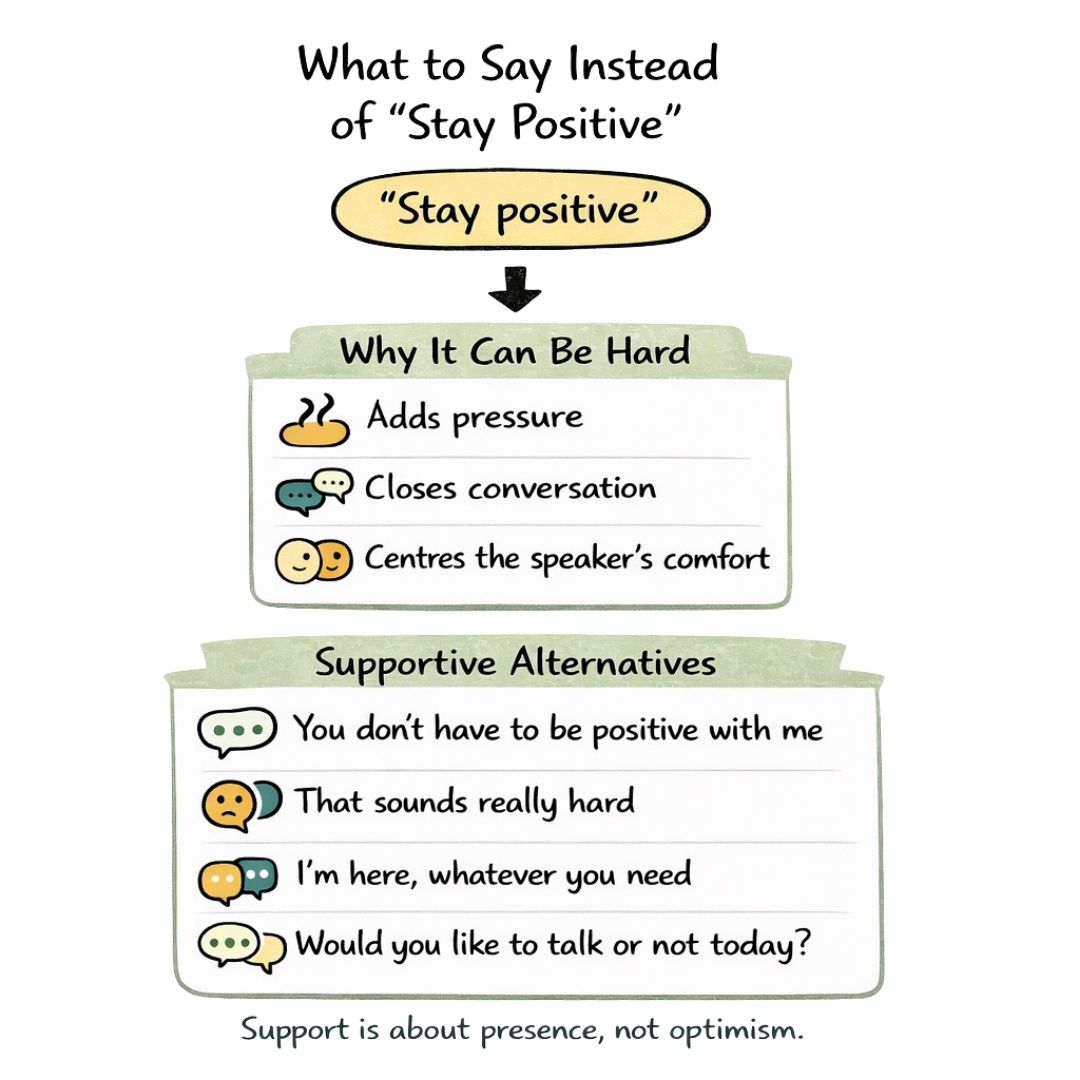
Simple, open statements tend to be far more supportive than upbeat encouragement. For example:
These responses do not try to fix anything. They create space.
One of the hardest parts of supporting someone with cancer is sitting with your own discomfort. It is natural to want to move the conversation away from fear or sadness. It is also natural to want to help in a way that feels active.
However, support is not measured by how much better you feel after the conversation. It is measured by whether the other person feels heard.
Sometimes the most supportive response is silence. Sometimes it is listening to the same worry more than once. Sometimes it is acknowledging that there are no reassuring answers.
This can feel unsatisfying, especially when you care deeply. But presence is often more valuable than positivity.
If you catch yourself about to say “stay positive,” it may help to pause and ask what you are really trying to convey. Often it is one of three things: hope, care, or a desire to reduce distress.
Those intentions can be expressed without placing emotional demands on the other person.
Instead of focusing on positivity, you might focus on companionship:
These statements offer support without conditions.
It is worth noting that enforced positivity affects caregivers as well. Partners, family members, and close friends are often expected to remain strong, calm, and encouraging at all times. They too may feel pressure to suppress fear or exhaustion for the sake of others.
Creating a culture where honesty is allowed benefits everyone involved. It reduces isolation on all sides.
None of this means you must avoid hope, humour, or encouragement altogether. Many people with cancer value lightness, laughter, and moments of normality. The key difference is consent and context.
Support works best when it follows the lead of the person experiencing the illness. Some days they may welcome optimism. Other days they may need space to be angry or afraid. Both are valid.
The goal is not to find the perfect words. It is to avoid placing expectations on someone who is already carrying enough.
Cancer changes conversations. It exposes how uncomfortable society often is with uncertainty and vulnerability. Resisting the urge to tidy those emotions away with positivity is not unkind. It is respectful.
If there is one principle to hold onto, it is this: support does not require optimism. It requires attention.
Listening without correcting, sitting without fixing, and allowing someone to be exactly where they are is one of the most meaningful things you can do.
We strongly advise you to talk with a health care professional about specific medical conditions and treatments.
The information on our site is meant to be helpful and educational but is not a substitute for medical advice.
Now As I Was Ready For Healing And Looking Forward To Gradually Bringing Myself To The Land Of Work Again...To Enjoy Being Out And About Again.
Body image really suffers from breast cancer and access to a good bra is critical for a woman to revive herself. The connection is intricate.
"Since My Diagnosis I Have Had Many Conversations With Men About Their Risk, The Need To Be Screened And Prostate Cancer Survival".