

Subtotal: £26.00

Subtotal: £26.00
Subtotal: £26.00
Yes, in many cases, blood tests can help to detect cancer. But it's not quite as simple as a single, all-in-one test. Instead, doctors have a range of different blood tests in their toolkit, each designed to uncover specific clues that might point to cancer, track how well a treatment is working, or check if cancer has returned.
It's a common question we hear: "can you just check for cancer with a blood test?" While it's tempting to think of one simple test giving a straightforward yes or no, the reality is a bit more complex—but also far more sophisticated.
Imagine your bloodstream as a busy motorway. It’s not just carrying the essentials like red and white blood cells; it’s also transporting countless microscopic signals and messengers from every organ and tissue in your body.
Some of these messengers can be crucial clues. A blood test acts like a highly specialised detective, equipped with different tools to spot specific signs that something isn't quite right. For instance, a basic blood count can reveal unusual numbers of blood cells, which might be the first hint of a blood cancer like leukaemia.
Beyond a simple cell count, more advanced tests are designed to hunt for specific substances that tumours release into the bloodstream. They're looking for things like:
Tumour Markers: These are specific proteins or other molecules made by cancer cells at a much higher rate than by healthy cells. The most well-known example is probably the PSA (Prostate-Specific Antigen) test, used in monitoring prostate cancer.
Circulating Tumour Cells (CTCs): In some cases, whole cells can break away from a primary tumour and start travelling through the bloodstream. Finding these CTCs can give doctors vital information.
Cell-free DNA (cfDNA): This is a groundbreaking approach, often called a liquid biopsy. It involves searching for tiny fragments of genetic material (DNA) that dying cancer cells have shed into the blood.
It's incredibly important to remember that a blood test alone rarely provides a definitive cancer diagnosis. An abnormal result is more like a red flag, a critical signal that tells your doctor something needs a closer look. It's just one piece of a much bigger diagnostic puzzle.
Solving that puzzle usually involves other steps. This might include imaging like a CT or MRI scan and, most definitively, a biopsy, where a small tissue sample is taken and examined under a microscope. By putting all these pieces together, doctors can build a complete and accurate picture to guide the best course of action.
So, can you really check for cancer with a blood test? The short answer is yes, but it's not quite as simple as one single test. It's more like sending in a team of specialist detectives, each trained to spot different kinds of clues. Let's break down the main types of blood tests and what they're actually looking for.
A Full Blood Count (FBC) is one of the most common blood tests your doctor will ever order. Think of it as a detailed census of your bloodstream, counting up all the different cells and checking their general health.
An FBC looks at three main players in your blood:
An FBC won't spot a tumour directly. What it does is give a broad picture of your health. For blood cancers like leukaemia, lymphoma, and myeloma, which start in the blood or bone marrow, an FBC is often the very first sign that something is wrong. A major, unexplained change in your cell counts is a big red flag that tells doctors they need to dig deeper.
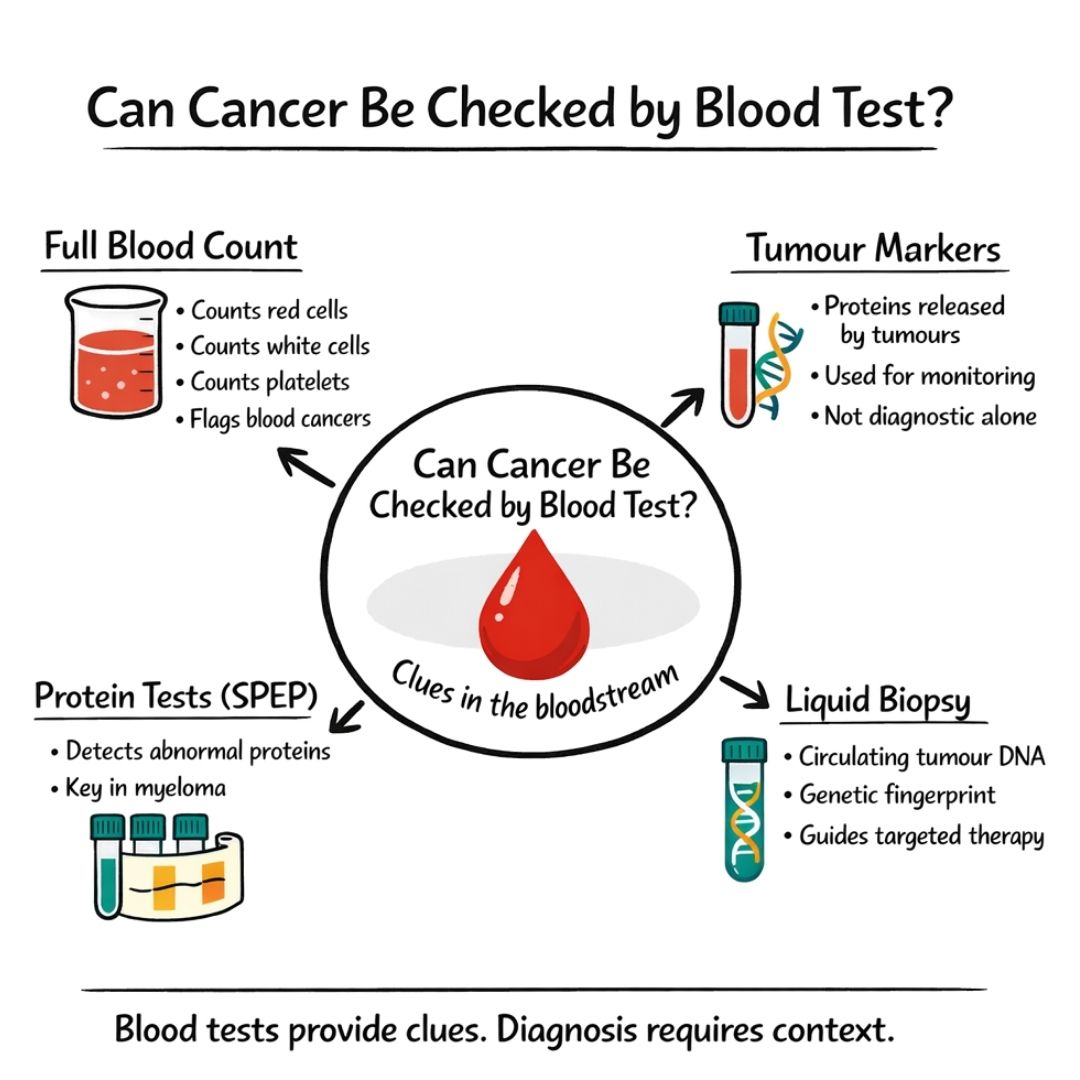
Tumour markers are substances, usually proteins, that are either made by cancer cells themselves or by your body as it reacts to the cancer. Imagine them as digital breadcrumbs left behind by a tumour, which we can then find in your blood, urine, or other body tissues.
It’s really important to know that these markers aren't a definitive diagnosis on their own. Lots of other things, like a simple infection or inflammation, can make these marker levels go up. This means they can sometimes create a "false positive" and cause a lot of unnecessary worry.
For that reason, we rarely use tumour markers to screen the general public. Where they really shine is in:
Common examples include Prostate-Specific Antigen (PSA) for prostate cancer and CA-125 for ovarian cancer. To get a better idea, you can learn more about the role of the CA 15-3 tumour marker in our specific guide.
The key takeaway here is that an elevated tumour marker isn’t a diagnosis—it's a signal. It tells your medical team that more investigation is needed to figure out exactly what’s going on.
Your blood is a complex soup filled with thousands of different proteins, all doing specific jobs. Some cancers, especially multiple myeloma, mess with this system and cause the body to churn out huge amounts of abnormal proteins. A blood test called serum protein electrophoresis (SPEP) is designed to spot these.
Think of it like a factory’s quality control line. The test sorts all the proteins by their size and electrical charge, looking for a massive spike of one identical, rogue protein. Finding this spike, known as a monoclonal or "M-protein," is a strong clue that points towards myeloma or a related condition, prompting more tests.
This is easily one of the most exciting frontiers in cancer detection right now. A liquid biopsy is a simple blood test that hunts for cancer cells or, more commonly, tiny fragments of DNA from a tumour that have broken off and are now floating in the bloodstream.
Picture it as finding a message in a bottle. Tumours shed bits of their genetic code, known as circulating tumour DNA (ctDNA), into the blood. Incredibly, modern technology can now find these tiny fragments and read the message inside.
This is a game-changer because it allows doctors to:
While it’s still an evolving field, the liquid biopsy is already transforming how we manage certain cancers. It’s a much less invasive way to get vital genetic information compared to a traditional tissue biopsy, which requires a surgical procedure.
Think of a blood test not as a one-off event, but as a trusted companion that guides doctors and patients throughout the entire cancer experience. From the first inkling that something might be wrong to the check-ups that follow treatment, these tests serve different, vital purposes at each stage. Understanding their role can take some of the mystery out of the process and give you the confidence to have better conversations with your medical team.
Let's break down the four key moments where a blood test can make all the difference, and see how its job changes along with a patient's needs.
Screening is all about looking for clues of cancer in people who feel perfectly healthy, particularly those who might have a higher risk due to their family history or lifestyle. It’s like a smoke detector for your body—it’s not there to put out a fire, but to give you the earliest possible warning that one might be starting.
While we don't yet have a single blood test that can screen for all cancers, a few specific ones are used this way. The most well-known is the Prostate-Specific Antigen (PSA) test for prostate cancer. A high PSA level doesn't automatically mean you have cancer, but it's a clear signal that something needs a closer look.
When someone develops symptoms that cause concern, blood tests become a fundamental part of the diagnostic puzzle. This is where a test like a Full Blood Count (FBC) can be incredibly revealing. If an FBC shows a huge number of abnormal white blood cells, for example, it points very strongly towards a diagnosis of leukaemia.
It's crucial to remember that in most situations, an abnormal blood test isn't the diagnosis itself. It's the red flag. It's the piece of evidence that tells a doctor, "Right, we need to investigate this further."
An unusual result will almost always lead to more tests. This usually involves imaging like a CT or MRI scan to get a picture of what’s going on inside. Ultimately, for most solid tumours, a definitive diagnosis comes from a biopsy—a small tissue sample examined by a pathologist. The blood test is often the critical first step that gets that whole process started.
Once cancer is diagnosed and treatment is underway, the purpose of blood tests shifts. Now, they act as a progress report, helping to track how well the treatment is working. It’s a bit like checking the gauges on a dashboard during a long journey to make sure everything is running smoothly.
For cancers that release specific tumour markers, regular blood tests offer real-time feedback. Take ovarian cancer, for example. A doctor will monitor a patient’s CA-125 levels during chemotherapy. If those levels are dropping steadily, it’s a great sign the treatment is working. If they stay high or start to rise, it might mean the cancer is resistant, prompting the team to rethink their strategy. The insights gained from laboratory medicine are absolutely central to shaping an effective, personalised treatment plan.
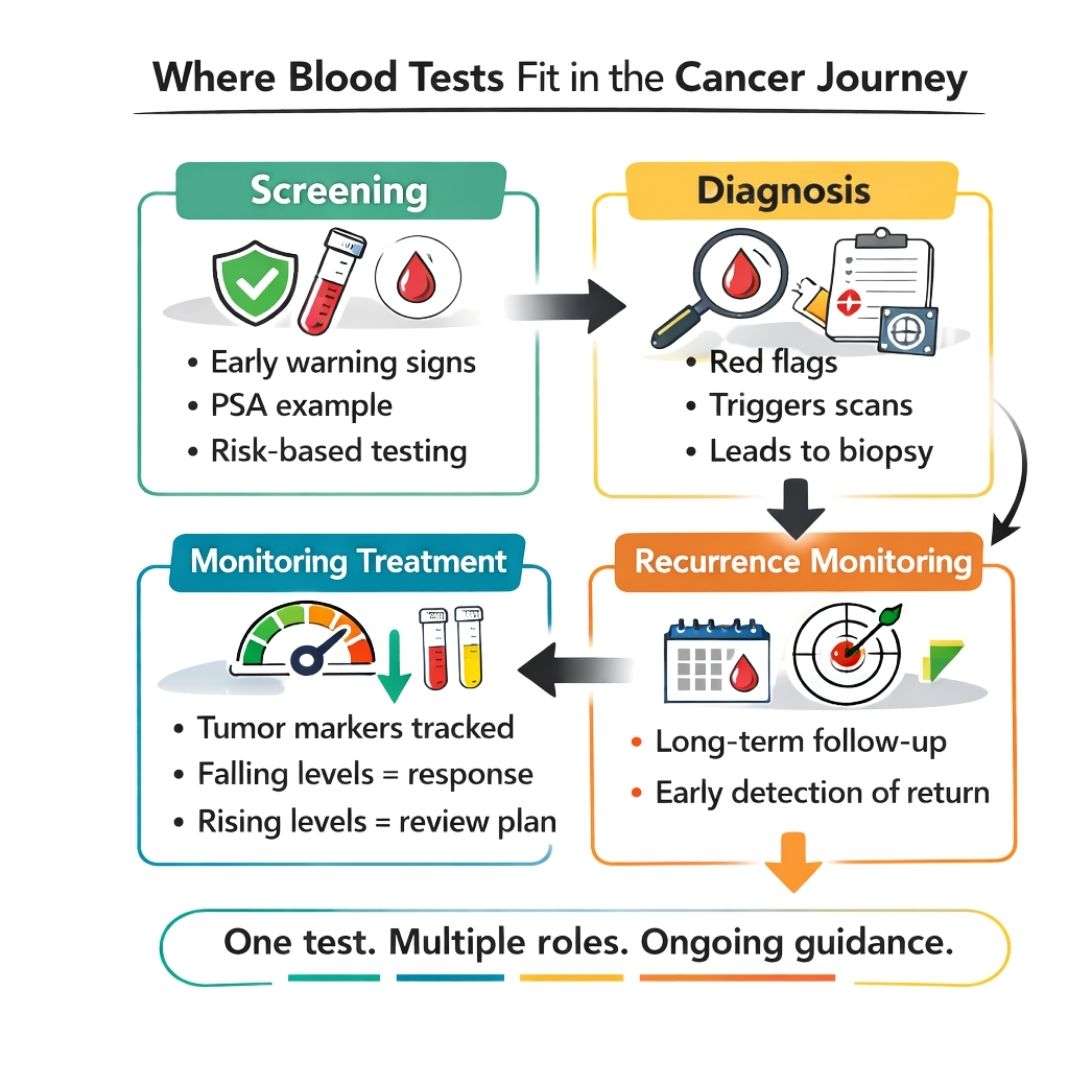
Finishing treatment is a huge milestone, but the fear of cancer returning is very real for many. Blood tests become a cornerstone of long-term follow-up care, acting as an early warning system to catch any potential recurrence.
Monitoring tumour marker levels can spot a problem long before any physical symptoms appear. A slow and steady rise in a marker that had returned to normal could be the first sign that the cancer is back. Catching it at this early stage is incredibly valuable, as it allows doctors to step in quickly with a new plan, which can make a huge difference to the outcome. This ongoing surveillance provides not just a proactive health strategy, but also a measure of peace of mind.
While blood tests for specific cancers have been part of a doctor's toolkit for years, the real revolution is happening now with multi-cancer early detection (MCED) tests. This is the closest science has ever come to a single blood test that can screen for dozens of different cancers all at once, long before any symptoms appear.
And one of the biggest real-world tests of this technology is taking place in the UK. The NHS-Galleri trial isn't just another small study; it's a massive, landmark project. It offers a powerful glimpse into what the future of cancer care could look like, not just for the UK, but for the entire world.
This pioneering trial is a joint effort between the NHS and the healthcare company GRAIL. The core mission is simple but ambitious: to find out if the Galleri blood test can reliably detect cancer early in people with no symptoms, and whether it could one day be rolled out as a standard part of a national screening programme.
The sheer scale is impressive. The study recruited over 140,000 volunteers across England, making it one of the largest trials of its kind. These participants, all aged between 50 and 77, were invited to provide blood samples. Half of the samples were immediately analysed using the Galleri test. The other half were stored away to act as a control group, allowing for a direct comparison.
So, how does it work? The Galleri test hunts for tiny fragments of DNA that tumours shed into the bloodstream, known as ctDNA. By analysing chemical patterns on this DNA (a process called methylation), the test doesn't just flag the potential presence of cancer. It can also predict where in the body that cancer might be, giving doctors a huge head start on where to look next.
The initial findings from the trial are nothing short of remarkable. The study found a significant increase in the total number of cancers detected when the Galleri test was used alongside standard screening methods.
A key success of the trial was its ability to detect cancers that are notoriously difficult to spot early, such as those of the head and neck, bowel, lung, and pancreas. For every one cancer found through standard screening, the Galleri test helped find two more.
This is a really big deal. Many of the most lethal cancers are so dangerous simply because we find them too late. A test that can shift diagnosis to Stage 1 or 2, when treatments are far more effective, could genuinely save thousands of lives every single year.
The NHS-Galleri trial is far more than a dry academic exercise; it's a real-world test case that has the attention of health experts globally. Its results are building the crucial evidence needed to potentially transform national screening programmes forever. If it proves successful in the long run, we could see a future where a simple blood test is a routine part of health checks for older adults.
The hope is that this research will usher in a new era of preventative medicine. It’s about moving from a reactive stance of treating advanced disease to proactively finding it early. By turning a once-theoretical idea into a practical reality, studies like this offer tangible hope and a clearer path to dramatically improve cancer diagnosis and survival rates for everyone.
The wait for test results can be an intensely stressful time, filled with uncertainty and a thousand questions. Whether the news comes over the phone or during a follow-up appointment, getting to grips with what the results actually mean is the first step toward feeling more in control.
It’s important to remember that blood tests rarely give a simple "yes" or "no" answer. Think of them as individual pieces of a much larger puzzle, providing crucial clues that help your doctor figure out what to do next.
Let’s walk through the two main scenarios—an abnormal result and a normal one—to demystify the process.
Hearing that a blood test result is abnormal or "positive" is understandably frightening. But it is absolutely vital to understand that an abnormal result is not an automatic cancer diagnosis.
Instead, picture it as a signal flare. It’s a sign that something needs a closer look, alerting your medical team that more investigation is needed to find out what’s causing the signal.
This result is simply the starting point of a well-trodden clinical path. The next steps are methodical, all designed to gather more specific information.
This whole process is about moving from a general clue to a specific answer. For example, an elevated PSA level might trigger a referral to a urologist. You can learn more about the Prostate-Specific Antigen test and its role in diagnosis to see how this works in practice.
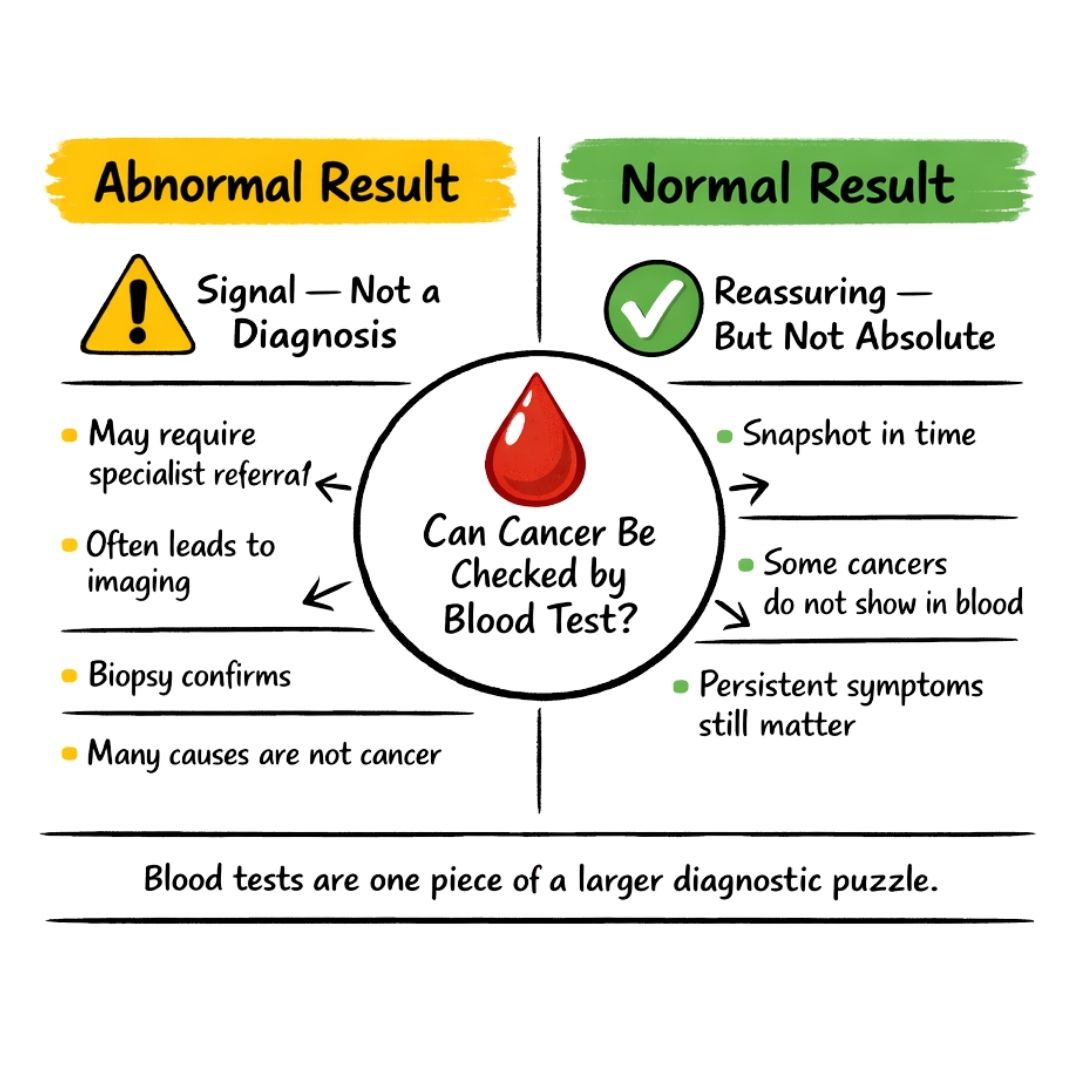
Hearing that your blood test results are normal or "negative" usually brings a huge wave of relief. For the most part, it’s excellent news. It provides reassurance that, based on the specific things tested, there are no immediate red flags to worry about.
However, a normal result isn't a permanent all-clear. It’s a snapshot in time, reflecting your health at that particular moment.
A normal blood test provides valuable information, but it doesn't rule out the possibility of cancer completely. Some cancers do not release detectable markers into the blood, especially in their earliest stages.
This is why context is so important. If you’re still dealing with persistent symptoms that are worrying you—like unexplained weight loss, bone-deep fatigue, or a lump—it's crucial to keep talking to your doctor, even after a normal blood test.
Your doctor will look at your entire health picture, including:
In the end, whether the result is normal or abnormal, it's just one piece of information. It’s there to empower you and your doctor to make informed decisions together, making sure you follow the right path to either get a clear diagnosis or rule out a problem.
While blood tests are already a cornerstone of cancer care, they’re not a perfect science just yet. Like any medical test, there’s always a tricky balance to strike, which brings us to two critical concepts: false positives and false negatives. Getting your head around these limitations is key to understanding what these tests can and can't do, and to appreciating the incredible progress being made.
A false positive is when a test flags up a potential cancer that isn’t actually there. Benign conditions, like inflammation, can sometimes trigger these results, causing a huge amount of anxiety and leading to follow-up procedures that ultimately weren't needed.
On the other hand, a false negative is when a test fails to spot a cancer that really does exist. This is arguably the more dangerous outcome, as it can give false reassurance and delay a life-saving diagnosis. This might happen if a tumour is still very small or isn't shedding enough tell-tale markers into the bloodstream to be picked up.
Scientists are in a constant race to improve both the sensitivity (how well a test finds people who do have the disease) and the specificity (how well it correctly identifies those who don't) of these tests. Nailing that balance is the holy grail.
Think of it like this: a test that’s overly sensitive might pick up every tiny, insignificant anomaly, leading to a flood of false positives. But a test that’s too specific might miss cancers in their earliest, most treatable stages, causing false negatives. It’s this delicate tightrope walk that researchers are trying to master.
The reality right now is that no single blood test is foolproof. Each has its own set of strengths and weaknesses, which is why doctors always use them as one piece of a much larger puzzle, alongside a physical examination, patient symptoms, and often scans or a biopsy.
The good news is that this field is moving forward at an astonishing pace. The future of cancer blood testing is all about making tests smarter, more accurate, and packed with more useful information than ever before. Two areas, in particular, are leading the charge.
First, we have artificial intelligence (AI). AI algorithms are brilliant at sifting through massive, complex data sets from blood tests to spot subtle patterns that would be completely invisible to the human eye. This has the potential to slash the number of false results by teaching computers to distinguish a genuine cancer signal from all the other background ‘noise’ caused by other health issues.
Second, liquid biopsies are becoming incredibly powerful. New developments, such as a liquid biopsy test for 56 theranostic genes, are changing the game for both detection and treatment. The tests of tomorrow will be able to detect even tinier fragments of tumour DNA, finding cancers earlier and revealing a huge amount about their unique genetic make-up. If you find the world of genetics fascinating, our article on decoding DNA for personalised chemotherapy is a great read.
All this forward-looking work is changing the answer to "can cancer be checked by a blood test?". While today's methods still have their limits, we’re on a clear path to a future where a simple blood draw could become a routine and truly life-saving tool for everyone.
It's completely natural to have questions when you're navigating the world of medical tests. Let's clear up a few common queries about blood tests for cancer, summarising some of the key points we've discussed.
No, a Full Blood Count (FBC) definitely can't detect all cancers. It’s an incredibly useful test for flagging up issues with your blood cells, making it a crucial first clue for blood-related cancers like leukaemia or lymphoma.
However, it’s not designed to be a screening tool for solid tumours—think breast, lung, or colon cancer. These cancers often don't change your overall blood count in a noticeable way, at least not until they are more advanced. So, while a normal FBC is good news, it doesn't give you the all-clear for other types of cancer.
Not at all. While high tumour markers can certainly be a warning sign for cancer, lots of other, less serious conditions can cause them to rise. Things like benign (non-cancerous) growths, inflammation, or even a simple infection can throw off the results.
This is exactly why doctors don't use tumour markers as a general screening test for everyone. Think of a high result as a red flag that signals the need for a closer look, usually involving imaging scans or a biopsy, to figure out what's really going on.
Yes, but it depends on the test and the situation. If your primary care doctor or a specialist suspects something and orders a standard blood test like an FBC or a specific tumour marker test, this is absolutely covered by the NHS in the UK. These are considered essential tools for investigating symptoms or monitoring a known condition.
The newer multi-cancer early detection (MCED) tests are a different story. Many of these, like the one used in the NHS-Galleri trial, are still being researched and aren't part of routine national health service care yet. If you wanted one of these tests today, you would most likely have to seek it privately, which can be expensive.
The bottom line is this: if your doctor thinks a particular blood test is a necessary step to investigate your health, it will be available to you through your country's health system. The best first step is always to have a chat with your healthcare provider to understand what's right for your specific circumstances.
We strongly advise you to talk with a health care professional about specific medical conditions and treatments.
The information on our site is meant to be helpful and educational but is not a substitute for medical advice.
End Of Life Care Is Not Treated Lightly And Both Doctors And Nurses Work To Ensure Priorities And Individual Needs Of The Patient Are Met.
Patient stories are helping transform cancer care by creating connection, improving communication, and supporting informed decision-making.
Discover How A Breakthrough Genetic Tool Is Transforming Chemotherapy By Predicting Drug Reactions Before Treatment Begins, Offering Safer, More Personalised Cancer Care.