In the cancer support space, there is often a visible gap between what is promised and what is actually delivered. This is rarely due to a lack of intent. Most organisations, whether charitable, clinical, or community-led, are motivated by a genuine desire to help. However, good intentions do not guarantee consistent outcomes. The difference between support offered and support delivered is where operational reality begins to surface.
This distinction matters. For individuals affected by cancer, support is not an abstract concept. It is practical, immediate, and often essential. It may be the difference between feeling able to cope with treatment or feeling overwhelmed. When support is inconsistent, delayed, or misaligned with need, the consequences are not theoretical. They are lived.
This article examines why this gap exists, what it reveals about how support systems operate, and why standardisation is not a constraint but a necessary framework for delivering meaningful and reliable care.
Support in the context of cancer is often described broadly. It includes emotional reassurance, practical assistance, access to information, and physical comfort. However, the delivery of support is far more complex than its description.
There are multiple layers involved. Clinical systems provide treatment but often have limited capacity to address non-medical needs. Charities and community organisations step in to fill these gaps. Informal networks, such as friends and family, provide additional support, though this is variable and dependent on individual circumstances.
Within this ecosystem, support is frequently positioned as flexible and responsive. While flexibility is valuable, it also introduces variability. What one person receives may differ significantly from what another receives, even when their needs are similar.
This is where the distinction between support offered and support delivered becomes critical.
Many organisations articulate comprehensive support offerings. These may include care packages, information resources, helplines, peer support, and access to services. On paper, these offerings appear robust.
However, the delivery of these services is influenced by operational constraints. These include funding limitations, staffing capacity, supply chain challenges, and administrative processes. As a result, the actual support delivered may differ from what is described.
For example, a care package may be listed as including a range of items designed to support comfort and wellbeing. In practice, stock availability may lead to substitutions. Delivery times may vary depending on logistics. Eligibility criteria may limit access in ways that are not immediately visible in promotional materials.
Similarly, support services such as helplines or peer networks may be advertised as accessible, but availability may be restricted by staffing levels or time zones. Information resources may be comprehensive but not tailored to individual circumstances.
None of these discrepancies are necessarily failures. They are reflections of operational reality. However, when they are not clearly communicated or managed, they create a disconnect between expectation and experience.
For individuals navigating cancer, predictability is important. Treatment pathways are already complex and often uncertain. Support systems are expected to provide stability, not additional ambiguity.
When there is a gap between what is offered and what is delivered, it can lead to several issues. There may be disappointment or frustration when expectations are not met. There may be delays in accessing needed support. There may be a loss of trust in the organisation providing the support.
More significantly, inconsistent support can exacerbate existing inequalities. Individuals who are more informed or more confident in navigating systems may be better able to access support. Those who are less able to advocate for themselves may receive less, even when their needs are greater.
This is not a question of fairness in principle. It is a question of outcomes in practice.
The gap between support offered and support delivered is fundamentally an operational issue. It reflects how systems are designed, managed, and resourced.
In many cases, support services evolve organically. They are developed in response to identified needs, often by small teams or volunteers. Over time, additional services are added, and the overall offering becomes more complex.
However, without structured operational design, this complexity can lead to inconsistency. Processes may not be standardised. Decision-making may be dependent on individuals rather than systems. Data on delivery may be limited or incomplete.
This makes it difficult to ensure that support is delivered consistently and equitably.
Operational design involves defining how services are delivered in practice. This includes establishing clear processes, setting expectations, managing resources, and monitoring outcomes. It is not separate from the mission of providing support. It is the mechanism through which that mission is realised.
Standardisation is often misunderstood as rigid or impersonal. In reality, it is a framework that enables consistency and reliability.
In the context of cancer support, standardisation means defining what is included in a service, how it is delivered, and what individuals can expect. It does not eliminate flexibility. It provides a baseline from which flexibility can be applied appropriately.
For example, a standardised care package ensures that every recipient receives a core set of items that have been identified as beneficial. Additional items can be included based on specific needs, but the baseline remains consistent.
Similarly, standardised processes for accessing support ensure that eligibility criteria are clear, application processes are straightforward, and delivery timelines are defined. This reduces uncertainty and improves access.
Standardisation also enables measurement. When services are delivered consistently, it is possible to assess their impact, identify gaps, and make improvements. Without standardisation, it is difficult to determine whether differences in outcomes are due to differences in need or differences in delivery.
A common concern is that standardisation may reduce the ability to provide personalised support. This is a valid consideration, but it is based on a false dichotomy.
Standardisation and personalisation are not mutually exclusive. Standardisation provides the structure within which personalisation can occur.
For instance, a standardised care package can include universally relevant items such as hydration support, comfort aids, and practical tools. Within this framework, additional items can be selected based on individual circumstances, such as treatment type, side effects, or personal preferences.
Similarly, standardised information resources can provide a foundation of accurate, evidence-based guidance. Personalised support can then be layered on through conversations, consultations, or tailored recommendations.
The key is to ensure that personalisation is applied intentionally, rather than as a substitute for structure.
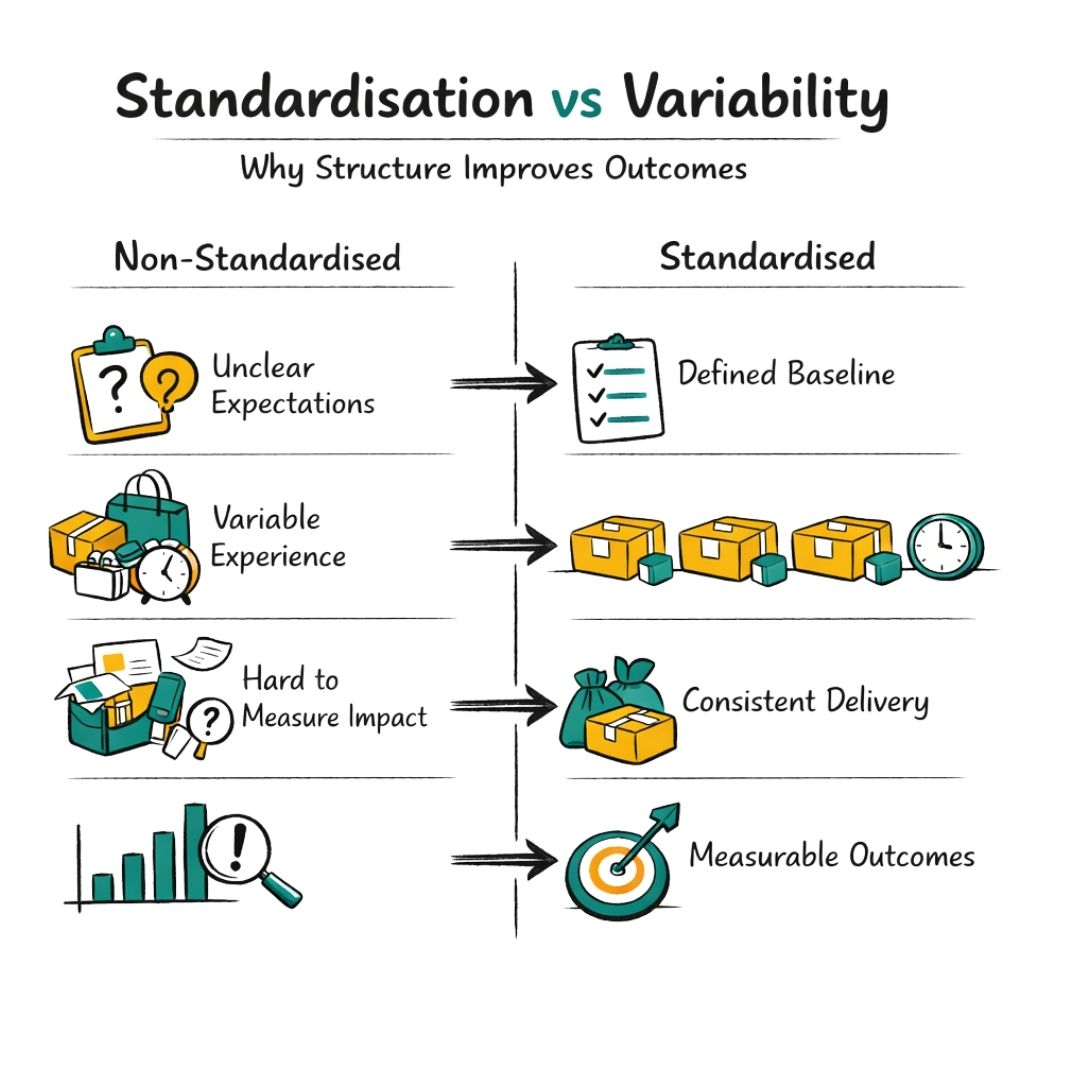
One of the most effective ways to address the gap between support offered and support delivered is through transparency.
This involves clearly communicating what is included in a service, what may vary, and what individuals can expect. It also involves being explicit about limitations.
For example, if a care package may include substitutions based on availability, this should be stated. If delivery times may vary, this should be communicated. If certain services have limited capacity, this should be made clear.
Transparency does not reduce the value of support. It enhances trust. It allows individuals to make informed decisions and reduces the risk of unmet expectations.
It also aligns with a broader principle of respect. Individuals affected by cancer are capable of understanding complexity. Providing clear and accurate information is a form of respect for their experience.
Operational reality is not static. It changes over time as demand, resources, and external conditions evolve.
To manage this effectively, organisations need data. This includes data on what is offered, what is delivered, and how individuals experience the support.
Feedback from recipients is particularly important. It provides insight into whether support is meeting needs and where gaps exist. However, feedback must be systematically collected and analysed. Informal feedback, while valuable, is not sufficient on its own.
Data enables organisations to identify patterns, assess performance, and make evidence-based improvements. It also supports accountability. When organisations can demonstrate what they deliver, they can build credibility with stakeholders, including donors, partners, and the individuals they serve.
The gap between support offered and support delivered is not unique to any single organisation. It is a sector-wide issue.
Addressing it requires a shift in how support is conceptualised and managed. It involves recognising that delivery is as important as intention. It requires investment in operational capacity, not just programme development.
It also requires collaboration. Many organisations operate within overlapping areas. Standardisation at a sector level, where appropriate, can improve consistency and reduce duplication. This does not mean uniformity across all organisations, but it does mean aligning on core principles and practices.
For example, agreed standards for care package contents, delivery timelines, or information accuracy could enhance the overall quality of support across the sector.
Care packages provide a useful case study for understanding the importance of standardisation.
At a surface level, a care package is a collection of items intended to support comfort and wellbeing. However, the impact of a care package depends on several factors.
The relevance of the items included is critical. Items should be selected based on evidence and experience, not assumptions. The consistency of the package is also important. Recipients should have confidence that they will receive a meaningful set of items.
The timing of delivery is another factor. A care package that arrives too late may not meet its intended purpose. The presentation and quality of the items also influence the experience.
Without standardisation, these factors can vary significantly. This can lead to inconsistent experiences and reduced effectiveness.
By contrast, a standardised approach ensures that each package meets a defined standard. It allows for scalability while maintaining quality. It also supports transparency, as recipients can understand what they will receive.
Bridging the gap between support offered and support delivered is not a simple task. It requires attention to operational detail, a commitment to transparency, and a willingness to standardise where appropriate.
However, the benefits are substantial. Consistent and reliable support improves outcomes for individuals. It enhances trust in organisations. It strengthens the overall effectiveness of the support ecosystem.
For organisations, this is not about reducing ambition. It is about aligning ambition with capability. It is about ensuring that what is promised can be delivered, and that what is delivered meets the needs of those it is intended to support.
In the context of cancer, where uncertainty is already high, the value of dependable support cannot be overstated. Standardisation is not a limitation. It is a foundation for delivering support that is not only well-intentioned, but also effective, consistent, and meaningful.
Ultimately, the measure of support is not what is described, but what is experienced. Closing the gap between the two is both an operational challenge and an ethical imperative.
We strongly advise you to talk with a health care professional about specific medical conditions and treatments.
The information on our site is meant to be helpful and educational but is not a substitute for medical advice.
Gain Confidence In Yourself With Meditative Movements. Experience Healing And Empowerment Through The Mind-Body Connection.
Practical, emotional, and informational support during cancer explained. An evidence-based look at what helps, what harms, and what people still need.
Discover Essential Exercise Tips To Stay Active During Cancer Treatment. Learn How To Maintain Strength, Energy, And Well-being With Safe And Effective Activities.