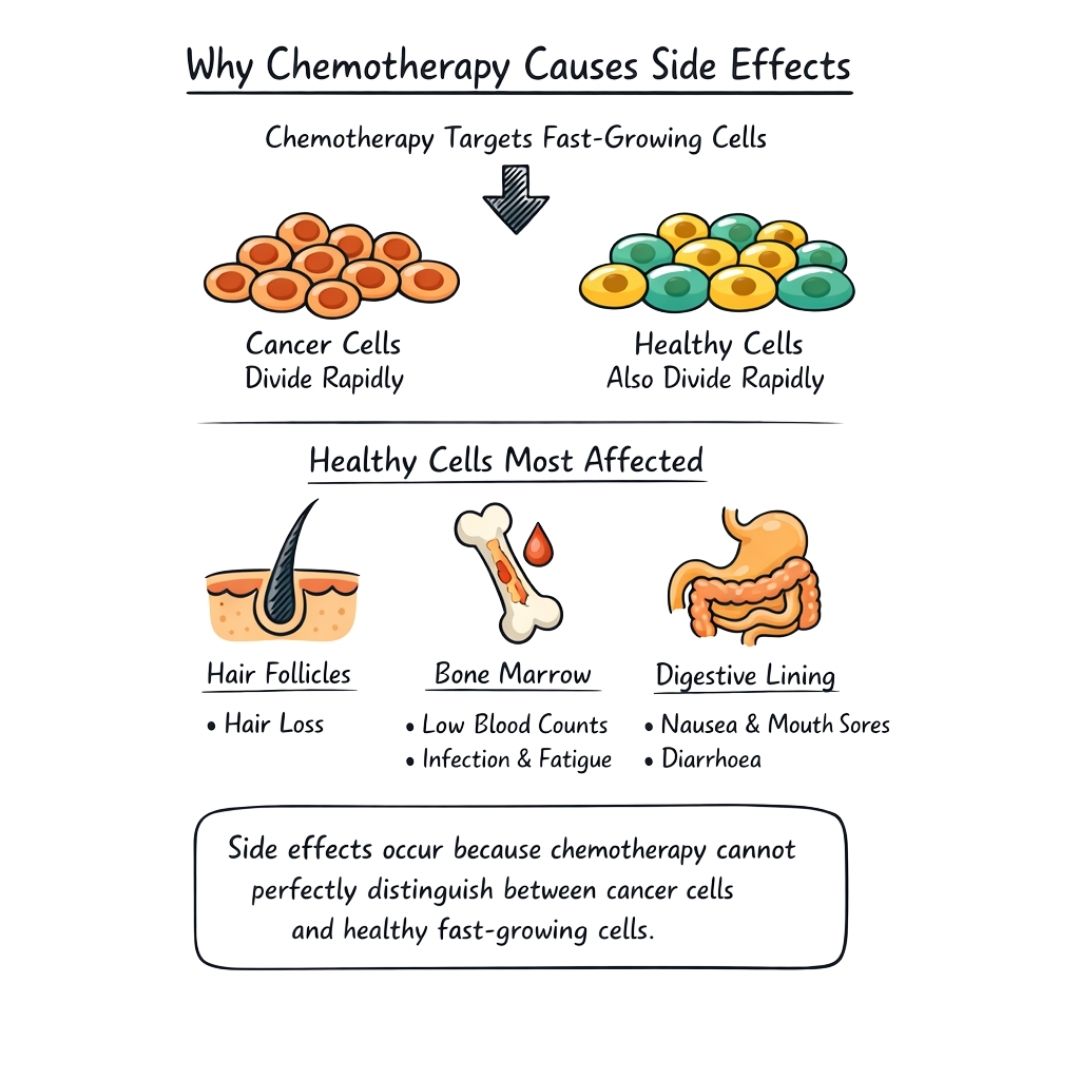
Chemotherapy is a powerful, life-saving treatment, but its strength lies in its ability to attack fast-growing cancer cells. The catch? It can't always tell the difference between those cancer cells and healthy cells that also divide quickly. This collateral damage is what causes the side effects so many people experience.
The reactions can be anything from nagging fatigue to more serious complications, and they really depend on the specific drugs you're given and how your own body responds. Getting your head around why these side effects happen is the first real step towards managing them.
Chemo drugs are designed to hunt down and destroy cells that multiply at a rapid rate—the very definition of how cancer grows. But this powerful targeting system isn't perfectly precise.
Think of it like a diligent gardener trying to clear aggressive weeds from a flowerbed. The main goal is to get rid of the invasive weeds (the cancer cells), but sometimes the process can't help but disturb some of the beautiful, fast-growing flowers planted nearby. These "flowers" are the healthy, normal cells in your body that naturally have a high turnover.
Because chemo can be a bit indiscriminate, certain parts of the body tend to feel the effects more than others. Knowing which areas are vulnerable helps to explain some of the most common side effects.
Realising that these side effects are a sign the treatment is doing its job can be a powerful mental shift. It helps you move from a place of uncertainty to one of active participation in your own care, ready to work with your oncology team to manage whatever comes your way. For a more detailed look at the basics, you can read our guide on what is chemotherapy.
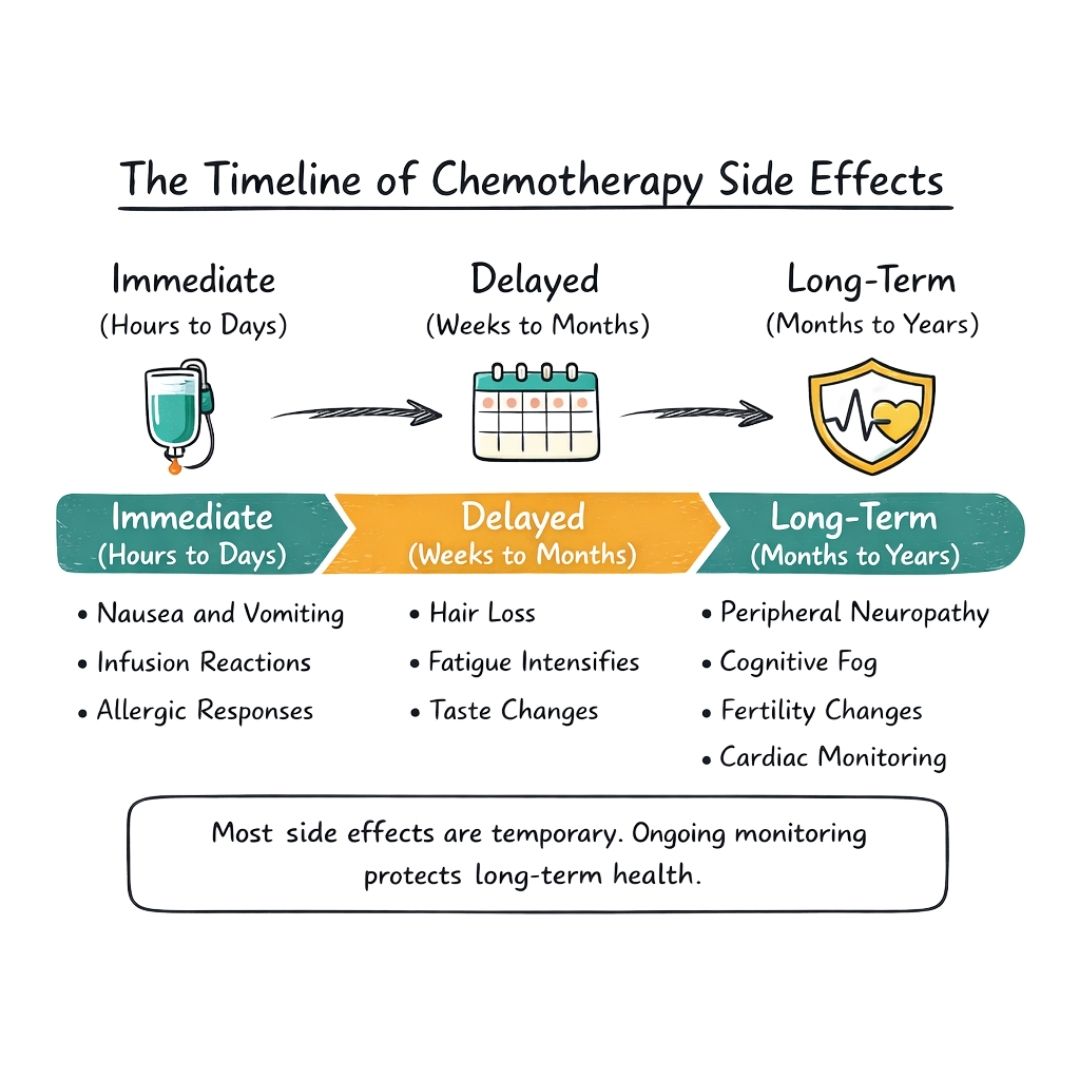
Side effects don’t just show up all at once. They can appear at different stages of your treatment, and knowing what to expect and when can make a huge difference.
We can generally categorise side effects based on when they pop up: immediate (acute), delayed, or long-term. This framework helps you and your medical team anticipate and manage symptoms as they arise, from the day of your first infusion to years down the line.
Understanding this general timeline is key. It sets the stage for the rest of this guide, where we’ll dive deeper into each of these categories and how to navigate them.
Once you begin chemotherapy, your day-to-day focus naturally shifts to handling the challenges that can crop up almost immediately. These short-term side effects are simply your body’s response to the powerful medicines doing their job.
Knowing what to expect, and having a few practical strategies up your sleeve, can make a world of difference to your comfort and well-being during this time. Let’s walk through some of the most common acute effects and some simple, supportive ways you can manage them at home.
Chemo fatigue isn't just about feeling a bit tired; it's a deep, bone-weary exhaustion that sleep doesn't always fix. This happens because your body is working incredibly hard, fighting the cancer while also repairing the healthy cells that get caught in the crossfire. It's easily one of the most widespread side effects of chemotherapy drugs.
In fact, a major clinical study found that a staggering 85% of patients experienced fatigue. What's more, the research showed this fatigue often lingers and can even develop months into treatment, highlighting just how important it is to have coping strategies from the very beginning.
So, what actually helps?
Nausea is another famous side effect, happening because chemotherapy can affect both your digestive tract and the part of your brain that controls sickness. Your oncology team will prescribe anti-sickness medications (called antiemetics), and modern ones are very effective.
Key Insight: The trick with anti-sickness medicine is to stay ahead of the nausea. Taking it on the schedule your doctor gives you—even if you feel fine—is far more effective than waiting for the queasiness to start.
Alongside your medication, small changes to what and how you eat can bring a lot of relief. You might also find your sense of taste and smell goes haywire, making your favourite foods suddenly seem off-putting.
If you’re looking for more detailed advice, our guide on how to manage chemotherapy-induced nausea is a great resource.
The cells lining your mouth divide very quickly, which makes them particularly sensitive to chemotherapy. This can lead to a condition called mucositis, causing a sore, inflamed mouth and sometimes painful ulcers. A gentle but consistent oral care routine is your best line of defence here. It helps prevent infections and can make eating and drinking much more comfortable.
To give you a quick reference, here are some of the most frequent issues and what you can do about them at home.
| Side Effect | What It Feels Like | Practical Management Tip |
|---|---|---|
| Mouth Sores | Painful spots or ulcers on the tongue, gums, or inside the cheeks. | Rinse your mouth several times a day with a simple saltwater solution (1/4 teaspoon of salt in a large glass of warm water). |
| Dry Mouth | A sticky, cotton-like feeling that can make swallowing difficult. | Sip water throughout the day, chew sugar-free gum, or suck on ice chips to help get saliva flowing again. |
| Taste Changes | Foods might taste metallic, bland, or just strange. | Don't be afraid to experiment with herbs and spices. Sometimes, using plastic cutlery instead of metal can help with a metallic taste. |
Many people find that painful canker sores are a big part of this, and learning how to treat canker sores effectively can bring significant relief.
By being proactive with these simple strategies, you can feel more in control and navigate your treatment with greater comfort and confidence.
Once active treatment is over, the journey doesn't just stop. It shifts into a new phase, one focused on recovery and long-term well-being. While many of the immediate side effects begin to fade, it's worth knowing that some health changes can pop up months or even years down the line.
These are often called late effects, and understanding what they are is the first step towards managing your health proactively for the future.
This isn't about creating worry. Far from it. This is about empowerment through knowledge. When you know what to look out for, you can work closely with your medical team to monitor your health and take positive steps to protect it for years to come.
One of the most common, and frankly frustrating, late effects people talk about is ‘chemo brain’. It’s not a formal medical diagnosis, but it’s a very real term people use to describe the thinking and memory problems that can linger after cancer treatment.
You might find yourself grasping for the right word mid-sentence, struggling to juggle tasks you used to handle with ease, or just feeling uncharacteristically forgetful. For many, these changes are subtle but can really knock your confidence. Researchers are still digging into the exact causes, but it’s likely a mix of the chemo drugs themselves, hormonal shifts, and the sheer emotional stress of a cancer diagnosis.
Another significant long-term issue that can arise is peripheral neuropathy. In simple terms, this is damage to the nerves furthest from your brain and spinal cord—which is why it usually affects the hands and feet. Certain types of chemotherapy drugs are known to be toxic to these delicate nerve cells.
The symptoms can be quite varied, but most people report things like:
For some, these symptoms slowly get better after treatment finishes, but for others, they can become a long-term challenge. It's really important to talk to your care team if you notice any of these sensations. We also have a dedicated article with more detail on peripheral neuropathy from chemo.
The whole point of survivorship care is to help you move forward with confidence. A personalised survivorship care plan is a brilliant tool for this. It outlines your treatment history and sets out a schedule for follow-up appointments, making sure both you and your primary care doctor know exactly which potential late effects to keep an eye on.
Beyond the more common issues like chemo brain and neuropathy, some chemotherapy drugs can have lasting effects on other parts of the body. The good news is that medical advancements have dramatically reduced many of these risks over the years.
For example, certain classes of drugs can affect heart function, while others might impact fertility for both men and women. These are serious considerations, and your oncology team will have discussed them with you before treatment ever began, carefully weighing the life-saving benefits against any potential long-term risks. That’s why regular check-ups are so important for monitoring things like heart health, and why discussions around fertility preservation are now a standard part of care for younger patients.
The landscape of long-term care has changed so much for the better. Research from The Christie highlights that cancer survivors who had treatment decades ago could face up to a 40% chance of serious late effects like secondary cancers or heart disease, depending on the drugs used. However, huge improvements in chemotherapy protocols over the last couple of decades have slashed these risks. More people than ever are living long, full lives after cancer. You can read more about the research into minimising these long-term effects.
This forward-looking perspective is key. Today, the focus is squarely on proactive monitoring and management, making a full and healthy life after cancer not just a hope, but an achievable reality for most.
While you'll learn to manage many chemotherapy side effects at home, some are genuine red flags. These are the symptoms that signal something more serious is going on, and they need urgent medical attention. Learning to tell the difference is one of the most important skills you can develop to keep yourself safe during treatment.
Your oncology team is your lifeline, and they absolutely want you to call if something feels wrong. Think of this section as your safety guide, designed to help you and your caregivers spot the signs that mean it's time to pick up the phone.
Some reactions are simply not up for debate—they require an immediate phone call to your cancer care team or a trip straight to the hospital. These aren't "wait and see" symptoms; they can point to potentially life-threatening complications that need to be dealt with quickly.
It's always better to call and be told everything is fine than to wait at home and risk a serious problem getting worse. Your medical team would much rather you contact them with any concerns, no matter how small they might seem.
Here are some of the critical alerts to watch out for. They are your body’s way of saying it needs professional help, right now.
When these symptoms appear, it’s time to act. Don't hesitate.
When you're feeling really unwell, it can be tough to think clearly. This checklist is designed to help you and your family quickly recognise the symptoms that mean you need to contact your medical team without any delay.
| Symptom | Why It's a Concern | What to Do Immediately |
|---|---|---|
| High Fever | A temperature of 38°C (100.4°F) or higher can signal a serious infection. When your immune system is weak, this can be life-threatening. | Call your 24-hour oncology helpline or go to the nearest emergency department immediately. Do not wait. |
| Sudden Confusion or Dizziness | This could be a sign of infection, dehydration, or other serious metabolic imbalances caused by the treatment. | Contact your medical team right away. Do not drive yourself to the hospital. |
| Persistent Sickness or Diarrhoea | If you can’t keep any fluids down for more than 24 hours, you’re at high risk of severe dehydration, which can become dangerous very quickly. | Phone your care team for advice. They may need to arrange for you to receive intravenous fluids to rehydrate you. |
Remember, staying hydrated is always a priority, as dehydration can spiral, making other side effects much worse and leading to new complications. For more tips, check out our guide on chemotherapy and dehydration. This checklist is a guide, not a substitute for medical advice, so always follow the specific instructions given by your own oncology team.
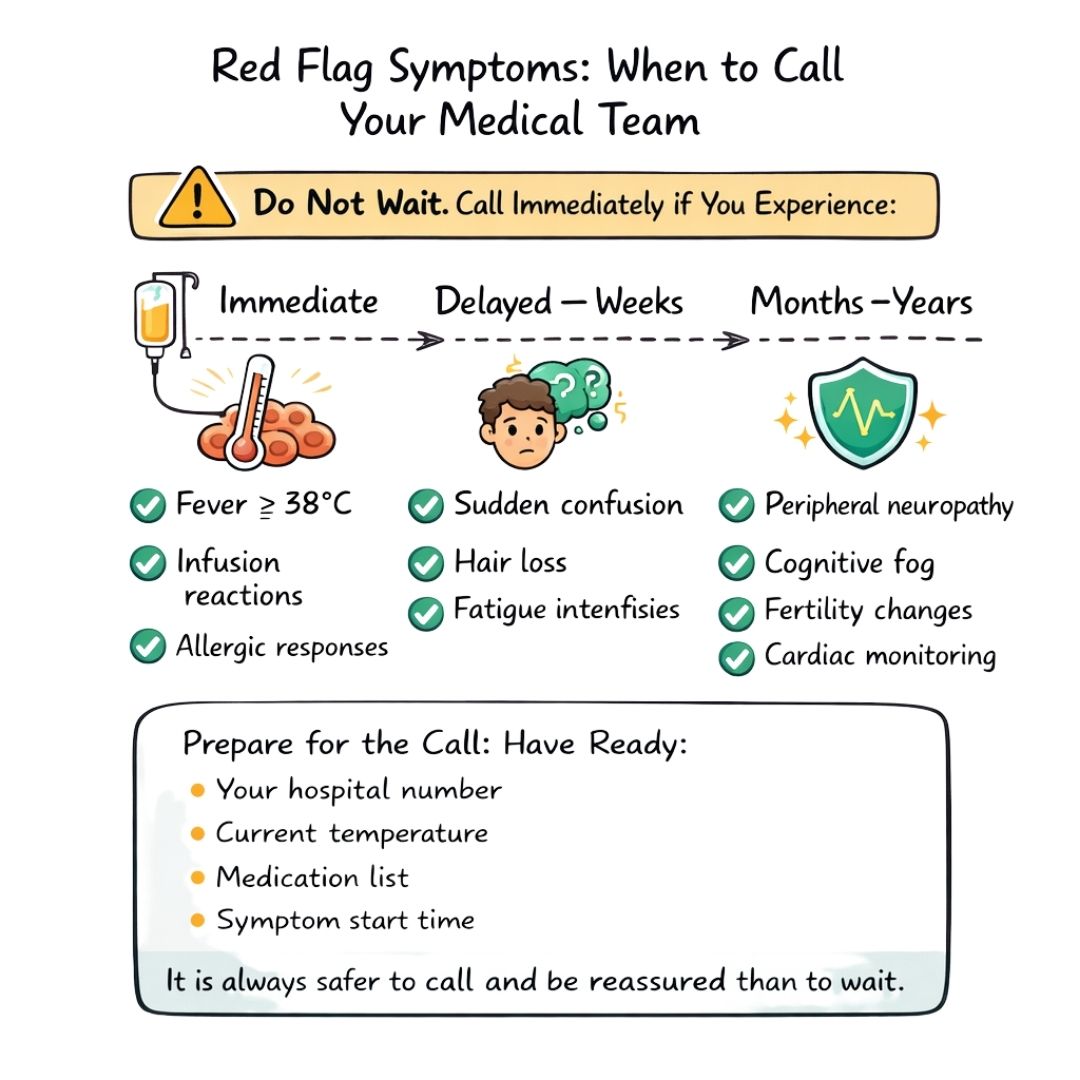
When you do need to ring for help, being prepared makes the whole process smoother and helps your team give you the right advice much faster.
Before you dial, try to have this information handy:
Keeping a small notebook with all this information written down can be a game-changer. It means that even if you're feeling stressed or exhausted, you or a caregiver can give the medical team all the essential details they need to help you.
The ripple effects of chemotherapy travel far beyond the physical. A cancer diagnosis and its treatment often trigger a whole spectrum of emotions, from deep-seated anxiety and fear to frustration and profound sadness. This emotional journey is a completely normal, valid part of the experience, both for the person in treatment and for those who love and support them.
Facing these mental health challenges head-on is the first step toward building resilience. It’s not about pretending difficult feelings don't exist, but about learning how to navigate them. Developing practical coping strategies can help manage the strain, making it possible to find moments of calm and strength even when things feel uncertain.
The mental weight of chemotherapy can feel immense. You might be wrestling with changes to your body and sense of self, anxiety about the future, or just the sheer exhaustion of it all. It is so important to give yourself permission to feel whatever comes up, without judgement.
Small, proactive steps can become an anchor in these turbulent times. These strategies are all about reclaiming a little bit of control and looking after your mental wellbeing when you need it most.
The goal isn't to erase negative feelings. It’s about building a personal toolkit of strategies that help you process them, validating your experience while fostering a sense of inner strength.
For a deeper dive, you might find our article on mental health support strategies helpful, as it offers more ideas you can adapt to your own journey.
Watching someone you care about go through chemotherapy is incredibly tough. As a caregiver, you often become their main pillar of support, juggling appointments, offering comfort, and trying to keep spirits up. It's a vital role, but one that carries its own heavy emotional load.
To give meaningful support, you have to look after yourself, too. Burnout is a very real risk for caregivers, and preventing it is essential for your own health and your ability to keep being there for your loved one.
No one should have to face cancer alone. Assembling a strong support network is one of the most powerful things you can do. And this network can be much wider than just your immediate family.
Consider reaching out to professional counsellors or therapists who specialise in oncology. They have the expertise to provide tailored tools for managing cancer-related distress. At the same time, patient support groups, whether online or in your community, offer a unique connection with others who truly get it. Sharing experiences with people on a similar path can dissolve feelings of isolation and provide invaluable practical advice and emotional solidarity.
Going through chemotherapy brings up a lot of questions. It's completely normal to have them. Here, we'll tackle some of the most common ones with straightforward answers, drawing on everything we've covered so far to help you feel more prepared.
Think of this as a final conversation to clear up any lingering uncertainties you might have.
This is probably one of the most common myths we hear, but the simple answer is no. There is no direct link between how rough you feel and how well the treatment is working against the cancer.
Every person's body reacts differently. Imagine two people getting the exact same drug; one might feel awful, while the other sails through with few issues. This comes down to a whole host of factors:
Someone with very mild side effects could be having a fantastic response to the chemo. On the flip side, a person who is incredibly sick might not be getting the best results. The real proof is in your scans and tests, not in the intensity of your side effects.
It’s tempting to want to boost your system with supplements, but you have to be incredibly careful here. The golden rule is to run every single thing by your oncology team before you take it, that includes vitamins, herbal remedies, and any other supplements.
The biggest worry is interference. Some seemingly harmless supplements, like high-dose Vitamin C or St. John's Wort, can actually get in the way of your chemotherapy. They might make the treatment less effective or, worse, ramp up the toxicity and make your side effects more severe.
If you have a genuine deficiency, like low iron or Vitamin D, your team will spot it in your blood tests and prescribe something safe for you to take. Don't self-prescribe.
Trying to balance a job with chemo is tough, there’s no doubt about it. But with some good planning and open communication, many people make it work.
A good first step is often to have a chat with your manager or HR department. You don't have to share every detail, but letting them know what's going on can open the door to helpful adjustments. You might be able to arrange things like:
It also pays to be clever about scheduling. If you can, having your infusion on a Friday gives you the weekend to rest and recover before the new work week begins. Most importantly, listen to your body. Pushing through when you're exhausted rarely works out well; sometimes, the most productive thing you can do is rest.
Thankfully, the vast majority of chemo side effects are temporary. Things like hair loss, nausea, and low blood counts will gradually disappear once your treatment is over. Your hair will start to grow back, your appetite will return, and your energy levels will slowly climb.
That said, a small number of side effects can be long-term or even permanent. We call these late effects, and they aren’t nearly as common. They can include issues such as:
Your oncology team is always weighing the benefits of treatment against these potential risks. They will have chosen your specific drugs very carefully and will talk you through any particular long-term risks before you begin. This is also why follow-up care after treatment is so crucial—it’s all about monitoring for and managing any late effects that might pop up down the line.
We strongly advise you to talk with a health care professional about specific medical conditions and treatments.
The information on our site is meant to be helpful and educational but is not a substitute for medical advice.
Help a cancer patient feel like themselves again. Learn how to donate hair: length rules, preparation steps, what happens next, and alternatives if you can't donate.
Discover How A Breakthrough Genetic Tool Is Transforming Chemotherapy By Predicting Drug Reactions Before Treatment Begins, Offering Safer, More Personalised Cancer Care.
Discover expert strategies for recovery from chemotherapy. Understand side effects nutrition emotional support and practical steps for a healthier future