As a medical professional, I have encountered countless cases that have tested not only our clinical knowledge but also our emotional resilience. Medicine, I have come to learn, is not only a science governed by protocols and evidence but also an art shaped by empathy, intuition, and the invisible yet powerful force of human emotional connections. Some stories remain pencilled in our memories forever, ones that remind us that in the path of healing, the human spirit often plays a role as basic as any medication or machine.
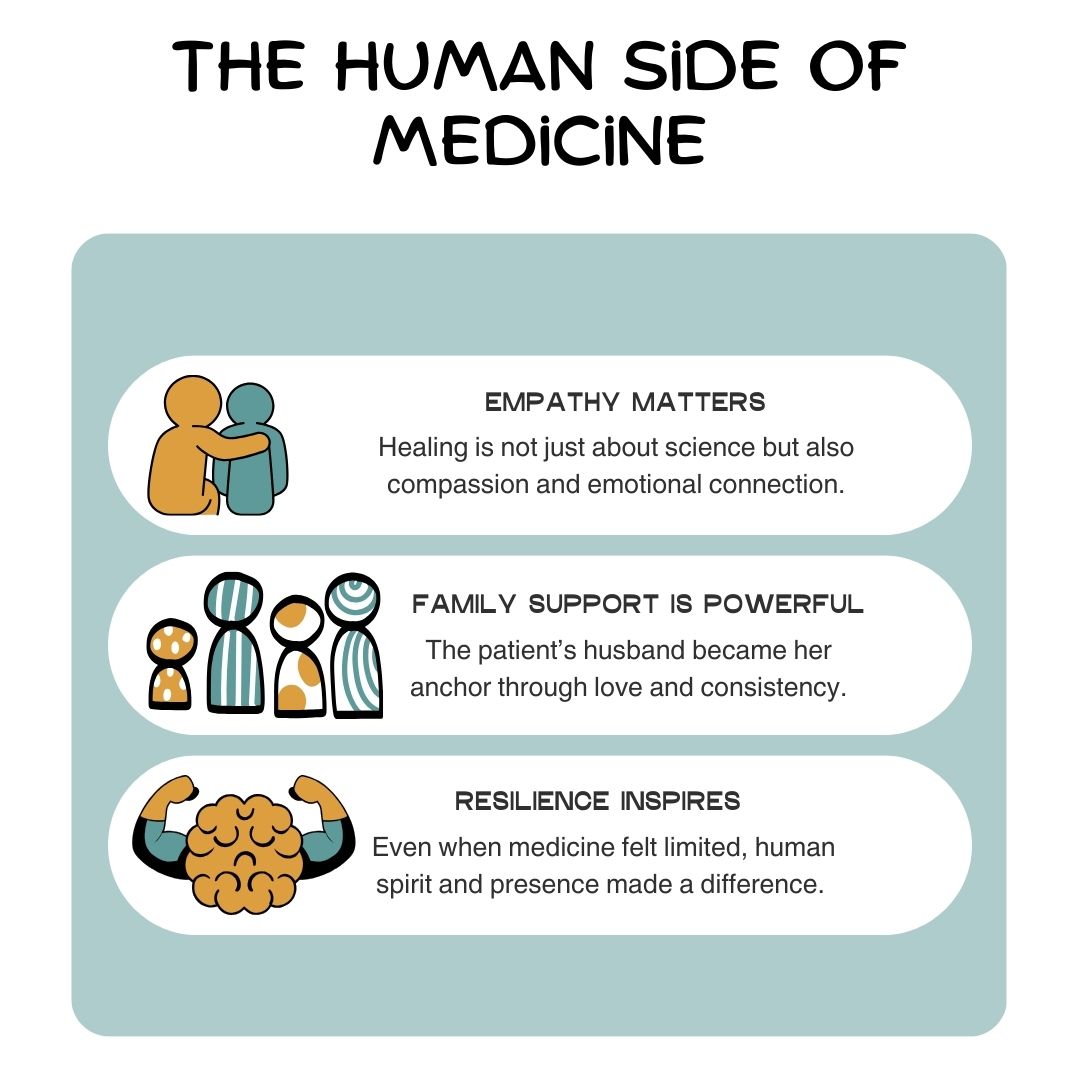
On the morning of the surgery, I remember seeing her sitting beside her husband, who was gently holding her hand. His eyes filled with emotion, grief, worry, love, and a desperate need to stay strong. He comforted her with quiet, reassuring words, trying to mask his tears and fear. He helped her believe that everything would be okay, even though the weight of uncertainty hung heavily in the air around them. That moment, their shared silence, the way he brushed her hair back, the way he whispered hope into her ears, remains one of the most human moments I have witnessed in medicine. In the absence of her parents, her husband was her whole world, her only anchor in a terrifying storm that she had to face.
The surgery began, and as the anaesthesiology team, we remained vigilant and prepared. But soon, the situation became dire. Intraoperatively, she suffered a massive haemorrhage, losing approximately 5 to 6 litres of blood. We worked relentlessly to control the bleeding, replacing blood loss with transfusions and using every resource available. The surgery was technically completed, but her body had been pushed to its limits. She did not regain consciousness after the operation and was transferred directly to the Intensive Care Unit (ICU), placed on mechanical ventilation.
Her condition in the ICU was critical from the very beginning. Her heart rate was dangerously high, persistently above 140 beats per minute. In medical terminology, she was experiencing atrial fibrillation with a rapid heart rate response, a serious and unstable heart rhythm that, if not controlled, can lead to further complications or even cardiac arrest. Despite our immediate efforts with medications and supportive therapies, her heart showed little improvement.
Each day, I visited her, carefully monitored her vitals, adjusted medications, and hoped for signs of progress. She remained unresponsive. Her blood pressure was fragile. Her oxygen saturation was maintained only with ventilatory support. Despite all we were doing, there was little to suggest that recovery was near.
In the midst of this storm, one thing remained constant: her husband. He came every single day. He would sit beside her, gently brushing her hair, massaging her arms and legs to maintain circulation and prevent muscle atrophy as advised by the physiotherapist. He talked to her, read her favourite stories aloud, and held her hand for hours. Watching him, I was moved by the sheer depth of love and devotion he displayed. It was a kind of faith I rarely saw in the clinical setting, a belief not just in her survival, but in her full recovery. Even when we, the medical team, began to feel helpless, he remained steady, a quiet pillar of hope.
By the twelfth day, her prognosis seemed increasingly grim. Her cardiac rhythm had not stabilised, and her organ function was beginning to show signs of failure. Some among us quietly began to prepare for the worst. I remember reviewing her chart that evening, overwhelmed by the reality that despite every protocol followed and every drug administered, we were losing her. I was feeling really low that day, thinking of her kids' future. That feeling of hopelessness within myself is yet hard to describe.
But sometimes, medicine requires not only knowledge and precision, it demands boldness, intuition, and yes, a little faith.
After an extensive discussion, my senior consultant and I decided to try something unconventional. We administered defibrillation, a procedure usually reserved for certain arrhythmias, but in this case, it was a final attempt, a spark of hope in a darkening situation.
What happened next felt almost surreal.
Her heart rhythm returned to normal. We watched, almost disbelieving, as her vital signs began to stabilise. Over the next several days, her lab values improved steadily. Her oxygen requirements had reduced. She began to move her fingers, then opened her eyes.
On the fifteenth day, she was successfully weaned off the ventilator. Her lungs were working on their own. Her heart, once erratic and unstable, was now beating at a regular rhythm. Her body, which had come so close to shutting down, had started to recover.
And then, on the twenty-first day, the miracle truly unfolded. I was walking past the ICU when I saw her, out of bed, hand-in-hand with her husband, slowly walking down the corridor. She was smiling. Her children were by her side, hugging her tightly. The same woman who had once lain motionless, surrounded by machines and doubt, was now alive, alert, and radiant with life.
In that moment, I realised something profound and unbelievable: Medicine may be the science of healing, but recovery often transcends science. Her survival was not just a result of medications or interventions; it was a tapestry woven from love, resilience, and a refusal to give up.
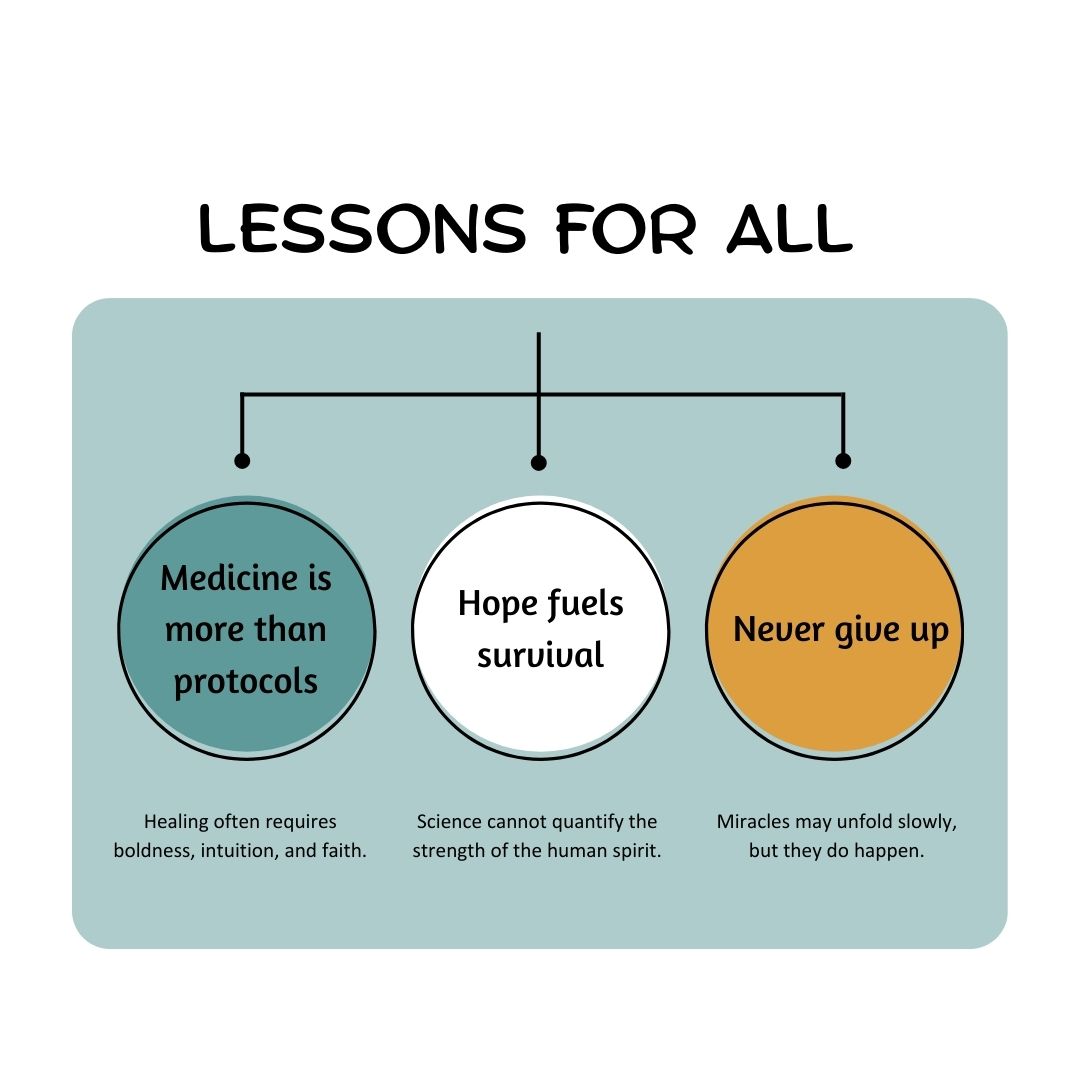
That experience changed me. It reaffirmed my belief that we are not just treating conditions, we are treating people, families, relationships, and hope. The most powerful forces in recovery are sometimes invisible: the unwavering presence of a loved one, the gentle touch of reassurance, the belief that miracles do happen.
To those who may be going through difficult times, whether as patients or as loved ones: never lose hope. Science can predict outcomes, but it cannot measure the strength of the human spirit. It cannot quantify the power of belief or the effect of unwavering love and hope that can bring back a human life.
Miracles may not always look like they do in movies. Sometimes, they unfold slowly, day by day, in sterile hospital rooms, among machines and beeping monitors, witnessed only by those who choose to believe even when logic says otherwise.
This story stays with me, not because of the clinical details, but because of what it taught me about the essence of healing. It reminded me that in the darkest of times, hope can be the brightest light, and it will stay with me forever.
Edited by: Katheeja Imani
We strongly advise you to talk with a health care professional about specific medical conditions and treatments.
The information on our site is meant to be helpful and educational but is not a substitute for medical advice.
Maintaining A Positive Attitude And Having Strong Faith Made A Significant Impact On My Ability To Overcome Adversity.
When People Are Diagnosed With Cancer, It Is Very Easy To Overlook The Toll The Disease Also Takes On The Cancer Caregivers.
Help a cancer patient feel like themselves again. Learn how to donate hair: length rules, preparation steps, what happens next, and alternatives if you can't donate.